Polio Disease in the United States 2026
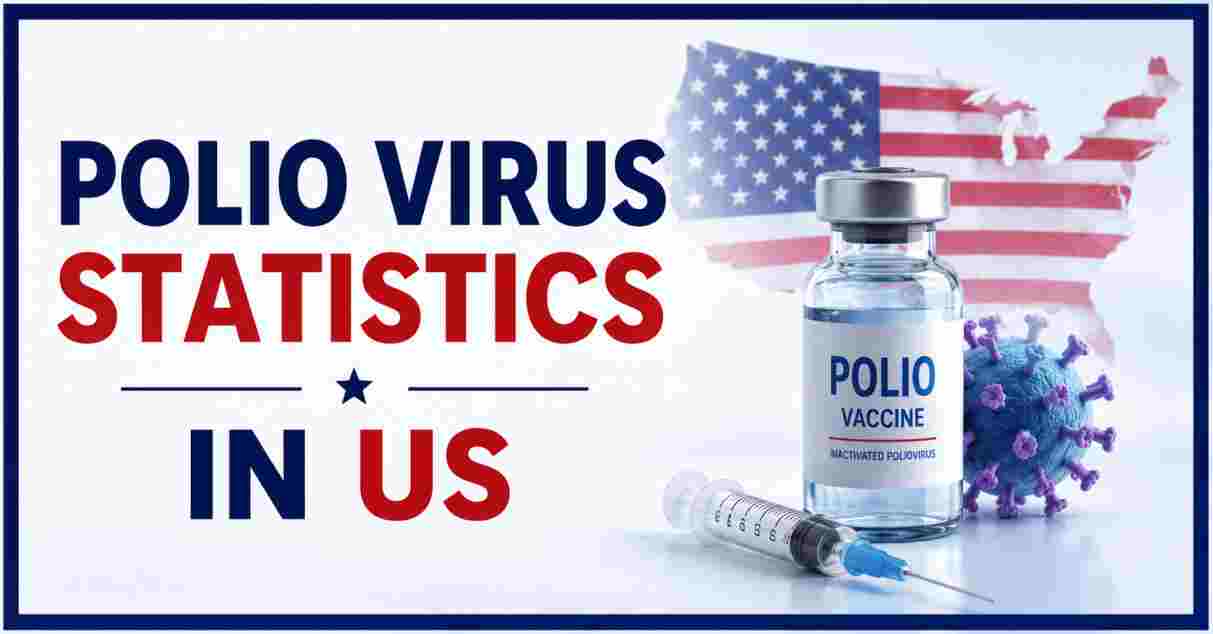
Wild poliovirus has not caused a case of polio acquired inside the United States since 1979. That eradication holds today, but the virus itself has not disappeared from the world, and a 2022 case in New York proved the US remains vulnerable to imported poliovirus wherever local vaccination coverage drops too low. Polio vaccination coverage among US kindergartners fell to 92.5% for the 2024-25 school year, below the 95% level needed for reliable community protection.
This report covers the full current picture of polio disease in the United States for 2026: the country’s eradication history, the 2022 Rockland County case and wastewater surveillance findings that followed it, current childhood vaccination coverage and exemption rates by state, the polio vaccine schedule used today, and the global picture that keeps US health officials monitoring for reintroduction. All figures come from the CDC, state health departments, and peer-reviewed CDC surveillance reports.
Key Polio Disease Facts for the US in 2026
| Statistic | Figure |
|---|---|
| Last wild poliovirus case acquired in the US | 1979 |
| Peak US paralytic polio cases (1952, pre-vaccine) | Over 21,000 |
| Global polio case decline since 1988 (GPEI launch) | More than 99% |
| Paralysis cases prevented worldwide since 1988 | ~20 million |
| Countries where wild poliovirus remains endemic | 2 — Afghanistan and Pakistan |
| Confirmed wild poliovirus cases worldwide, 2024 | 12 |
| US kindergarten polio vaccine coverage, 2024-25 school year | 92.5% |
| US kindergarten polio vaccine coverage, 2019-20 (pre-pandemic) | 95% |
| Kindergartners with a vaccine exemption, 2024-25 (record high) | 3.6% (~138,000 children) |
| Paralysis rate among unvaccinated infected persons | 1 in 190 to 1 in 1,900 |
| Countries under CDC Level 2 polio travel notices, early 2026 | 32 |
Source: CDC Pink Book; CDC SchoolVaxView; CDC Global Polio Vaccination program; New York State and New Jersey Department of Health polio surveillance data, 2022-2026.
The core fact driving every polio statistic in this article: the disease has not been eliminated worldwide, only reduced by more than 99%. As long as Afghanistan and Pakistan report wild poliovirus transmission, and as long as under-vaccinated communities exist anywhere with international travel connections, the US remains at risk of imported cases exactly like the one confirmed in New York in 2022. The gap between 95% kindergarten coverage in 2019-20 and 92.5% in 2024-25 is not a large number on paper, but it represents roughly 286,000 additional unprotected children entering school each year, concentrated disproportionately in specific states and counties rather than spread evenly nationwide.
The 2022 New York case remains the clearest illustration of how this risk plays out in practice. A single unvaccinated adult in Rockland County developed paralytic polio from a vaccine-derived poliovirus strain, and subsequent wastewater testing found the same virus circulating in surrounding counties for months — meaning the outbreak was larger than the one paralytic case suggested, with additional undetected infections almost certainly occurring in the surrounding under-vaccinated community. That single case triggered a coordinated, multi-state wastewater surveillance response that continues today, with the CDC and state health departments still monitoring for any recurrence as of 2026.
US Polio Disease History and Eradication Statistics 2026
| Milestone | Year |
|---|---|
| Peak epidemic year (21,000+ paralytic cases) | 1952 |
| First polio vaccine (Salk, inactivated/IPV) introduced | 1955 |
| Oral polio vaccine (Sabin, OPV) introduced | 1961 |
| Western Hemisphere certified free of wild poliovirus | 1994 |
| US switches exclusively to IPV, discontinues OPV | 2000 |
| Last wild poliovirus case acquired in the US | 1979 |
| First US paralytic polio case since 2013 | 2022 (Rockland County, NY) |
Source: CDC Pink Book, Chapter 18: Poliomyelitis.
Before vaccination, polio was one of the most feared diseases in America, paralyzing over 21,000 people in the single worst year, 1952. The Salk inactivated vaccine arrived in 1955 and the Sabin oral vaccine followed in 1961, together driving wild poliovirus transmission out of the country by 1979 — the last year a case was acquired on US soil rather than imported. The Western Hemisphere was formally certified free of wild poliovirus in 1994, and the US moved entirely to the inactivated (IPV) vaccine in 2000, ending domestic use of the oral vaccine because OPV’s live, weakened virus can, in rare cases and in under-vaccinated communities, mutate back into a form capable of causing paralysis.
That mutation pathway is precisely what caused the 2022 New York case. The vaccine-derived poliovirus type 2 strain that paralyzed the unvaccinated Rockland County adult did not originate from a vaccine given in the US — the US hasn’t used OPV since 2000 — but from a chain of transmission originating in a country that still uses oral vaccine, most likely spreading silently through under-vaccinated communities before reaching New York. It was both the first paralytic polio case in the US since 2013 and the first confirmed instance of community transmission since 2005.
The 2022 New York Case and Wastewater Surveillance 2026
| Detail | Figure |
|---|---|
| Location | Rockland County, New York |
| Patient | Unvaccinated adult |
| Virus strain | Vaccine-derived poliovirus type 2 (VDPV2) |
| US jurisdictions that tested wastewater, 2022-2023 | 7 (5 states, 2 cities) |
| Separate importation events detected in NY wastewater | 2 |
| Jurisdictions with confirmed poliovirus in wastewater | New York State and New York City only |
| Jurisdictions tested with no poliovirus detected | Connecticut, New Jersey, Michigan, Illinois/Chicago |
| New Jersey poliovirus status, confirmed June 2026 | No poliovirus detected |
Source: CDC Emerging Infectious Diseases journal, “Wastewater Surveillance for Poliovirus in Selected Jurisdictions, United States, 2022-2023”; New Jersey Department of Health, Communicable Disease Service.
Following the Rockland County case, health departments in seven US jurisdictions tested wastewater for poliovirus between 2022 and 2023. The testing confirmed two genetically distinct VDPV2 importation events in New York state and New York City — separate introductions of the virus into the community, not a single spreading chain. One of those two importations led to sustained community transmission across multiple New York counties and the one confirmed paralytic case. The other four jurisdictions tested — Connecticut, New Jersey, Michigan, and Illinois/Chicago — found no poliovirus in their wastewater during that surveillance window, and New Jersey’s health department confirms that status has held through June 2026.
Wastewater testing matters because poliovirus rarely causes visible symptoms. Among people who become infected, 70% to 95% develop no symptoms or only a mild, flu-like illness, and paralysis occurs in as few as 1 in 1,900 infections depending on the viral serotype. That means a community can have active, silent poliovirus transmission for weeks or months without a single visible case — wastewater surveillance is the only reliable way to detect that circulation before it produces the kind of paralytic case seen in Rockland County.
Polio Vaccine Schedule and How It Works 2026
| Detail | Figure |
|---|---|
| Vaccine used in the US since 2000 | Inactivated polio vaccine (IPV) only |
| Total doses in the standard childhood schedule | 4 |
| Dose 1 | 2 months |
| Dose 2 | 4 months |
| Dose 3 | 6-18 months |
| Dose 4 (booster) | 4-6 years |
| IPV prevents paralytic disease | Yes, highly effectively |
| IPV prevents gastrointestinal infection/transmission | No — does not fully block silent spread |
Source: CDC Pink Book; CDC Emerging Infectious Diseases journal, 2024.
The US childhood polio vaccination schedule requires four doses of inactivated polio vaccine, given at 2 months, 4 months, 6-18 months, and a booster between 4 and 6 years old. IPV is highly effective at preventing the paralytic disease itself, but it has one specific limitation worth understanding: it does not fully prevent gastrointestinal infection or silent transmission of the virus between people. This is why a fully IPV-vaccinated population can still harbor undetected poliovirus circulation in wastewater even when no one develops symptoms — the vaccine protects individuals from paralysis, but community-wide elimination of viral circulation still depends on maintaining high enough coverage that the virus cannot find enough susceptible hosts to keep spreading.
Polio remained a universally recommended vaccine in the CDC’s revised January 2026 childhood immunization schedule, even as that overhaul reduced the number of vaccines recommended for all children from 18 diseases to 11. That decision reflects the consistent view across US and global health authorities that polio’s near-eradication is fragile enough, and its consequences severe enough, to keep it among the small set of non-negotiable childhood vaccines.
State-by-State Vaccination Coverage and Exemption Disparities 2026
| Metric | Figure |
|---|---|
| National kindergarten polio coverage, 2024-25 | 92.5% |
| US states with polio coverage below 90% among kindergartners | 3 |
| States where MMR/DTaP/polio coverage declined vs. prior year | More than half |
| Lowest state-level MMR coverage (Idaho) | 78.5% |
| Highest state-level MMR coverage (Connecticut) | 98.2% |
| Kindergartners nationally exempt from 1+ vaccine | 3.6% (record high) |
| States with exemption rates above 5% | 17 |
| Idaho’s non-medical exemption rate | 15.4% |
Source: CDC SchoolVaxView, 2024-25 school year data; KFF analysis of CDC kindergarten vaccination data.
National averages mask sharp state-level differences. Three US states now report kindergarten polio vaccination coverage below 90%, well under the level needed to prevent sustained local transmission if the virus were reintroduced. Idaho illustrates the extreme end of this range, with MMR coverage at just 78.5% and a non-medical exemption rate of 15.4% — meaning roughly one in seven kindergartners in the state has an exemption from at least one required vaccine. Connecticut sits at the opposite end, with 98.2% MMR coverage and one of the lowest exemption rates in the country.
Seventeen states now report vaccine exemption rates above 5% among kindergartners, a threshold at which even full vaccination of every non-exempt child would still leave the state unable to reach the 95% coverage level needed for reliable community protection. Exemption rates increased in 36 states and Washington DC in the most recent school year alone, and the national exemption rate has now risen for four consecutive years, driven almost entirely by non-medical exemptions rather than medical ones, which have remained flat around 0.2%. For a fuller picture of how these declines are affecting other vaccine-preventable diseases beyond polio, see our measles statistics in the US coverage, where falling MMR coverage has already produced the largest US measles outbreak in over two decades.
Global Polio Eradication Progress and Remaining Risk 2026
| Metric | Figure |
|---|---|
| Countries with endemic wild poliovirus | 2 — Afghanistan and Pakistan |
| Global wild poliovirus cases, 2024 | 12 confirmed |
| cVDPV outbreaks detected, January 2023-June 2024 | 74 outbreaks in 39 countries |
| Share of cVDPV outbreaks that were newly detected | 64% |
| Region with most cVDPV outbreaks | Africa |
| GPEI target to stop all cVDPV transmission | End of 2026 |
| Only human disease ever fully eradicated | Smallpox |
Source: CDC MMWR, “Update on Vaccine-Derived Poliovirus Outbreaks”; CDC Global Polio Vaccination program, January 2026.
Wild poliovirus transmission is now confined to just two countries worldwide: Afghanistan and Pakistan. Global case counts have fallen more than 99% since the Global Polio Eradication Initiative (GPEI) launched in 1988, and the initiative has prevented an estimated 20 million cases of paralysis. But eradication is not yet complete, and vaccine-derived poliovirus outbreaks — caused by the live, weakened virus in oral vaccine reverting to a dangerous form in under-vaccinated communities — have become a persistent complication. Between January 2023 and June 2024, 74 separate cVDPV outbreaks were confirmed across 39 countries, the large majority in Africa, and 64% of those outbreaks were entirely new, not continuations of prior ones.
The Global Polio Eradication Initiative has set a target of stopping all circulating vaccine-derived poliovirus transmission by the end of 2026, but the initiative’s own reporting acknowledges that surveillance gaps in security-compromised and hard-to-reach areas continue to delay outbreak detection and response. Only one human disease, smallpox, has ever been fully eradicated, and polio’s persistence more than three decades after the 99% milestone illustrates just how difficult the final stretch of disease eradication becomes. For broader context on how the US immunization system as a whole is tracking against these international benchmarks, see our immunization statistics in the US coverage.
International Travel and Imported Polio Risk 2026
| Metric | Figure |
|---|---|
| Countries under active CDC Level 2 polio travel notice, early 2026 | 32 |
| Notable countries under notice | United Kingdom, Germany, Israel |
| UK wastewater cVDPV2 detection | Environmental sample, January 28, 2026 — no paralysis cases |
| Germany wastewater WPV1 detection | Hamburg, late 2025 — genetically linked to an Afghanistan cluster |
| CDC guidance for international travelers | Confirm polio vaccination status before departure |
Source: Vax-Before-Travel, CDC Level 2 Travel Health Notice tracking, February 2026; CDC polio travel guidance.
Thirty-two countries currently carry a CDC Level 2 Travel Health Notice due to ongoing poliovirus circulation, a list that in early 2026 includes not just historically affected regions but also developed nations like the United Kingdom, Germany, and Israel, all of which recorded wastewater detections without any associated paralytic cases. The UK Health Security Agency found circulating vaccine-derived poliovirus type 2 in a routine environmental sample collected in late January 2026, and German health authorities have maintained heightened surveillance since finding wild poliovirus type 1 in Hamburg wastewater in late 2025, a strain genetically linked to an ongoing cluster in Afghanistan.
These detections in wealthy, high-vaccination-rate countries underscore a point US health officials have repeated since the 2022 New York case: polio remains, as one CDC-cited health expert put it, just a plane ride away. Anyone planning international travel should confirm their polio vaccination status before departure, and adults who are unsure of their own vaccination history should review medical records or speak with a healthcare provider rather than assume childhood vaccination alone guarantees lifelong protection in every circumstance. For readers weighing how this travel-related exposure risk fits into the country’s overall immunization picture, our broader vaccination statistics in the US coverage tracks coverage trends across the full childhood and adult vaccine schedule, not polio alone.
Reporting and Clinical Response Statistics 2026
| Detail | Figure |
|---|---|
| CDC guidance on suspected polio cases | Contact CDC Emergency Operations Center within 4 hours |
| CDC Emergency Operations Center phone line | 770-488-7100 |
| Seroconversion rate among household contacts of an infected person | Over 90% |
| Poliovirus classification | Enterovirus subtype C, family Picornaviridae |
| Species that can be infected | Humans and some great apes only |
Source: NIH/NCBI StatPearls, “Poliomyelitis” clinical reference, 2026.
Because polio is so rare in the US today, clinicians are specifically instructed to treat any suspected case as a public health emergency requiring immediate reporting. CDC guidance directs healthcare providers to contact the agency’s Emergency Operations Center within four hours of a suspected diagnosis to trigger diagnostic testing, surveillance, and public health follow-up. That urgency reflects how contagious poliovirus is among unvaccinated people — more than 90% of household contacts of an infected person will become infected themselves, even though most of those secondary infections will never produce visible symptoms. Poliovirus is an enterovirus that infects only humans and a small number of great ape species, and it spreads primarily through the fecal-oral route, which is precisely why sanitation infrastructure and vaccination together, rather than either alone, have been necessary to drive the disease toward eradication.
Disclaimer: The data research report we present here is based on information found from various sources. We are not liable for any financial loss, errors, or damages of any kind that may result from the use of the information herein. We acknowledge that though we try to report accurately, we cannot verify the absolute facts of everything that has been represented.