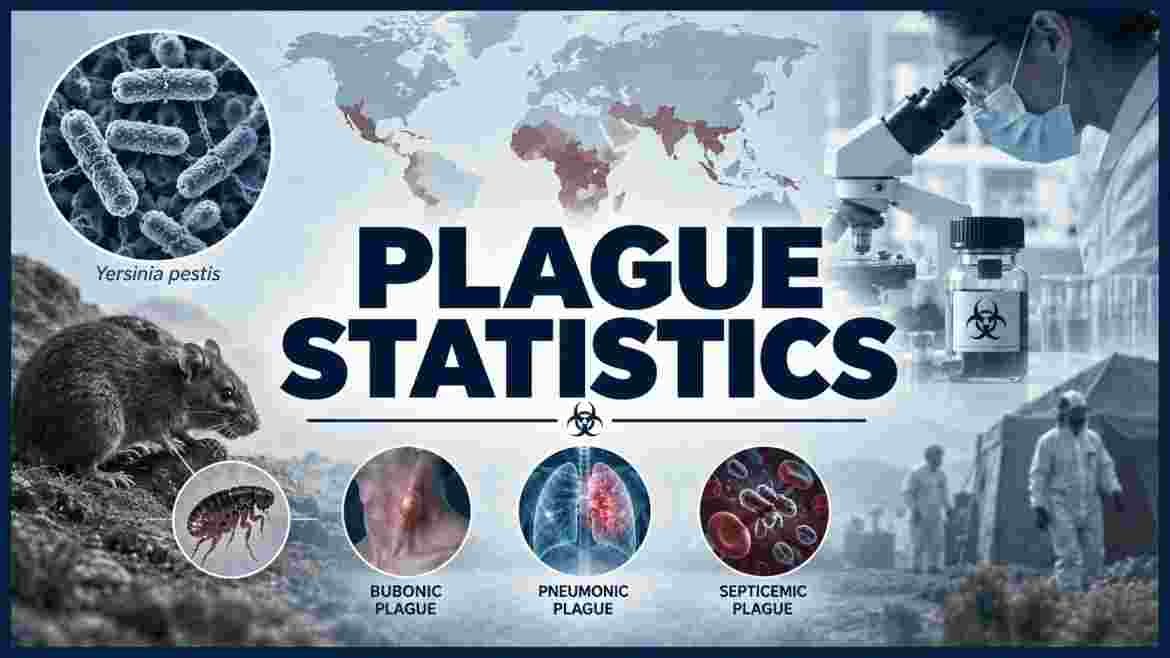
Plague statistics 2026 from the World Health Organization show that 10 countries reported 3,847 suspected human plague cases and 423 deaths between 2019 and 2025, an 11% case fatality rate, with the Democratic Republic of the Congo and Madagascar accounting for 97.7% of the 2,646 confirmed cases. Plague is curable with early antibiotics, and it was not confirmed in the October 2, 2026 laboratory death in Irkutsk, Russia.
Plague – Introduction
Plague in 2026 describe a disease that never left. The World Health Organization (WHO) logged 3,847 suspected human cases and 423 deaths across 10 countries between 2019 and 2025, and a scare in Siberia on October 2, 2026 pushed the topic back into the headlines. Plague is caused by the bacterium Yersinia pestis. It moves between rodents and fleas, and it still reaches people in Africa, Asia and the Americas every year.
The counts are small next to cholera or measles, but they are concentrated and uneven. Two countries produce 97.7% of confirmed cases. This report covers WHO’s newest seven-year dataset, the 2025 breakdown by country, 2026 events from Mongolia to New Mexico, the CDC’s US count, the three historic pandemics and the treatment facts that make modern plague curable. All figures run through October 8, 2026.
Interesting Facts About Plague Statistics 2026
WHO PLAGUE REPORTING, 2019-2025
Suspected cases | ██████████████████████████████████ 3,847
Confirmed cases | ███████████████████████ 2,646
Deaths          | ████ 423
| Fact | Confirmed Data |
|---|---|
| Suspected human cases, 2019–2025 | 3,847 |
| Confirmed cases, 2019–2025 | 2,646 |
| Deaths, 2019–2025 | 423 |
| Observed case fatality rate | 11% |
| Countries reporting cases | 10 (six with confirmed cases) |
| Share of confirmed cases in DR Congo and Madagascar | 97.7% |
| Cases reported for 2025 | 183 (113 confirmed), 31 deaths |
| Average US human cases per year (CDC) | 5 |
Source: World Health Organization, Weekly Epidemiological Record, Vol. 101, No. 38, 25 September 2026; WHO news release, 29 September 2026; CDC Plague Maps and Statistics, 7 October 2026.
The chart shows how the WHO totals nest. Of 3,847 suspected cases, 2,646 were confirmed and 423 people died, which gives the 11% case fatality rate. That averages out to roughly 550 suspected cases and 60 deaths a year, although single outbreaks swing the yearly figures widely.
The table adds geography. Ten countries reported cases, but only the DR Congo, Kenya, Madagascar, Uganda, China and Mongolia reported confirmed ones. WHO warns the totals are not a measure of global incidence, because surveillance quality differs by country and silent countries may still have plague in animals. The roughly 5 US cases a year sit in a different category: sporadic and rural.
Plague Cases by Country 2026: WHO Data for 2019–2025
CONFIRMED HUMAN PLAGUE CASES BY COUNTRY, 2019-2025
DR Congo   | ██████████████████████████████████████ 1,893
Madagascar | ██████████████ 693
Kenya      | ▌ 22
China      | ▌ 19
Mongolia   | ▌ 17
Uganda     | ▌ 2
| Country | Suspected Cases | Confirmed Cases | Deaths |
|---|---|---|---|
| DR Congo | 1,893 | 1,893 | 101 |
| Madagascar | 1,482 | 693 | 307 |
| Kenya | 375 | 22 | 0 |
| Mongolia | 76 | 17 | Not itemized |
| China | 19 | 19 | Not itemized |
| Uganda | 2 | 2 | 1 |
Source: World Health Organization, Weekly Epidemiological Record, Vol. 101, No. 38, 25 September 2026. WHO’s news release cites 3,847 suspected cases in total; one passage of the record cites 3,860. WHO notes the DR Congo submitted identical suspected and confirmed counts.
The DR Congo leads with 1,893 confirmed cases, and Madagascar follows with 693. Together they hold 2,586 of the 2,646 confirmed cases. Kenya (22), China (19), Mongolia (17) and Uganda (2) split the remaining 60.
The suspected column tells a wider story. Madagascar reported 1,482 suspected cases and confirmed 693, a confirmation rate of 46.8%. Mongolia confirmed 17 of 76 (22.4%), and Kenya confirmed 22 of 375 (5.9%). Low confirmation rates can reflect limited laboratory access as well as false alarms, which is why WHO publishes both columns. WHO also cautions that the DR Congo’s suspected and confirmed counts were identical in every year, so its 1,893 confirmed cases should not be read as independent laboratory verification.
Plague Death Rate 2026: How Deadly Is Plague Today?
OBSERVED CASE FATALITY RATE, 2019-2025
Madagascar | █████████████████████ 20.7%
Global     | ███████████ 11.0%
DR Congo   | █████ 5.3%
Kenya      | 0.0%
| Measure | Figure |
|---|---|
| Global observed case fatality rate | 11.0% (423 of 3,847) |
| Madagascar | 20.7% (307 of 1,482) |
| DR Congo | 5.3% (101 of 1,893) |
| Kenya | 0% (0 of 375) |
| Untreated bubonic plague | 30%–60% |
| Untreated pneumonic or septicaemic plague | Invariably fatal unless treated early |
Source: World Health Organization plague fact sheet, 29 September 2026; fatality rates calculated from WHO country counts.
WHO’s seven-year rate is 11%, but countries sit far apart. Madagascar recorded 307 deaths among 1,482 suspected cases, a rate of 20.7%. The DR Congo recorded 101 deaths among 1,893 cases, or 5.3%. Kenya reported no deaths among 375 cases. These four countries explain 409 of the 423 deaths. The other 14 sit with Mongolia, China and the remaining reporters.
Untreated plague is far deadlier. WHO puts untreated bubonic fatality at 30% to 60% and says the pneumonic and septicaemic forms are invariably fatal without early treatment. Pneumonic plague can kill within 18 to 24 hours of onset. The observed 11% sits well below those ranges, which shows what early antibiotics change, though mixed clinical forms and suspected cases make the comparison rough.
Plague Statistics 2026 by Country: The 2025 Full-Year Breakdown
PLAGUE CASES REPORTED TO WHO IN 2025
Madagascar | █████████████████ 87
DR Congo   | ███████████ 54
Kenya      | ██████ 28
Mongolia   | ███ 14
Uganda     | 0
China      | 0
| Country | Reported Cases | Confirmed | Deaths |
|---|---|---|---|
| Madagascar | 87 | 51 | 29 |
| DR Congo | 54 | 54 | 1 |
| Kenya | 28 | 7 | 0 |
| Mongolia | 14 | 1 | 1 |
| Uganda | 0 | 0 | 0 |
| China | 0 | 0 | 0 |
| Total | 183 | 113 | 31 |
Source: World Health Organization, Weekly Epidemiological Record, Vol. 101, No. 38, Table 9, 25 September 2026. Reported cases include probable and confirmed cases, so the columns should not be added.
WHO’s 2025 table lists 183 reported cases, 113 confirmed, and 31 deaths across six reporting countries. Madagascar led with 87 cases, or 47.5% of the total, and recorded 29 of the 31 deaths. The DR Congo followed with 54 cases, all confirmed, and 1 death.
Kenya reported 28 cases with 7 confirmed. Mongolia reported 14 cases with 1 confirmed and 1 death. Uganda and China reported none. The 2025 total is about one third of the seven-year average of roughly 550 cases a year. The data alone cannot show whether that means a quieter year or weaker reporting.
Plague Trends 2026: How Cases and Deaths Compare With the 2010s
AVERAGE REPORTED CASES PER YEAR
2010-2019, six leading countries   | ████████████████ ~455
2019-2025, ten reporting countries | ████████████████████ ~550

CASE FATALITY RATE
2010-2019 | █████████████████ 17.3%
2019-2025 | ███████████ 11.0%
| Period | Cases Reported | Deaths | Fatality Rate | Cases Per Year |
|---|---|---|---|---|
| 2010–2019 (six leading countries) | 4,547 | 786 | 17.3% | ~455 |
| 2019–2025 (ten reporting countries) | 3,847 | 423 | 11.0% | ~550 |
Source: American Journal of Tropical Medicine and Hygiene review of WHO data, 2010–2019, via the National Institutes of Health; World Health Organization, Weekly Epidemiological Record, 25 September 2026. Periods overlap in 2019 and country sets differ, so the comparison is approximate.
Reported cases per year rose from about 455 in the 2010s to about 550 in 2019–2025, while the fatality rate fell from 17.3% to 11.0%. Madagascar illustrates the shift in volume. The 2010s review credits it with 3,396 cases and 652 deaths, a rate of 19.2%, and the 2017 urban epidemic drove most of that total. Its 2019–2025 rate was 20.7%, so the lower global rate does not come from Madagascar.
Three caveats apply. More countries report now, and the DR Congo submits far more cases than a decade ago, so part of the rise is better counting rather than more disease. A single epidemic can distort a decade, as Madagascar’s did in 2017. And WHO has said annual numbers fluctuate with the timing, location and size of outbreaks. Treat the direction as a signal and the decimals as approximate.
Plague Outbreaks in 2026: Confirmed Cases and the Irkutsk Scare
IRKUTSK CONTACT MONITORING, OCTOBER 2026
Contacts identified (at least)          | ████████████████████ 197
Other infections found (COVID-19, cold) | ▌ 4
Plague-positive contacts                | 0
| Date | Place | Event | Status |
|---|---|---|---|
| April 2026 | Apache County, Arizona | First human case in the county since 2015; patient recovered | Confirmed |
| June 11, 2026 | Santa Fe County, New Mexico | Woman died; first human case of the year in the state | Confirmed |
| July 24, 2026 | Khovd Province, Mongolia | Bubonic plague after eating marmot meat | Confirmed |
| September 29, 2026 | Geneva | WHO publishes 2019–2025 plague analysis | Official |
| October 2, 2026 | Irkutsk, Russia | Laboratory technician, 28, dies of pneumonia of unknown cause | Plague not confirmed |
Source: New Mexico Department of Health, June 2026; Xinhua and Mongolia’s National Centre for Zoonotic Diseases, July 25, 2026; UN News, October 6, 2026; NBC News and the Washington Times, October 6, 2026.
Confirmed 2026 cases have been scattered. Arizona reported its Apache County case in April, and the patient recovered. A Santa Fe County woman died in June in New Mexico’s first human case of 2026. Mongolia’s National Centre for Zoonotic Diseases confirmed bubonic plague in Khovd province on July 24, and it says 17 of the country’s 21 provinces are plague-risk areas.
Irkutsk is a different kind of data point. Russia told WHO on October 6 that no plague was recorded, and WHO rated the risk moderate to low for Irkutsk, low for Russia and very low for Europe. At least 197 contacts were monitored, and testing found two COVID-19 cases, two rhinovirus cases and no plague. In the DR Congo, read 2026 plague counts with the Ebola epidemic in mind: the country reported 8,603 confirmed Ebola cases and 4,148 deaths by October 4, tracked in these Ebola strains statistics. A health system under that load likely has less spare capacity for routine plague detection.
Plague Cases in the United States 2026: What the CDC Counts
US HUMAN PLAGUE CASES
Highest year since 2000      | █████████████████ 17
Average per year             | █████ 5
2026 so far (to Sept 26)     | ██ 2
| Metric | Figure |
|---|---|
| Average human cases per year | 5 |
| Annual range since 2000 | 0–17 |
| Share of cases that are bubonic | Over 80% |
| 2026 cases, CDC provisional (to Sept 26) | 2 (Arizona 1, New Mexico 1) |
| New Mexico human cases in 2025 | 3 |
| Last US urban epidemic | Los Angeles, 1924–1925 |
| Age range of US cases | Infants to 96 years |
Source: CDC Plague Maps and Statistics, 7 October 2026; New Mexico Department of Health; CDC provisional data as reported by The Hill, October 2026.
The CDC counts an average of 5 human cases a year, with a range of 0 to 17, and 50% of patients are between 12 and 45. Provisional data list 2 cases in 2026 as of September 26, one each in Arizona and New Mexico. New Mexico alone logged 3 human cases in 2025.
Most US infections come from two regions: northern New Mexico, northern Arizona and southern Colorado, or California, southern Oregon and far western Nevada. Cases follow rodent and flea exposure, not vaccination gaps, which separates plague from diseases such as measles. The MMR vaccine statistics in the US show how that second group behaves.
Plague Pandemics in History 2026: Three Waves and Their Death Tolls
ESTIMATED PLAGUE PANDEMIC DEATHS, UPPER ESTIMATE
Black Death, worldwide | ████████████████████████████████████████ 200M
Black Death, Europe    | ██████████ 50M
Justinian plague       | ██████████ 50M
Third pandemic         | ███ 15M
| Pandemic | Years | Estimated Deaths |
|---|---|---|
| Justinian plague | 541–750 | 25 million–50 million (debated) |
| Black Death, Europe | From 1347 | 25 million–50 million |
| Black Death, worldwide | From 1347 | 75 million–200 million |
| Third pandemic | 1855–1960 | 12 million–15 million |
Source: CNN Health summary of WHO data, October 8, 2026; University of St Andrews plague research; Public Health Online, 2026. Historical death tolls are estimates.
Plague has caused three recorded pandemics. The Justinian plague killed an estimated 25 million to 50 million, though historians debate the scale. The Black Death killed 25 million to 50 million in Europe, roughly 30% to 60% of the population, and an estimated 75 million to 200 million worldwide. The third pandemic began in China in 1855 and killed 12 million to 15 million, mostly in India and China.
Modern plague is a different problem. WHO’s seven-year toll of 423 deaths is less than one thousandth of one percent of the lowest worldwide Black Death estimate. Antibiotics, flea control and contact tracing changed the outcome. Madagascar’s 2017 urban epidemic is the modern benchmark: 2,348 cases, 1,791 of them pneumonic, and 202 deaths between August and November, a fatality rate of 8.6%.
Plague Treatment and Prevention 2026: Forms, Symptoms and Response
UNTREATED FATALITY VS OBSERVED FATALITY
Pneumonic, untreated    | ███████████████████████████ 100%
Septicaemic, untreated  | ███████████████████████████ 100%
Bubonic, untreated      | ███████████████████ up to 60%
Observed, WHO 2019-2025 | ██████ 11%
| Form | Untreated Fatality | How It Spreads | Response |
|---|---|---|---|
| Bubonic | 30%–60% | Flea bites, handling infected animals | Early antibiotics |
| Septicaemic | Invariably fatal unless treated early | Bloodstream infection | Early antibiotics |
| Pneumonic | Invariably fatal; death within 18–24 hours | Person to person through respiratory droplets | Isolation, 7-day contact prophylaxis |
Source: World Health Organization plague fact sheet, updated 29 September 2026.
Plague responds to common antibiotics when they start early. WHO recommends that close contacts of pneumonic patients be identified, monitored and given a 7-day preventive course. In Madagascar, the epidemic season runs from September to April, so the next peak is arriving now, and most cases occur in the Central Highlands above 800 metres. Pneumonic plague is the form that can drive person-to-person epidemics, which is why a single suspected case triggers wide contact tracing.
Detection depends on rodent surveillance, laboratories and funding. WHO says continued animal monitoring and rapid outbreak response remain essential, and it notes that plague can occur in countries that do not report. How global-health money reaches those systems is covered in these US foreign aid statistics, which track health budgets for African countries.
Frequently Asked Questions
How many plague cases are there in the world in 2026?
No verified live global count exists. WHO’s latest data cover 2019–2025: 3,847 suspected cases, 2,646 confirmed cases and 423 deaths. For 2025, WHO lists 183 reported cases and 31 deaths.
Which countries have the most plague cases?
The DR Congo and Madagascar. They account for 97.7% of confirmed cases from 2019 to 2025, with 1,893 and 693 confirmed cases.
How many people die from plague each year?
WHO’s 423 reported deaths over seven years average about 60 a year. The 2025 table lists 31 deaths, with 29 in Madagascar.
Is plague still around in 2026?
Yes. Human cases were confirmed in Arizona, New Mexico and Mongolia in 2026, and WHO says plague remains endemic in several countries.
Is there a plague outbreak in Russia in 2026?
Not a confirmed one. A laboratory technician in Irkutsk died on October 2 of pneumonia of unknown cause. Russia told WHO that no plague was recorded, and contact testing found no plague.
What are the three types of plague?
Bubonic, septicaemic and pneumonic. Bubonic is the most common. Pneumonic plague infects the lungs and spreads through respiratory droplets.
Can plague be cured?
Yes. Common antibiotics work when given early. Without treatment, bubonic plague kills 30% to 60% of patients, and pneumonic plague is invariably fatal.
How is plague spread?
Mostly by flea bites and contact with infected animals such as rodents and marmots. Pneumonic plague can pass between people through coughing.
How many plague cases does the US have in 2026?
The CDC’s provisional data list 2 cases as of September 26, 2026, in Arizona and New Mexico. The US averages about 5 cases a year.
Where is plague found in the world?
In animals on every continent except Oceania. Most human cases since the 1990s have occurred in Africa, mainly the DR Congo and Madagascar.
How many people did the Black Death kill?
An estimated 75 million to 200 million people worldwide, including 25 million to 50 million in Europe.
Why do plague numbers differ between sources?
Sources count suspected, probable and confirmed cases differently, and countries report with different completeness. WHO’s news release cites 3,847 suspected cases while one passage of its record cites 3,860.
Disclaimer: The data research report we present here is based on information found from various sources. We are not liable for any financial loss, errors, or damages of any kind that may result from the use of the information herein. We acknowledge that though we try to report accurately, we cannot verify the absolute facts of everything that has been represented.