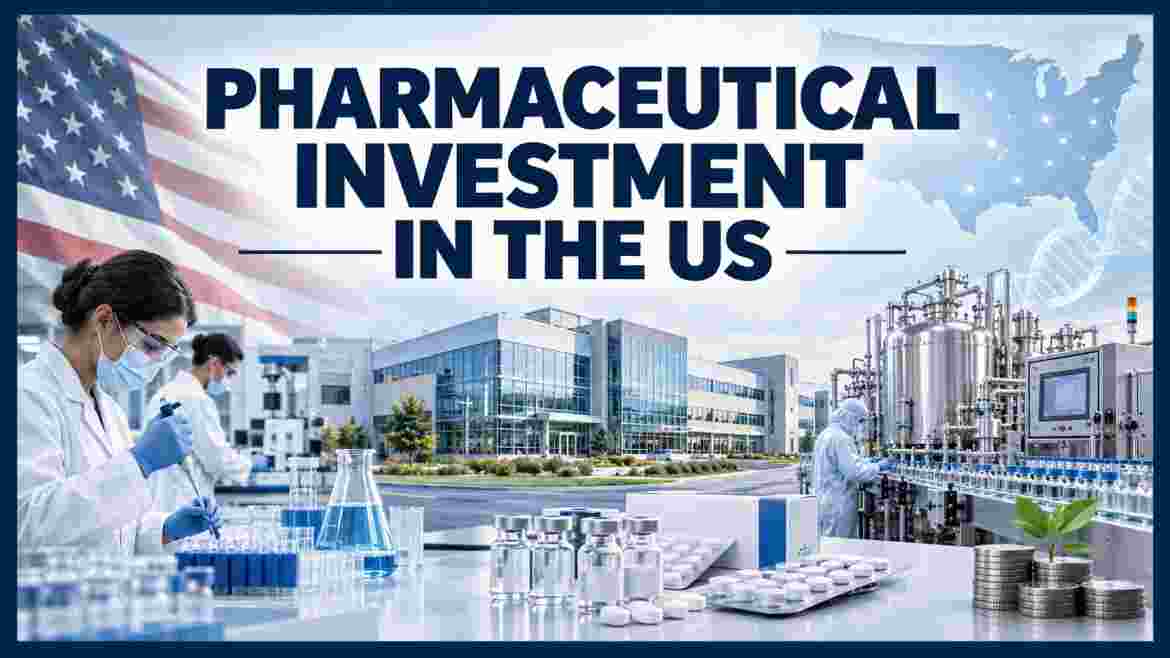
Pharmaceutical and biotech companies struck more than $130 billion in M&A deals in the first half of 2026 alone, already nearing all of 2025’s total, while separately committing over $500 billion to new US manufacturing capacity. Combined R&D spending across the 25 largest drugmakers reached roughly $185 billion, led by Merck, Johnson & Johnson, AstraZeneca, Roche, and Eli Lilly.
Pharmaceutical Investment in the US in 2026
Pharmaceutical investment in 2026 is flowing through three distinct channels at once, and each is moving at a pace that would have qualified as a record year on its own in any prior period. Companies are pouring over $500 billion into new US manufacturing capacity to get ahead of Section 232 tariffs, spending roughly $185 billion combined on research and development across the industry’s 25 largest players, and striking more than $130 billion in mergers and acquisitions in the first six months of the year alone, a pace that puts 2026 on track to be the strongest dealmaking year since before the pandemic.
This report breaks down where that capital is actually going: which companies are spending the most on R&D relative to their revenue, which acquisitions have defined the first half of 2026, how venture capital is flowing into private biotech startups, and what’s driving an unusually active licensing market dominated by deals for Chinese-originated drug candidates. Every figure below comes from company financial disclosures, named deal trackers, or industry analysis, not from independent estimates.
These four categories, manufacturing, R&D, M&A, and licensing, don’t operate in isolation from one another. A company’s acquisition strategy is often a direct substitute for in-house R&D spending, buying a promising clinical-stage asset rather than discovering and developing it internally, while manufacturing investment frequently follows an acquisition once a newly acquired drug approaches commercial launch and needs dedicated production capacity. Reading all four channels together gives a far more complete picture of where pharmaceutical capital is actually headed in 2026 than any single metric could on its own.
Interesting Facts About Pharmaceutical Investment in 2026
| Fact | Detail |
|---|---|
| Pledged US manufacturing investment, 2025-2026 | $500 billion+ |
| Combined R&D spending, top 25 drugmakers | ~$185 billion |
| M&A deal value, H1 2026 | $130-134 billion across 33-42 deals |
| Full-year 2026 M&A forecast (IQVIA) | $140-160 billion, best case $250 billion |
| Biotech VC funding, Jan-June 2026 | $9.1 billion, across 68 companies |
| Biotech IPO proceeds, 2026 to date | $4.5 billion, across 13 IPOs |
| Largest single deal, H1 2026 | Sun Pharma/Organon, $11.75 billion |
| Most active acquirer, 2026 | Eli Lilly, 9 deals over $250M each, $26B deployed |
Source: IQVIA Biopharma M&A Mid-Year 2026 Update; BioPharma Dive; IntuitionLabs R&D analysis; Pharmaceutical Executive, 2026.
The $130 billion-plus in M&A deal value struck in just the first half of 2026 already sits close to all of 2025’s full-year total, with deal count running at 84% of 2025’s entire annual volume in half the time. That pace reflects a now-familiar dynamic in the industry: large drugmakers facing looming patent cliffs on blockbuster drugs are racing to acquire a shrinking pool of promising late-stage biotech assets before their competitors do, even as no mega-mergers above $30 billion have closed so far in 2026, continuing a multi-year drought in truly massive, company-defining transactions.
Eli Lilly’s position as the year’s most prolific dealmaker, nine separate acquisitions above $250 million each, funded by $26 billion in cumulative spending, illustrates how the company’s GLP-1 blockbuster cash flows have reshaped its competitive posture across the entire industry. Rather than making one enormous bet, Lilly has spread its acquisition capital across multiple smaller, targeted purchases, a strategy that has let it build pipeline depth across several therapeutic modalities simultaneously rather than concentrating risk in a single mega-deal.
Separately from M&A, biotech venture capital and IPO activity, $9.1 billion and $4.5 billion respectively in the first half of 2026, add a third distinct layer of private-market investment flowing into the sector, bringing total disclosed pharmaceutical and biotech capital activity across M&A, VC, and IPOs well past $140 billion for the first six months of the year alone, before even counting R&D budgets or manufacturing capital expenditure.
Pharmaceutical R&D Spending by Company in 2026
TOP R&D SPENDERS, 2026 ($ billions, selected companies)
Roche (projected)     ██████████████ $14.0B
Amgen                 ███████ $7.27B
Bayer                 ███████ $6.78B
Gilead Sciences       ██████ $5.79B
Takeda                ████ $4.455B
| Company | 2026 R&D Spending | R&D as % of Revenue |
|---|---|---|
| Roche (projected) | $14.0 billion | — |
| Amgen | $7.27 billion | — |
| Bayer | $6.78 billion | — |
| Gilead Sciences | $5.79 billion | — |
| Takeda | $4.455 billion | — |
| Vertex Pharmaceuticals | $3.9 billion | ~32.5% |
| Moderna | $3.13 billion | ~163% |
| Johnson & Johnson | Among top 5 combined | 15.6% |
| Pfizer | Among top 5 combined | ~16.7% |
| Regeneron | — | ~41% |
Source: PharmaShots, “Top 20 R&D Spending Biopharma Companies of 2026”; IntuitionLabs, “Pharma R&D Spending 2026,” analysis of 25 consolidated drugmakers.
Merck, Johnson & Johnson, AstraZeneca, Roche, and Eli Lilly occupy the top five positions by absolute R&D spending, together accounting for roughly $72 billion of the approximately $185 billion IntuitionLabs calculated across 25 consolidated drugmakers in its 2026 analysis. But absolute dollars tell only part of the story: R&D intensity, spending as a share of revenue, ranges enormously across the industry, from just 5.9% at Teva Pharmaceutical Industries up to an extraordinary 163% at Moderna, a company still spending well beyond its current revenue base to fund its pipeline.
That intensity gap maps closely onto company type. Large, diversified originators like Johnson & Johnson (15.6%) and Pfizer (approximately 16.7%) post comparatively modest R&D intensity despite leading on absolute spend, simply because their revenue base is so large. Narrower, biotechnology-focused companies like Regeneron (approximately 41%) and Vertex (approximately 32.5%) post some of the industry’s highest ratios, reflecting their smaller, more concentrated revenue bases relative to ambitious research programs. Whether R&D spending is rising or falling in 2026 depends heavily on individual portfolio dynamics: GLP-1-exposed companies like Lilly and Novo Nordisk have grown R&D spending alongside surging revenue, while patent-cliff-affected companies including Pfizer, Bristol Myers Squibb, and Merck have faced more pressure to rein in spending growth. For a deeper look at how GLP-1 demand specifically has reshaped company investment priorities, the GLP-1 Ozempic statistics report tracks the revenue and market dynamics driving that single drug category’s outsized influence on 2026 R&D decisions.
Biggest Pharmaceutical M&A Deals in 2026
LARGEST DISCLOSED M&A DEALS, H1 2026 ($ billions)
Sun Pharma / Organon       ████████████ $11.75B
AbbVie / Apogee            ███████████ $10.9B
GSK / Nuvalent             ███████████ $10.6B
Gilead / Arcellx           ████████  $7.8B
Eli Lilly / Kelonia        ███████  $7.0B
| Acquirer / Target | Deal Value | Announced |
|---|---|---|
| Sun Pharma / Organon | $11.75 billion | April 26, 2026 |
| AbbVie / Apogee Therapeutics | $10.9 billion | June 22, 2026 |
| GSK / Nuvalent | $10.6 billion | 2026 |
| Gilead Sciences / Arcellx | $7.8 billion | April 28, 2026 |
| Eli Lilly / Kelonia Therapeutics | Up to $7.0 billion | April 20, 2026 |
| Merck & Co. / Terns Pharmaceuticals | $6.7 billion | 2026 |
| Biogen / Apellis Pharmaceuticals | $5.6 billion | Completed May 14, 2026 |
| Gilead / Tubulis | $5.0 billion | 2026 |
Source: Healthcare Brew, “2026’s biggest healthcare deals so far”; DCAT Value Chain Insights; IQVIA.
India-based Sun Pharmaceutical Industries’ all-cash acquisition of New Jersey-based Organon for $11.75 billion, announced April 26, stands as the largest deal of the year so far and a notable sign of non-Western pharmaceutical companies competing directly for established US and European drug portfolios. AbbVie’s $10.9 billion purchase of Apogee Therapeutics, targeting multiple clinical-stage candidates for inflammatory and immunological disease, and GSK’s $10.6 billion acquisition of oncology-focused Nuvalent round out the three deals that crossed the $10 billion threshold in the first half of the year.
Six additional deals landed in the $5 billion to $10 billion range, including Gilead’s two separate billion-dollar-plus acquisitions, Arcellx for $7.8 billion and Tubulis for $5 billion, making Gilead one of the year’s most active large-cap acquirers alongside Lilly. Biogen’s completed $5.6 billion purchase of Apellis Pharmaceuticals, finalized May 14, extended a pattern of established companies absorbing smaller specialists with approved or near-approved therapies rather than betting purely on earlier-stage science, a somewhat more conservative dealmaking posture than the industry showed during its riskier, earlier-stage buying sprees of past cycles.
Biotech Venture Capital and IPO Funding in 2026
BIOTECH VC AND IPO ACTIVITY, H1 2026
VC funding, 68 companies       █████████ $9.1B
IPO proceeds, 13 companies     █████ $4.5B
| Funding Metric | H1 2026 Figure |
|---|---|
| Biotech VC funding raised | $9.1 billion, across 68 companies |
| Biotech IPO proceeds | $4.5 billion, across 13 IPOs |
| Median IPO size, 2026 | ~$302 million |
| Biotech VC funding range, 2023-2026E | $42-48 billion annually |
| Share of funding rounds in immune/cancer drugs | 40%+ |
| Isomorphic Labs Series B (AI drug discovery) | $2.1 billion |
Source: BioPharma Dive, “Biotech startup funding gap widens despite rebound in VC investment,” 2026; Xtalks Biotech Funding Tracker.
Biotech venture capital funding continued a multi-year surge into 2026, with at least 68 biotech companies raising a combined $9.1 billion between January and June, according to BioPharma Dive data. On the public-markets side, 13 biotech companies raised $4.5 billion combined through IPOs in the same period, an unusually large median offering size of roughly $302 million compared to prior years, with Parabilis Medicines and Kailera Therapeutics each setting new sector records for their respective offerings.
That headline funding figure comes with an important caveat: it’s partially inflated by a single $2.1 billion Series B round for Isomorphic Labs, the Alphabet-controlled AI drug discovery company, a deal so large it would dominate any funding ranking on its own. Investors in 2026 have leaned toward comparatively safer bets within an already risk-averse funding environment, with immune and cancer-focused drug developers accounting for more than 40% of funding rounds in the first half of the year, while companies working on cellular or genetic medicines continued a multi-year funding slump that has persisted since the sector’s post-pandemic pullback. For broader context on how this capital flows alongside the pharmaceutical sector’s other major spending categories, the US investment statistics report tracks pharmaceutical and biotechnology investment against venture capital activity across the wider US economy.
Pharmaceutical Licensing Deal Trends in 2026
LICENSING DEAL GROWTH, 2025 vs EARLY 2026
2025 total                ████████████████████████ $250B+ (516 deals)
Early 2026 avg deal size  ████████████████ +76% vs 2025
| Licensing Metric | Figure |
|---|---|
| Total 2025 licensing deal value | $250 billion+, across 516 deals |
| Average deal size growth, early 2026 vs 2025 | +76% |
| AstraZeneca-CSPC licensing deal | $18.5 billion (weight-loss drug) |
| GSK-Hengrui licensing deal | $12 billion+ (12 candidates) |
| BMS-BioNTech licensing deal | $11.1 billion (bispecific) |
| BMS-Hengrui licensing deal | $15.2 billion (13 early-stage programs) |
Source: Vision Life Sciences, “Biotech Licensing Deal Tracker 2026”; IQVIA.
Licensing has emerged as a parallel, equally massive investment channel running alongside traditional M&A, with 2025 alone producing $250 billion-plus in disclosed licensing value across 516 separate deals, the most active year on record for this specific deal structure. Early 2026 data shows that momentum accelerating further still, with average licensing deal size up 76% compared to 2025 levels, driven heavily by mega-licensing agreements for drug candidates originating in Chinese biotech companies.
AstraZeneca’s $18.5 billion licensing deal with CSPC Pharmaceutical for a weight-loss drug candidate, and Bristol Myers Squibb’s $15.2 billion agreement with Hengrui spanning 13 early-stage oncology, hematology, and immunology programs, illustrate a structural shift in where Western pharmaceutical companies are sourcing innovative pipeline assets. Chinese biotech companies have become prime sources of de-risked, clinically validated drug candidates largely because they can move from discovery to proof-of-concept data faster and at lower development cost than many Western counterparts, a dynamic that has drawn growing attention from US policymakers concerned about pharmaceutical supply chain and intellectual property dependence on China even as individual companies continue signing these deals at a record pace. Much of this licensing and acquisition activity ultimately shows up downstream in how aggressively companies market their resulting products once approved, a connection the pharmaceutical advertising report explores through direct-to-consumer ad spending data for 2025 and 2026.
US Pharmaceutical Market Size and Spending in 2026
US MEDICINE SPENDING PROJECTION, 2025-2026 ($ billions)
Projected 2025 range   ████████████████████████  $605-635B
| Market Metric | Figure |
|---|---|
| Projected US medicine spending, 2025 | $605-635 billion |
| US share of global pharmaceutical sales | Highest of any single country |
| Big Pharma share of total biotech R&D investment | ~60% |
| US biotech annual VC funding (longer-run average) | $50 billion+ |
Source: Statista pharmaceutical R&D forecast data; PatentPC biotech R&D analysis.
The United States is projected to spend between $605 billion and $635 billion on medicine in 2025 alone, a figure significantly higher than any other single country and one that underpins why pharmaceutical companies continue directing such a disproportionate share of global manufacturing, R&D, and dealmaking investment toward the American market specifically. Big Pharma companies collectively contribute roughly 60% of all biotech R&D investment industry-wide, with giants like Roche, Johnson & Johnson, and Pfizer dominating that spending even as smaller, venture-backed biotechs drive a disproportionate share of genuinely novel early-stage science.
That combination, a market large enough to justify massive manufacturing and R&D commitments, paired with a biotech ecosystem still capable of attracting tens of billions in annual venture funding despite recent sector headwinds, is what has made the US the undisputed center of gravity for essentially every category of pharmaceutical investment tracked in this report: manufacturing, R&D, M&A, licensing, and venture capital alike.
Pharmaceutical Investment FAQs
How much has the pharmaceutical industry invested in the US in 2026?
Across manufacturing, R&D, and M&A combined, commitments exceed $500 billion in pledged manufacturing investment alone, plus roughly $185 billion in combined R&D spending and $130 billion-plus in M&A deals in the first half of the year.
What is the biggest pharmaceutical acquisition of 2026 so far?
Sun Pharmaceutical Industries’ $11.75 billion acquisition of Organon, announced April 26, 2026.
Which pharmaceutical company has made the most acquisitions in 2026?
Eli Lilly, with 9 acquisitions above $250 million each, totaling roughly $26 billion in cumulative deal spending.
How much is pharmaceutical M&A expected to total for all of 2026?
IQVIA forecasts $140 billion to $160 billion for the full year, with a best-case scenario reaching $250 billion.
Which companies spend the most on pharmaceutical R&D?
Roche leads with a projected $14 billion in 2026 R&D spending, followed by Merck, Johnson & Johnson, AstraZeneca, and Eli Lilly among the top five by total spend.
Which company has the highest R&D intensity relative to revenue?
Moderna, at approximately 163% of revenue, reflecting a company still investing well beyond its current commercial sales base.
How much venture capital went into biotech in the first half of 2026?
$9.1 billion, raised by at least 68 companies, according to BioPharma Dive data.
What drove the surge in pharmaceutical licensing deals in 2026?
Mega-licensing agreements for drug candidates originating from Chinese biotech companies, including AstraZeneca’s $18.5 billion deal with CSPC and BMS’s $15.2 billion deal with Hengrui.
Have there been any mega-mergers (over $30 billion) in pharma in 2026?
No. As of mid-2026, no deal has exceeded the $30 billion mega-merger threshold, continuing a pattern seen in 2024 and 2025 as well.
How much does the US spend on medicine each year?
Between $605 billion and $635 billion, projected for 2025, the highest of any single country globally.
What share of biotech R&D comes from large pharmaceutical companies versus startups?
Big Pharma companies contribute roughly 60% of total biotech R&D investment industry-wide.
How big was the biotech IPO market in 2026?
$4.5 billion raised across 13 IPOs in the first half of the year, with a median deal size of about $302 million.
Disclaimer: The data research report we present here is based on information found from various sources. We are not liable for any financial loss, errors, or damages of any kind that may result from the use of the information herein. We acknowledge that though we try to report accurately, we cannot verify the absolute facts of everything that has been represented.