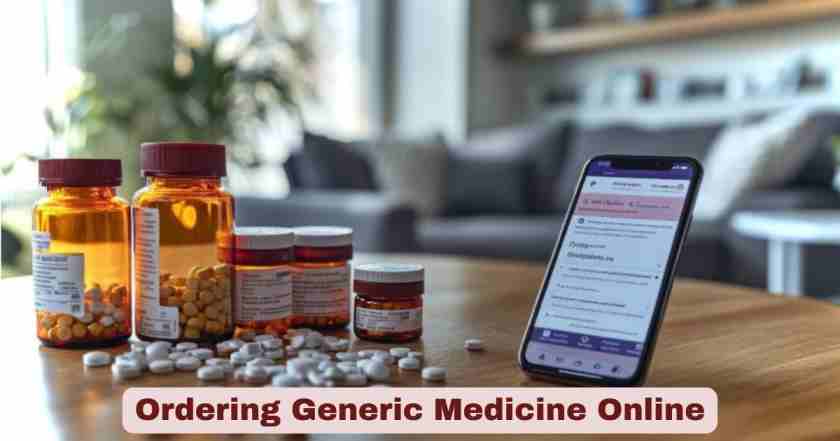
Using an online pharmacy website to order generic medicine online has become increasingly common. However, ordering errors happen when patients overlook critical label details. A small oversight in composition or strength can lead to receiving the wrong medication entirely.
This guide walks you through reading medicine labels accurately. You will learn to verify listings before ordering and check deliveries upon arrival.
Why do most wrong orders happen
Ordering mistakes typically stem from a few common oversights.
- Patients often search by brand name rather than verifying the active ingredient.
- Confusion between strength units like ‘mg’ and ‘mcg’ causes significant errors.
- Ignoring modified-release markers like ‘SR’ or ‘ER’ leads to incorrect substitutions.
According to research, e-pharmacies dispensing medicines against scanned prescriptions face manipulation risks. Prescriptions can be doctored without proper authentication procedures like digital signatures.
How online “generic/substitute medicine” ordering works
E-pharmacies operate through two primary models in India.
- The inventory model involves platforms maintaining their own medicine stocks.
- The marketplace model connects consumers with licensed physical pharmacies through digital platforms.
These platforms offer accessibility benefits, including personalised medicine reminders. Doorstep delivery and prescription validation through licensed pharmacists add convenience. However, understanding how substitutions work remains your responsibility.
The must-match fields
Before accepting any generic medicine online, verify these essential details match your prescription exactly.
1. Composition (salt/active ingredient)
Composition refers to the active pharmaceutical ingredient present in the medicine used to manage your condition. According to the World Health Organisation (WHO) and the Central Drugs Standard Control Organisation (CDSCO), generic medicines must be bioequivalent to their reference (branded) products. This means identical dosage form, strength, and intended use.
2. Strength (mg/mcg/mg per ml/% for topicals)
Strength indicates the amount of active ingredient per unit. Consider these critical differences:
- Tablets and capsules: Strength shown per unit (e.g., 500 mg per tablet)
- Liquid preparations: Expressed as mg per ml or mg per 5 ml
- Topicals: Shown as percentage concentration
3. Dosage form (tablet/capsule/syrup/drops/cream)
The dosage form determines how medicine enters your body. Each form has different absorption rates. Never substitute one form for another without consulting your doctor.
Stronger strength does not mean a higher dose
A common misconception is that higher strength equals higher dosing. Your prescribed dose depends on your doctor’s assessment of your condition. Body weight, age, and other factors also influence dosing decisions. Always follow prescribed instructions regardless of strength variations.
How to verify a medicine listing before you add it to your cart
Take these steps before confirming any online medicine order.
Check pack size and quantity (strips/tablets/ml/grams)
Rule 105 of the Drugs and Cosmetics Rules defines specific pack sizes. Tablets should have quantities matching units or multiples of five. Net contents must appear in metric terms on the innermost container label.
Read storage notes and key warnings (especially for liquids/topicals)
Medicines require proper storage as recommended by manufacturers. Exposure to high temperatures during transit diminishes efficacy. Check expiry dates carefully, noting they indicate the last day of the stated month.
Prescription upload and verification
Understanding the prescription process helps ensure accurate orders.
a) What makes a prescription upload usable
Schedule H, Schedule H1, and Schedule X medicines require valid prescriptions. A genuine prescription contains the doctor’s registration number and, ideally, a digital signature. These details enable verification of prescription authenticity.
b) What typically happens in the verification step
Licensed pharmacists verify patient and prescriber details upon receiving prescriptions. They confirm authenticity before initiating medicine dispensation. E-prescriptions are uploaded and maintained as records.
Delivery day label check
Verification does not end at ordering. Check these details upon delivery.
a) Match identity: composition, strength, dosage form, release type
Every batch should display mandatory information, including the generic name and batch number. Verify manufacturing date, expiry date, and storage conditions. Look for Rx symbols and cautionary statements where applicable.
b) Safety checks: seal, expiry, batch number, invoice
Confirm the packaging seal remains intact. The invoice should contain the medicine name, quantity, batch number, and expiry date. Non-compliant labelling indicates “misbranded” medicines under Section 17 of the Drugs and Cosmetics Act.
Common mistakes that users make
Awareness of these errors helps you avoid them when using any online pharmacy website.
a) Ordering by name instead of composition
Searching by brand name rather than salt composition leads to incorrect orders. Always verify the active ingredient matches your prescription.
b) Strength mix-ups (mg/mcg, mg/5 ml)
Remember that 1 mg equals 1000 mcg. This thousandfold difference can have serious consequences. For liquids, mg/5 ml requires measuring exactly 5 ml for the stated dose.
c) Dosage form confusion
Different forms serve different purposes. A syrup cannot replace tablets without medical guidance.
d) Ignoring SR/ER/CR/XR
Modified-release formulations release medicine slowly over time. Switching between immediate- and extended-release versions without advice causes problems.
e) Accepting substitutions without checking what changed
Verify that any substituted medicine matches composition, strength, and form. CDSCO requires bioequivalence studies for approving generics.
f) Skipping delivery verification
Always inspect packages upon arrival. Checking labels takes minutes but prevents medication errors.
Taking confident steps toward safe online ordering
Reading labels correctly protects you from ordering errors. Platforms provide transparent information about generic alternatives. Always verify composition, strength, and dosage form before confirming orders. Consult your pharmacist when uncertain about any substitution.
FAQs
If two medicines have the same salt, are they always interchangeable?
Not necessarily. While the active ingredient matches, factors like release mechanisms differ. Sustained-release and immediate-release versions work differently. Consult your doctor before switching between formulations.
What does ‘mg/5 ml’ mean, and how should I measure it?
This indicates milligrams of active ingredient per 5 millilitres of liquid. Use the measuring device provided with your medicine. Never estimate doses with household spoons.
What do ‘SR/ER/CR/XR’ labels mean, and can I switch?
SR/ER/CR/XR means that the medicine is a modified-release version that releases the drug slowly over time for a longer-lasting effect. Switching to an immediate-release version isn’t a direct swap and should only be done with medical guidance, as it can change how the medicine is absorbed and how it works.
What should I do if the pack looks different from my previous medicine?
Verify that the composition, strength, and manufacturer details match your prescription. Different manufacturers produce generics with varying packaging. Consult your pharmacist if discrepancies exist.
What should I verify immediately after delivery?
Check seal integrity, expiry date, batch number, and invoice accuracy. Match the composition and strength against your prescription. Report any concerns to the pharmacy immediately.