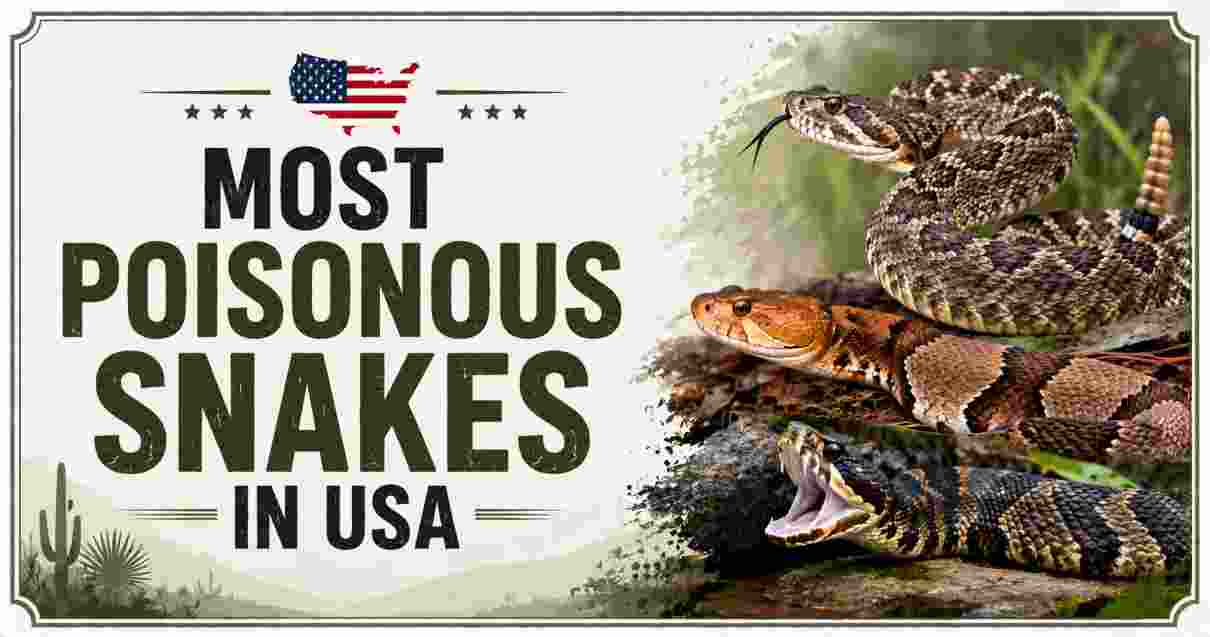
Most Poisonous Snakes in America 2026
Snake season runs long across the United States, and 2026 has already turned into one of the busier years for close calls between people and venomous snakes. Roughly 30 venomous snake species live within US borders, spread across four families — rattlesnakes, copperheads, cottonmouths, and coral snakes — and every state except Alaska and Hawaii is home to at least one of them. Understanding which snakes carry the most dangerous venom, and where they’re most likely to be encountered, matters more than ever as warmer winters push snake activity earlier into the calendar and deeper into suburban backyards, hiking trails, and campsites.
This report ranks the most poisonous snakes in the USA 2026 using the measures toxicologists actually rely on: venom potency (LD50), venom yield per bite, geographic range, and real-world bite and fatality data. A snake with the most lethal venom drop-for-drop isn’t always the one responsible for the most deaths — delivery matters just as much as potency. Below, every fact is broken down by species, backed by the latest verified snakebite statistics, and organized so hikers, homeowners, and outdoor workers can see exactly where the real risk lies in 2026.
Interesting Facts About Venomous Snakes in the USA 2026
Annual Venomous Snakebite Outcomes in the USA
Total bites/year        |████████████████████████████████| 7,000-8,000
Bites needing hospital  |██████████████████              | ~40-50%
"Dry" bites (no venom)  |████████████████                | ~25-50%
Deaths/year             |▏                              | ~5-10
| Interesting Fact | 2026 Figure |
|---|---|
| Venomous snake species native to the US | ~30 |
| Venomous snakebites, US, per year | 7,000-8,000 |
| Average annual US snakebite deaths | ~5 (range 5-10) |
| Odds of a venomous bite per 100,000 people | 2.0-2.3 |
| States with no native venomous snakes | Alaska and Hawaii |
| Rattlesnake share of fatal native snakebites (1989-2018) | 90.2% |
| Most potent LD50 of any US rattlesnake | 0.06 mg/kg (tiger rattlesnake) |
| California venomous bites, Q1 2026 | 77 (vs. 200-300 typical full-year average) |
| California heat-season deaths, early 2026 | 2 (vs. usual 0-1 per year) |
Source: CDC NIOSH; StatPearls (NCBI); World Atlas; Backpacker Magazine, 2026
Two numbers explain most of what matters about snake danger in the US: 7,000 to 8,000 bites happen every year, yet only around 5 of those bites turn fatal, a survival rate that reflects fast access to antivenom rather than mild venom. That gap is exactly why 90.2% of fatal native snakebites between 1989 and 2018 trace back to rattlesnakes specifically — they combine wide distribution with large venom yields, so when treatment is delayed, the odds shift quickly. The tiger rattlesnake’s LD50 of 0.06 mg/kg stands out as the most potent venom of any US pit viper by a wide margin, though its low venom yield keeps it far down most real-world danger rankings.
2026 has also been a notably active year for snake encounters. A warmer-than-usual western winter pulled snakes out of brumation earlier, and California’s poison control system logged 77 venomous bites in the first three months alone — a pace that, if sustained, would roughly triple a typical full year’s total. Two confirmed deaths in California by early spring already matched or exceeded what the state usually records across an entire twelve months, underscoring how sensitive snake activity is to shifting seasonal temperatures.
Top 10 Most Poisonous Snakes in the USA 2026 Ranked
Venom Potency (LD50, mg/kg — lower number = more toxic)
Tiger Rattlesnake        |██                          | 0.06
Mojave Rattlesnake       |███████                     | 0.18-0.23
Eastern Coral Snake      |█████████                   | 0.23-0.30
E. Diamondback Rattler   |██████████████████████████  | 1.3-2.4
W. Diamondback Rattler   |████████████████████████████| ~2.8
| Rank | Snake | Venom Type | LD50 (mg/kg) | Region |
|---|---|---|---|---|
| 1 | Eastern Diamondback Rattlesnake | Hemotoxic | 1.3-2.4 | Southeastern US |
| 2 | Western Diamondback Rattlesnake | Hemotoxic | ~2.8 | Southwestern US |
| 3 | Mojave Rattlesnake | Neurotoxic/Hemotoxic | 0.18-0.23 | Desert Southwest |
| 4 | Eastern Coral Snake | Neurotoxic | 0.23-0.30 | Southeastern US |
| 5 | Timber Rattlesnake | Hemotoxic | Moderate-high | Eastern forests |
| 6 | Tiger Rattlesnake | Neurotoxic-leaning | 0.06 (lowest) | Southern Arizona |
| 7 | Cottonmouth (Water Moccasin) | Hemotoxic | Moderate | Southeastern wetlands |
| 8 | Copperhead | Mild hemotoxic | Low potency | Eastern/Central US |
| 9 | Southern Pacific Rattlesnake | Hemotoxic | ~1.5 | California |
| 10 | Sidewinder Rattlesnake | Hemotoxic | Moderate | Desert Southwest |
Source: WorldAtlas venom database; iNaturalist; NCBI StatPearls; Bond Arms deadliest snakes report, 2026
The Eastern Diamondback Rattlesnake tops this list not because its venom is the single most potent, but because it combines a massive average venom yield of 400-450 mg per bite (with recorded maximums near 1,000 mg) with the longest fangs of any US rattlesnake and a distribution across the entire southeastern coastal plain. Its estimated human lethal dose sits at just 100-150 mg, meaning a single full bite can deliver several times what’s needed to kill an adult. The Western Diamondback ranks second largely on volume — it’s tied to more documented human deaths historically than any other US species simply because of how often it encounters people across its huge Southwestern range.
Toxicity tells a different story further down the list. The Mojave Rattlesnake’s venom is frequently called the most medically dangerous native venom in North America because its Type A Mojave toxin attacks the nervous system in a way no other US rattlesnake venom does, sometimes delaying serious symptoms for hours. The Eastern Coral Snake carries similarly potent neurotoxic venom capable of holding enough total volume to kill five adult humans, yet its small fixed fangs and reluctant bite behavior mean coral snake envenomations remain rare — accounting for well under 3% of all US snakebite cases. The tiger rattlesnake, meanwhile, illustrates the opposite pattern: the single most potent LD50 on this entire list, paired with a venom yield of only 6-11 mg, keeps it near the bottom of any practical danger ranking despite topping every toxicity chart.
For hikers planning trips into snake country this year, it’s worth checking recent updates on trail conditions before heading out — the latest national parks data breaks down which parks see the heaviest foot traffic through prime rattlesnake and copperhead habitat.
Snakebite and Fatality Statistics in the USA 2026
2021 Venomous Snake Exposures by Species (National Poison Data System)
Copperhead      |████████████████████████████████| 2,287
Rattlesnake     |█████████████████               | 1,184
Unspecified     |███████                         | 524
Cottonmouth     |███                             | 229
Coral Snake     |█▏                             | 75
| Species | 2021 Reported Exposures | Fatality Risk |
|---|---|---|
| Copperhead | 2,287 | Very low; rarely fatal |
| Rattlesnake (all species) | 1,184 | Highest; drives ~90% of fatal bites |
| Unspecified venomous snake | 524 | Varies |
| Cottonmouth (Water Moccasin) | 229 | Low-moderate |
| Coral Snake | 75 | Low frequency, high severity if untreated |
Source: National Poison Data System 2021 Annual Report; Clinical Toxicology journal
The snakebite statistics for the USA in 2026 confirm a pattern that has held for decades: copperheads bite the most people by far, but they cause the fewest deaths, because their venom is comparatively mild and rarely life-threatening with treatment. Rattlesnakes sit at the opposite end of that curve — fewer total bites than copperheads, yet responsible for the overwhelming majority of US snakebite deaths thanks to larger venom yields and more severe hemotoxic effects on tissue and blood clotting. Only about 0.2% of all venomous snakebites nationally prove fatal when medical care is sought promptly, which is precisely why emergency antivenom access, not raw venom toxicity, is the single biggest factor separating a full recovery from a tragedy.
Coral snake bites remain the rarest entry on this table at just 75 reported exposures in the most recent full-year data, a figure that reflects the species’ reluctance to bite rather than any shortage of coral snakes in the wild. Roughly half of all venomous snakebites nationally are classified as “dry,” meaning no venom was actually injected, which further explains why raw bite counts don’t map directly onto death counts. Anyone bitten should still treat every strike from a venomous species as a medical emergency, since there’s no reliable way to tell a dry bite from an envenomated one without clinical evaluation.
Regional Hotspots for Snakebites in the USA 2026
State/Regional Danger Signals in 2026
Georgia    → Pygmy rattlesnake leads state risk rankings
Oklahoma   → Western pygmy rattlesnake tops state list
Connecticut→ Timber rattlesnake most significant threat
Kansas     → Timber rattlesnake most significant threat
California → Sharp early-season bite spike, 2026
| State/Region | Leading Venomous Threat | 2026 Note |
|---|---|---|
| Georgia | Pygmy Rattlesnake | Ranked top state snake threat |
| Oklahoma | Western Pygmy Rattlesnake | Ranked top state snake threat |
| Connecticut | Timber Rattlesnake | Shares top ranking nationally |
| Kansas | Timber Rattlesnake | Shares top ranking nationally |
| California | Southern Pacific Rattlesnake | Bites up sharply in early 2026 |
| Arizona | Mojave/Western Diamondback | Above-average spring bite season |
Source: World Population Review 2026 State Animal Danger Report; Backpacker Magazine, 2026
Snake risk in the US isn’t evenly spread, and the 2026 state-level data shows just how much it varies by region and even by which specific rattlesnake species dominates locally. Georgia and Oklahoma are unusual in that their single biggest venomous threat is the comparatively small pygmy rattlesnake, rather than one of the larger diamondback species that headline national rankings — a reminder that local prevalence matters as much as species-level venom potency when assessing personal risk. Connecticut and Kansas, geographically far apart, both name the timber rattlesnake as their top threat, reflecting how that species’ range stretches from New England hardwood forests down through the central US.
The Southwest and West Coast have generated the most 2026 headlines specifically because of timing rather than any new species distribution change. California’s unusually early and heavy bite season, concentrated in the first quarter of the year, points to warmer winter temperatures shortening the dormant period for local rattlesnake populations. That pattern lines up closely with broader national findings on how rising temperatures are reshaping seasonal risk windows — the same state-by-state population and climate exposure data shows the fastest-growing Sun Belt states are also the ones seeing the biggest year-over-year jumps in outdoor wildlife encounters, snakes included.
Rising Snakebite Trends in the USA 2026
2026 vs. Typical Year: California Venomous Snakebites
Typical full-year average   |████████████████    | 200-300
Q1 2026 alone                |██████             | 77
| Trend Indicator | 2026 Data Point |
|---|---|
| Western US winter temperature trend, 2025-26 | Warmer than average |
| California venomous bites, Q1 2026 | 77 (vs. 200-300 typical full year) |
| California snakebite deaths, early 2026 | 2 (vs. usual 0-1 annually) |
| Hiker deaths from bites, Western US, spring 2026 | At least 3 |
| Comparable national annual bite baseline | 7,000-8,000 |
| National annual death baseline | ~5 |
Source: Backpacker Magazine reporting, April 2026; California Poison Control System
The clearest driver behind 2026’s elevated snakebite numbers is climate timing rather than any change in overall snake population size. When winters run warmer, rattlesnakes and other pit vipers emerge from brumation weeks earlier than usual, which extends the active season during which bites can occur and puts snakes on trails and in yards before many hikers have adjusted their seasonal awareness. California’s poison control reports illustrate this vividly: 77 venomous exposures in the first three months of 2026 is a pace far outside the state’s typical range, and the two confirmed deaths recorded that early already matched what the state usually sees across an entire year.
This isn’t purely a California phenomenon. Reporting from across the Western US in spring 2026 documented at least three hiker deaths tied to venomous snakebites, a toll that stands out against the roughly five deaths the entire country typically records in a full twelve-month period. None of this suggests venom itself has become more dangerous — rather, it reflects more people encountering more active snakes during a longer warm season, reinforcing standard trail advice: watch foot placement carefully on warm days in brush or rocky terrain, especially during the shoulder-season months that used to see far less snake activity.
Venom Type Comparison: Neurotoxic vs Hemotoxic Snakes in the USA 2026
Venom Mechanism Comparison
Hemotoxic (pit vipers)   → Tissue damage, blood clotting failure, swelling
Neurotoxic (coral snake) → Nerve signal blockage, respiratory paralysis risk
| Feature | Hemotoxic Venom (Rattlesnakes, Copperheads, Cottonmouths) | Neurotoxic Venom (Coral Snake) |
|---|---|---|
| Primary effect | Tissue destruction, blood clotting disruption | Nerve signal blockage, potential paralysis |
| Onset of symptoms | Fast, usually within minutes | Delayed, up to 10-18 hours |
| US LD50 example | 1.3-2.8 mg/kg (diamondbacks) | 0.23-0.30 mg/kg (eastern coral snake) |
| US annual bite share | ~97%+ of cases | Under 3% of cases |
| Documented US fatalities (recent literature) | Majority of the ~5/year total | Only 1 documented case in modern literature |
Source: ACEP Toxicology Section; ScienceDirect Snake Bite: Coral Snakes; NCBI StatPearls
The split between hemotoxic and neurotoxic venom explains why two snakes with similar-sounding danger levels can produce completely different clinical pictures. Hemotoxic venom, delivered by every US rattlesnake, copperhead, and cottonmouth, breaks down tissue and interferes with blood clotting almost immediately, producing visible swelling, bruising, and pain at the bite site within minutes — symptoms that, while frightening, at least give victims and doctors a fast, obvious signal to begin treatment. Neurotoxic venom, by contrast, is the eastern coral snake’s specialty: it targets nerve signaling rather than tissue, and its effects can stay hidden for up to 10 to 18 hours after a bite before producing muscle weakness, drooping eyelids, and in severe untreated cases, respiratory failure.
That delayed onset is exactly why coral snake bites are treated so cautiously despite being rare — waiting for symptoms to appear before seeking treatment can be a fatal mistake given how quickly things can deteriorate once paralysis begins. Fortunately, the coral snake’s small, fixed fangs and reluctance to bite keep annual case numbers low, and only one documented US death appears in modern medical literature, involving a patient who did not seek treatment after being bitten. Hemotoxic bites remain far more common and, cumulatively, responsible for the large majority of the country’s roughly five annual snakebite deaths.
Snakebite Safety and Emergency Response Facts in the USA 2026
CDC First-Aid Guidance: What Actually Helps
✔ Stay calm, move away from the snake
✔ Remove jewelry near the bite before swelling starts
✔ Keep the bite below heart level
✔ Get to emergency care immediately
✘ Do NOT apply ice
✘ Do NOT cut the wound or attempt to suck out venom
✘ Do NOT use a tourniquet
| Emergency Response Fact | 2026 Guidance |
|---|---|
| CDC-recommended first step | Move away from the snake immediately |
| Ice application | Not recommended |
| Wound cutting/venom suction | Not recommended; ineffective |
| Tourniquet use | Not recommended by CDC |
| Antivenom for pit vipers (rattlesnake/copperhead/cottonmouth) | CroFab, Anavip widely available |
| Antivenom for coral snakes | Limited supply nationally |
| US outdoor workers dying from venomous bites annually | ~5 within the broader national total |
Source: CDC NIOSH Venomous Snakes at Work guidance, 2026
Modern CDC guidance on snakebite first aid runs directly counter to decades of outdated folk remedies, and the gap between the two can genuinely affect outcomes. Cutting the wound, attempting to suck out venom, applying ice, or tying a tourniquet above the bite are all explicitly discouraged, since research has repeatedly shown these methods either fail to remove meaningful venom or actively worsen tissue damage. The actual recommended sequence is simpler: move calmly away from the snake to avoid a second strike, remove rings, watches, or tight clothing near the bite before swelling sets in, keep the affected limb below heart level if possible, and get to an emergency room as quickly as possible rather than waiting to see if symptoms develop.
Antivenom availability differs sharply by species, which is part of why correct identification matters when it’s safe to note it. CroFab and Anavip, the two antivenoms used for pit viper bites, are stocked at most US emergency departments in snake-endemic regions and neutralize venom from rattlesnakes, copperheads, and cottonmouths effectively. Coral snake antivenom is a different story: domestic production ended in the early 2000s, and hospitals now rely on a limited, aging supply, which is one more reason coral snake bites — rare as they are — get treated with particular urgency. Outdoor workers face elevated occupational exposure year-round, a risk factor that compounds with the broader seasonal heat patterns tracked in the current heat-related health statistics, since hotter, longer summers extend the window during which both heat stress and snake activity peak simultaneously.
Disclaimer: The data research report we present here is based on information found from various sources. We are not liable for any financial loss, errors, or damages of any kind that may result from the use of the information herein. We acknowledge that though we try to report accurately, we cannot verify the absolute facts of everything that has been represented.