Microsoft’s Presence in the Middle East 2026
Microsoft has been building its footprint across the Middle East for over three decades, but nothing in that history compares to the scale and ambition of what the company is executing in 2026. With a $15.2 billion total investment commitment to the UAE alone stretching from 2023 to 2029, a brand-new Azure cloud region coming online in Saudi Arabia’s Eastern Province in 2026, active offices across UAE, Saudi Arabia, Qatar, Israel, Jordan, Lebanon, and Egypt, and one of the world’s most strategically important R&D centers in Herzliya, Israel, Microsoft’s Middle East presence in 2026 is the most expansive and deeply integrated it has ever been. The company operates under three distinct regional entities — Microsoft Gulf FZ LLC (headquartered in Dubai), Microsoft Arabia (covering Saudi Arabia with offices in Riyadh, Khobar, and Jeddah), and the Microsoft Israel Development Center (ILDC) — each representing a distinct dimension of the company’s strategy across the region’s commercial, government, and engineering landscapes.
What makes Microsoft’s Middle East office network in 2026 particularly significant is how the company has transformed from a software vendor with sales offices into a sovereign infrastructure partner deeply embedded in national digital strategies. In Saudi Arabia, the Microsoft Azure cloud region announced at LEAP 2023 is now fully constructed — three availability zones in the Eastern Province — with public availability expected in Q4 2026. In the UAE, Microsoft has committed the largest single foreign tech investment the country has ever received, building AI and cloud data centers through its G42 partnership, establishing a Global Engineering Development Center and an AI for Good Lab in Abu Dhabi, and pledging to skill one million people in the UAE by 2027. Across the region, Microsoft’s office locations in the Middle East in 2026 tell a story not just of commercial presence, but of a company that has chosen the Gulf as a central pillar of its global AI infrastructure strategy.
Interesting Facts: Microsoft Office Locations in the Middle East 2026 | At a Glance
| Fact | Detail |
|---|---|
| Total Microsoft investment in UAE (2023–2029) | $15.2 billion |
| Microsoft UAE spending (2023 through end-2025) | $7.3 billion total — including $4.6B on AI & cloud data centers, $1.5B equity investment in G42, $1.2B operating expenses |
| Microsoft UAE investment plan (2026–2029) | $7.9 billion — including $5.5B capex for AI & cloud expansion |
| Microsoft investment in G42 (UAE state AI firm) | $1.5 billion equity stake — Brad Smith joined G42 board |
| Microsoft + G42 new 200 MW data center expansion | Announced November 2025; coming online before end of 2026 |
| Microsoft UAE skilling target | 1 million people skilled in UAE by 2027 |
| Microsoft Saudi Arabia office locations | 3 offices — Riyadh (Business Gate), Khobar (Al-Rashed Towers), Jeddah (Jameel Square) |
| Microsoft presence in Saudi Arabia | 25+ years |
| Microsoft Saudi Arabia Azure cloud region | Construction complete on 3 availability zones in Eastern Province; availability Q4 2026 |
| Saudi Arabia cloud region announced | February 2023 at LEAP, Riyadh (in partnership with MCIT) |
| First Microsoft Datacenter Academy in Middle East | Launched in Saudi Arabia (in partnership with National IT Academy), 2025 |
| Microsoft AI skilling goal in Saudi Arabia | 3 million people to acquire AI skills by 2030 |
| Learners already trained in Saudi Arabia | Over 800,000 people trained in AI, cloud and data programs |
| Saudi educators supported via Microsoft 365 | Over 109,000 educators |
| Microsoft Qatar office | Burj Al Fardan, Lusail City — company’s 4th and largest Qatar office (opened June 2022) |
| Microsoft Gulf regional office (Dubai) | Supports: Bahrain, Kuwait, Oman, Qatar, UAE |
| Microsoft Israel offices | Herzliya, Tel Aviv, Haifa, Nazareth — plus planned expansion sites |
| Microsoft Israel R&D Center (ILDC) founded | 1991 — first Microsoft R&D center outside the United States |
| Microsoft Israel R&D target workforce | Plan to grow from 2,300 to 4,500+ engineers |
| Microsoft Abu Dhabi Global Engineering Development Center | Established 2025 — attracts world-class tech talent, develops new products |
| Microsoft AI for Good Lab — Abu Dhabi | Staffed by PhD-level researchers in large-scale AI, vision-language models |
| Microsoft global Azure regions (total) | 70 regions across 33 countries after Saudi Arabia East launches |
Source: Microsoft On the Issues blog (Nov 2025), Microsoft MEA News Center, Microsoft Worldwide Sites, G42 press release (Nov 2025), Data Center Dynamics, Times of Israel, Gulf News (Nov 2025)
These facts paint a picture of a company that has made the Middle East one of the highest-priority investment theatres in its entire global operation. The $15.2 billion UAE commitment alone exceeds the entire national IT budget of many countries, and the three-office footprint in Saudi Arabia — Riyadh, Khobar, and Jeddah — reflects a company that has been institutionally embedded in the Kingdom’s commercial fabric for over 25 years. The 3 million AI skilling target for Saudi Arabia by 2030, combined with the first-ever Microsoft Datacenter Academy in the Middle East launched in Saudi Arabia in 2025, shows how Microsoft is pursuing not just infrastructure contracts but a generational talent development agenda alongside its cloud and AI build-out.
What truly stands out when looking at these facts together is the depth of integration at government level. Saudi Arabia’s Ministry of Education uses Microsoft Azure to run the Madrasati platform for 7 million students and teachers. The Saudi Data and Artificial Intelligence Authority built and trained ALLaM — the Kingdom’s sovereign Arabic large language model — on Microsoft Azure infrastructure. In the UAE, Abu Dhabi’s entire government sovereign cloud is being built on Microsoft Azure through the Core42 partnership, with the stated ambition to become the world’s first fully AI-native government by 2027. These are not vendor relationships — they are structural dependencies that make Microsoft’s office presence in the Middle East a permanent feature of the region’s national infrastructure architecture.
Microsoft Office Locations in the Middle East 2026
| Country | Office / Entity | Location / Address | Role |
|---|---|---|---|
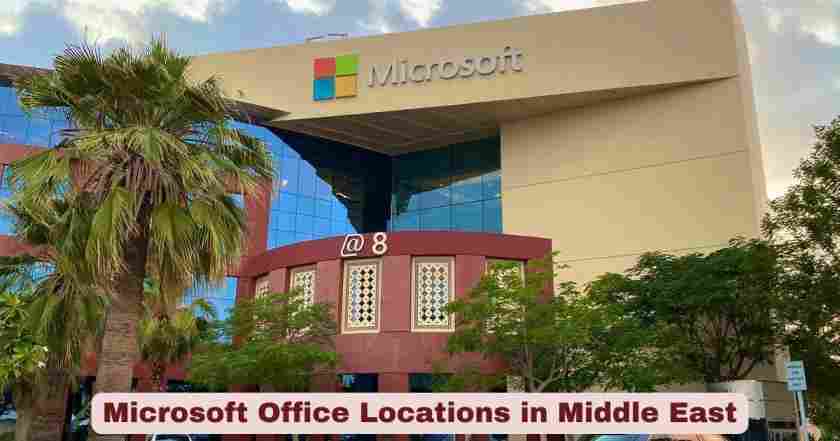
| UAE (Dubai) | Microsoft Gulf FZ LLC | Building No. 8, Dubai Internet City, P.O. Box 52244, Dubai | Gulf regional HQ; supports Bahrain, Kuwait, Oman, Qatar, UAE |
| UAE (Abu Dhabi) | Microsoft Abu Dhabi | Abu Dhabi (specific tower not publicly listed) | AI partnerships, G42 collaboration, government accounts |
| UAE (Abu Dhabi) | Global Engineering Development Center | Abu Dhabi | Engineering talent development; product & service R&D for ME & Africa |
| UAE (Abu Dhabi) | AI for Good Lab | Abu Dhabi | PhD-level AI research; humanitarian AI models for ME & Africa |
| Saudi Arabia (Riyadh) | Microsoft Arabia, Riyadh | The Business Gate, Building A2, Airport Road, Cordobah, P.O. Box 47007, Riyadh 11552 | Saudi Arabia national HQ; enterprise, government, cloud sales |
| Saudi Arabia (Khobar) | Microsoft Arabia, Khobar | Al-Rashed Towers, 12th Floor, King Fahad Road, Bandaria, P.O. Box 2615, Khobar 31952 | Eastern Province commercial office |
| Saudi Arabia (Jeddah) | Microsoft Arabia, Jeddah | Jameel Square, 7th Floor, Office No. 709, Prince Moh’d Bin Abdulaziz St (Tahlia), Andalus, P.O. Box 4133, Jeddah 21491 | Western region commercial office |
| Qatar (Lusail) | Microsoft Qatar | Burj Al Fardan, Lusail City (4th and largest Qatar office) | Qatar national office; cloud, enterprise, government |
| Qatar (Pearl) | Microsoft Qatar (secondary) | Office 1, 4th Floor, Tower 121, Abraj Quartier 2, The Pearl | Secondary Qatar operations |
| Israel (Herzliya) | Microsoft Israel Development Center (ILDC) — HQ | 46,000 sq meter campus, Herzliya Pituach | Primary R&D campus; cybersecurity, AI, cloud engineering |
| Israel (Tel Aviv) | Microsoft Israel — Tel Aviv | Tel Aviv | R&D and sales; Microsoft Ventures (M12) and Microsoft for Startups |
| Israel (Haifa) | Microsoft Israel — Haifa | Haifa | R&D development center (cybersecurity, AI) |
| Israel (Nazareth) | Microsoft Israel — Nazareth | Nazareth | Development center; diversity hiring focus |
| Israel (Ra’anana) | Microsoft Israel — Ra’anana (HQ listed) | 2 HaPnina St., Ra’anana 43107 | Corporate HQ address for Israel |
| Israel (Jerusalem) | Microsoft Israel — Jerusalem | Jerusalem | Development site targeting ultra-Orthodox and Arab talent pools |
| Israel (Beersheba) | Microsoft Israel — Beersheba | Beersheba | Development site (opened for under-represented communities) |
| Jordan (Amman) | Microsoft Jordan | King Hussein Business Park, Building GH3, 2nd Floor, End of Mecca Street, P.O. Box 3321, Amman 11181 | Jordan national office |
| Lebanon (Beirut) | Microsoft Lebanon SARL | Berytus Parks, 4th Floor, French Ave, Mina AlHosn, Solidere, Beirut, P.O. Box 11-1850 | Lebanon office (North Africa, East Med and Pakistan subsidiary) |
| Egypt (Cairo) | Microsoft Egypt | Cairo | Egypt national office — General Manager role active |
| Iraq | Microsoft Iraq | Email: msiraq@microsoft.com | Remote/representative operations |
Source: Microsoft Worldwide Sites (microsoft.com/en-us/worldwide), Microsoft Gulf contact page, Microsoft Israel Careers page, Microsoft MEA News Center, Qatar Moments, Serin.cc
The sheer geographic spread of Microsoft’s office network across the Middle East in 2026 is a testament to how comprehensively the company has structured its regional operations. The Dubai Internet City office functions as the Gulf regional headquarters, providing operational coverage for Bahrain, Kuwait, Oman, Qatar, and the UAE — five countries served from a single hub. This hub-and-spoke model means that Microsoft’s Gulf footprint extends far beyond the countries where it has dedicated offices; a business in Kuwait or Oman accessing Microsoft enterprise services does so through the Dubai-based Microsoft Gulf entity. The company’s decision to establish its Gulf HQ in Dubai Internet City — one of the world’s first purpose-built free zones for technology companies — reflects an early and strategic bet on the UAE that has paid off enormously.
The Saudi Arabia operation, branded as Microsoft Arabia, runs three physical offices that cover the Kingdom’s three most economically significant cities. Riyadh’s Business Gate serves as the national headquarters and primary interface with Saudi government entities including MCIT, SDAIA, the Ministry of Education, and the Public Investment Fund. Khobar’s Al-Rashed Towers office on King Fahad Road anchors Microsoft’s presence in the Eastern Province — critically important given that Saudi Arabia’s new Azure cloud region availability zones are located in precisely this part of the country. Jeddah’s Jameel Square office covers the Red Sea commercial capital and its thriving private sector. Three offices for one country reflects the scale of Microsoft’s Saudi commercial ambitions; very few global technology companies maintain this level of in-country coverage in the Kingdom.
Microsoft UAE Office & Investment Statistics 2026 | Emirates Data
| Metric | Data | Source |
|---|---|---|
| Total Microsoft UAE investment (2023–2029) | $15.2 billion | Microsoft On the Issues, Nov 2025 |
| Microsoft UAE spending: 2023 through end-2025 | $7.3 billion | Microsoft On the Issues, Nov 2025 |
| Of which: AI & cloud data centers capex | $4.6 billion | Microsoft On the Issues, Nov 2025 |
| Of which: equity investment in G42 | $1.5 billion | Microsoft / G42, April 2024 |
| Of which: local operating expenses & COGS | Over $1.2 billion | Microsoft On the Issues, Nov 2025 |
| Microsoft UAE investment plan: 2026–2029 | $7.9 billion | Microsoft On the Issues, Nov 2025 |
| Of which: AI & cloud infrastructure capex (2026–2029) | Over $5.5 billion | Microsoft On the Issues, Nov 2025 |
| Of which: local operating expenses & partnerships (2026–2029) | Almost $2.4 billion | Microsoft On the Issues, Nov 2025 |
| Microsoft + G42 Khazna Data Centers new expansion | 200 MW — coming online before end of 2026 | G42 / Microsoft, Nov 2025 |
| Microsoft Azure UAE cloud region launch | First opened 2019 (three availability zones, Dubai) | Data Center Dynamics |
| Microsoft Azure UAE regions active | 2 — UAE North (Abu Dhabi) and UAE Central (Dubai) | Microsoft Azure |
| GPU export licenses secured (US government) | Equivalent of 60,400 A100 chips (Nvidia GB300 GPUs) — first company to do so | Data Center Dynamics, Mar 2026 |
| AI infrastructure total allocation of $15.2B | Over $10 billion earmarked for cloud and AI data center development | Gulf News, Nov 2025 |
| Local operations, research & partnerships (of $15.2B) | Over $3 billion | Gulf News, Nov 2025 |
| Abu Dhabi Government sovereign cloud deal | Multi-year agreement with Core42 (G42 subsidiary) and Microsoft | UAE Embassy / March 2025 |
| Abu Dhabi Government Digital Strategy 2025–2027 budget | AED 13 billion ($3.54 billion) | UAE Embassy, March 2025 |
| AI-native government target | Abu Dhabi aims to be world’s first fully AI-native government by 2027 | UAE Embassy, March 2025 |
| Microsoft UAE skilling commitment | 1 million people in UAE to be skilled by 2027 | Microsoft / G42, Nov 2025 |
| Global Engineering Development Center | Established 2025 in Abu Dhabi | Microsoft On the Issues, Nov 2025 |
| Responsible AI Future Foundation (RAIFF) | Founded by Microsoft, G42, and MBZUAI in Abu Dhabi, February 2025 | Microsoft Blog |
Source: Microsoft On the Issues (blogs.microsoft.com, Nov 3 2025), G42 press release (Nov 5 2025), Microsoft MEA News Center, UAE Embassy Washington DC (March 2025), Gulf News (Nov 2025), Data Center Dynamics (Mar 2026)
Microsoft’s UAE investment story in 2026 is best understood not as a single commitment but as a layered, multi-dimensional partnership that spans infrastructure, enterprise AI, sovereign government cloud, engineering talent, and AI ethics governance — all simultaneously. The $15.2 billion breaks down with unusual clarity: $4.6 billion already spent on data centers, $1.5 billion directly invested into G42’s equity, and a forward commitment of $5.5 billion more in capital expenditure between 2026 and 2029. The fact that Microsoft secured US government export licenses to ship the equivalent of 60,400 Nvidia A100-equivalent GPUs (in the form of Nvidia’s newer GB300 units) into the UAE — becoming the first company to achieve this — shows how central the UAE has become to Microsoft’s global AI hardware deployment strategy.
The Abu Dhabi sovereign cloud deal, signed in March 2025 between the Abu Dhabi Government, Microsoft, and Core42 (G42’s sovereign cloud subsidiary), is perhaps the most consequential single contract in Microsoft’s UAE history. It commits the Abu Dhabi government to running its entire public sector on Microsoft Azure, mediated through Core42’s sovereign controls platform. Combined with the Global Engineering Development Center in Abu Dhabi — established in 2025 and developing new Microsoft products specifically for the Middle East and Africa — and the AI for Good Lab staffed by PhD-level researchers working on humanitarian AI applications, Microsoft’s UAE office presence in 2026 has evolved into something much more than a sales operation. It is a full-stack technology and engineering presence embedded at the highest levels of the UAE’s national digital agenda.
Microsoft Saudi Arabia Statistics 2026 | Kingdom Data
| Metric | Data | Source |
|---|---|---|
| Microsoft Arabia offices in Saudi Arabia | 3 — Riyadh, Khobar, Jeddah | Microsoft Worldwide Sites |
| Microsoft presence in Saudi Arabia | 25+ years | Microsoft MEA News Center, Dec 2024 |
| Saudi Azure cloud region announced | February 2023, LEAP conference, Riyadh (with MCIT) | Microsoft MEA News Center |
| Saudi Azure cloud region: construction status | Complete — all 3 availability zones built (Eastern Province) | Microsoft MEA News Center, Dec 2024 |
| Saudi Azure cloud region: expected availability | Q4 2026 | Data Center Dynamics, Mar 2026 |
| Azure availability zones: location | Eastern Province, Saudi Arabia | Microsoft MEA News Center |
| Each zone features | Independent power, cooling, and networking infrastructure | Microsoft MEA News Center |
| Initial investment figure cited at LEAP 2023 | $2.1 billion (per Saudi MCIT minister) | Middle East AI News |
| Microsoft skilling target in Saudi Arabia | 3 million people to acquire AI skills by 2030 | Microsoft Source EMEA, Feb 2026 |
| People already trained in AI, cloud and data programs | Over 1 million engaged; 800,000+ completed training | Microsoft Source EMEA, Feb 2026 |
| First Microsoft Datacenter Academy in Middle East | Launched in Saudi Arabia with National IT Academy (NITA) — 2-year program | Microsoft MEA News Center, Feb 2025 |
| Saudi educators trained via Microsoft 365 | Over 109,000 educators | Microsoft Source EMEA, Feb 2026 |
| Saudi government employees trained in one quarter | 1,000 (with Digital Government Authority, DGA) | Microsoft Source EMEA, Feb 2026 |
| AI Global Leadership Program | Equipped 120+ senior Saudi executives (public & private sector) with AI training at Microsoft centers in Amsterdam, Munich, Seattle | Microsoft Source EMEA, Feb 2026 |
| Microsoft AI Academy (with SDAIA) | Offers Azure Professional Certificates; supports national AI capability | Microsoft MEA News Center |
| Centre of Excellence (with MCIT) | Established to advance AI and cloud computing skills nationally | Microsoft MEA News Center |
| Ministry of Education use of Azure | Hosts Madrasati platform for 7 million students and teachers | Data Center Dynamics / Microsoft |
| SDAIA’s ALLaM (Arabic LLM) | Built and trained on Microsoft Azure | Data Center Dynamics / Microsoft |
| Microsoft Arabia President | Turki Badhris | Microsoft MEA News Center |
| Microsoft 365 in schools | Nationwide deployment across Saudi schools and universities | Microsoft Source EMEA, Feb 2026 |
Source: Microsoft MEA News Center, Microsoft Source EMEA (Feb 11 2026), Microsoft Worldwide Sites, Data Center Dynamics, Middle East AI News
Microsoft Arabia’s three-office presence across Saudi Arabia represents a commercial and infrastructure commitment that goes back more than 25 years — longer than almost any other global tech company in the Kingdom. But the pace of acceleration in 2025–2026 has no historical parallel. The LEAP 2023 announcement of a dedicated Azure cloud region was the first public signal that Microsoft was moving from sales offices to sovereign infrastructure, and by December 2024 that commitment had been physically delivered: all three availability zones in the Eastern Province are built and ready, awaiting the Q4 2026 go-live. The initial $2.1 billion investment figure cited by the Saudi MCIT minister at the announcement understates the total commitment, which includes the broader AI skilling ecosystem being built in parallel with the hardware infrastructure.
The 3 million AI skills target by 2030 — backed by a landmark partnership with MCIT, an already-delivered base of 800,000+ trained Saudis, and the first Microsoft Datacenter Academy in the Middle East — is Microsoft’s recognition that building cloud infrastructure without the local talent to use it would be strategically shortsighted. The 109,000 educators trained via Microsoft 365, the Madrasati platform powering learning for 7 million students and teachers, and the ALLaM Arabic LLM trained on Azure infrastructure all demonstrate that Microsoft’s Saudi Arabia presence in 2026 has become structurally embedded in the country’s educational and government systems — not just its enterprise IT departments. For Saudi Vision 2030, Microsoft is not merely a vendor; it is a co-architect of the Kingdom’s digital future.
Microsoft Israel R&D Center 2026 | ILDC Statistics & Office Data
| Metric | Data | Source |
|---|---|---|
| Microsoft Israel Development Center (ILDC) founded | 1991 — first Microsoft R&D center outside the US | Times of Israel |
| Current Israel office locations | Herzliya, Tel Aviv, Haifa, Nazareth (+ Jerusalem and Beersheba expansion) | Microsoft Israel Careers page |
| Herzliya campus size | 46,000 square meters (495,000 sq ft) — opened November 2020 | Times of Israel |
| Herzliya campus cost | Estimated NIS 350 million (~$105 million) | Times of Israel |
| Israel employee count (end-2020 baseline) | Approx. 2,300 — 2,000 in R&D, 300 in sales & marketing | Times of Israel |
| Microsoft Israel R&D target workforce | Over 4,500 people (plan to add 2,500+ engineers) | Times of Israel / JNS |
| New sites planned (announced 2021) | 5 new sites — Tel Aviv (2nd), Herzliya (expansion), Jerusalem, Beersheba, + 1 TBD | Times of Israel |
| Tel Aviv 2nd site | Houses over 1,000 employees on 25,000 sq meter grounds | Times of Israel |
| Herzliya expansion | Additional 17,000 sq meters for 1,000 more employees | Times of Israel |
| Jerusalem & Beersheba sites | Targeting under-represented sectors — ultra-Orthodox Jews and Israeli Arabs | Times of Israel |
| Microsoft Israel D&B ranking (2025) | #2 best tech firm to work for in Israel | Dun & Bradstreet 2025 ranking |
| Top D&B ranking companies (total employees) | D&B top 50 tech firms in Israel employ over 47,000 people | Times of Israel, Oct 2025 |
| ILDC designation | One of Microsoft’s three strategic global R&D centers (alongside Silicon Valley and Boston) | Microsoft Israel R&D Center |
| Key R&D domains in Israel | Cybersecurity, AI, cloud, big data, healthcare AI, vision-language models, autonomous systems | Microsoft Israel Careers |
| Microsoft Ventures (M12) — Israel | Operates from Tel Aviv offices; invests in Israeli tech startups | Microsoft Israel Careers |
| Microsoft for Startups — Israel | Branch operating from Tel Aviv; collaborates with local ecosystem | Microsoft Israel Careers |
| Microsoft Israel: R&D classification | Among tech giant’s biggest global R&D operations | Times of Israel |
Source: Microsoft Israel Careers page (careers.microsoft.com), Times of Israel (Oct 2021, Oct 2025), JNS, Microsoft Israel R&D Center website (microsoftrnd.co.il), Dun & Bradstreet 2025 ranking
Microsoft’s Israel Development Center (ILDC) is in a class entirely apart from the company’s other Middle East offices. Founded in 1991 as the first Microsoft R&D center outside the United States, it predates the Gulf offices by decades and has grown into one of the most technically influential engineering operations Microsoft runs anywhere in the world. The 46,000-square-meter Herzliya campus, which cost an estimated $105 million and opened in November 2020, anchors an R&D network spanning Herzliya, Tel Aviv, Haifa, Nazareth, Jerusalem, and Beersheba — six cities across the country, reflecting Microsoft’s commitment to accessing talent from all segments of Israel’s highly educated population. The plan to grow the Israeli R&D workforce from 2,300 to over 4,500 — more than doubling it — signals that Israel remains Microsoft’s most technically strategic location in the entire broader Middle East region.
The domains being developed at ILDC read like a roadmap of Microsoft’s highest-priority product bets globally: cybersecurity, AI, cloud engineering, big data, healthcare AI, vision-language models, and autonomous systems. The fact that Microsoft Israel ranked #2 in Dun & Bradstreet’s 2025 survey of the best high-tech employers in Israel — the first such ranking conducted during wartime conditions — speaks to the organizational culture that has been built there over more than three decades. The Microsoft Ventures (M12) and Microsoft for Startups branches operating out of Tel Aviv further embed the company into Israel’s vibrant startup ecosystem, ensuring a continuous pipeline of innovation and acquisition targets. In 2026, ILDC remains the intellectual engine of Microsoft’s Middle East presence — even as the Gulf offices are becoming the commercial and infrastructure backbone.
Microsoft Qatar & Other Middle East Office Statistics 2026 | GCC & Levant Data
| Country / Office | Key Details | Notable Facts | Source |
|---|---|---|---|
| Qatar — Lusail City (Primary) | Burj Al Fardan, Lusail City — 4th and largest Microsoft Qatar office | Opened June 2022; Microsoft’s largest Qatar facility | Microsoft MEA News Center |
| Qatar — The Pearl | Office 1, 4th Floor, Tower 121, Abraj Quartier 2, The Pearl | Secondary Qatar presence | Serin.cc |
| Qatar — Azure Cloud Region | Microsoft Cloud Datacenter Region (Qatar Central) | Active Azure region covering Qatar | Microsoft Azure |
| Qatar General Manager | Ahmad El Dandachi (appointed 2025) | Lana Khalaf moved to MEA Public Sector role | Microsoft MEA News Center |
| Qatar partnerships | Qatar government, Ministry of Communications and IT | Microsoft AI Tour held in Qatar 2025 | Microsoft MEA News Center |
| Jordan — Amman | King Hussein Business Park, Building GH3, 2nd Floor | National office covering Jordan | Microsoft Worldwide Sites |
| Lebanon — Beirut | Berytus Parks, 4th Floor, French Ave, Mina AlHosn, Solidere | Part of North Africa, East Med and Pakistan subsidiary | Microsoft Worldwide Sites |
| Egypt — Cairo | Cairo national office | Mirna Arif transitioned to MEA Growth Markets GM role (July 2025); new Egypt GM to be appointed | Microsoft MEA News Center |
| Iraq | Email-based representative presence (msiraq@microsoft.com) | No physical office listed | Microsoft Worldwide Sites |
| Gulf Region (Dubai-served) | Microsoft Gulf FZ LLC, Dubai Internet City | Serves: Bahrain, Kuwait, Oman, Qatar, UAE | Microsoft Worldwide Sites |
| Microsoft MEA President | Naim Yazbeck (promoted to President, Middle East and Africa) | Oversees entire MEA region | Microsoft MEA News Center |
| Microsoft CEMA VP (Middle East + Africa) | Samer Abu-Ltaif, Corporate VP & President, Central and Eastern Europe, MEA | Regional executive overseeing UAE G42 investment | Microsoft G42 press release |
Source: Microsoft Worldwide Sites, Microsoft MEA News Center, Serin.cc, Microsoft Azure global infrastructure
Qatar holds a special place in Microsoft’s Middle East network for two reasons: the presence of an active Azure cloud region (Qatar Central), and the opening in June 2022 of what became Microsoft’s fourth and largest Qatar office — the Lusail City facility at Burj Al Fardan. The choice of Lusail City as the location was deliberate; this purpose-built urban development north of Doha was Qatar’s showcase for the FIFA World Cup 2022 and represents the country’s ambition to create a modern, internationally credible business hub. Microsoft’s decision to anchor its largest Qatar facility there sends a strong signal of confidence in Qatar’s Vision 2030 digital ambitions and its growing role as a regional cloud and data center market. The Qatar Central Azure region ensures that Qatari organizations — particularly regulated industries like finance and government — can keep their data within national borders while accessing the full Microsoft cloud stack.
Beyond Qatar, Microsoft’s Levant and North Africa network — covering Jordan, Lebanon, and Egypt — represents the connective tissue between the Gulf’s high-investment markets and the broader Arab world. The Jordan office in Amman’s King Hussein Business Park serves a market that has become increasingly important as a technology hub in its own right, with a growing startup ecosystem and government digitization agenda. The Egypt office in Cairo covers one of the Arab world’s largest IT markets, with Microsoft having maintained a continuous national presence there for years; the July 2025 leadership transition — with Mirna Arif moving from Egypt GM to a broader MEA Growth Markets role — reflects the significance Microsoft places on this geography. Across all of these countries, the Dubai-based Microsoft Gulf FZ LLC and the overall MEA regional leadership under President Naim Yazbeck provide the organizational architecture that coordinates Microsoft’s multi-country strategy from a single regional command structure.
Disclaimer: The data research report we present here is based on information found from various sources. We are not liable for any financial loss, errors, or damages of any kind that may result from the use of the information herein. We acknowledge that though we try to report accurately, we cannot verify the absolute facts of everything that has been represented.