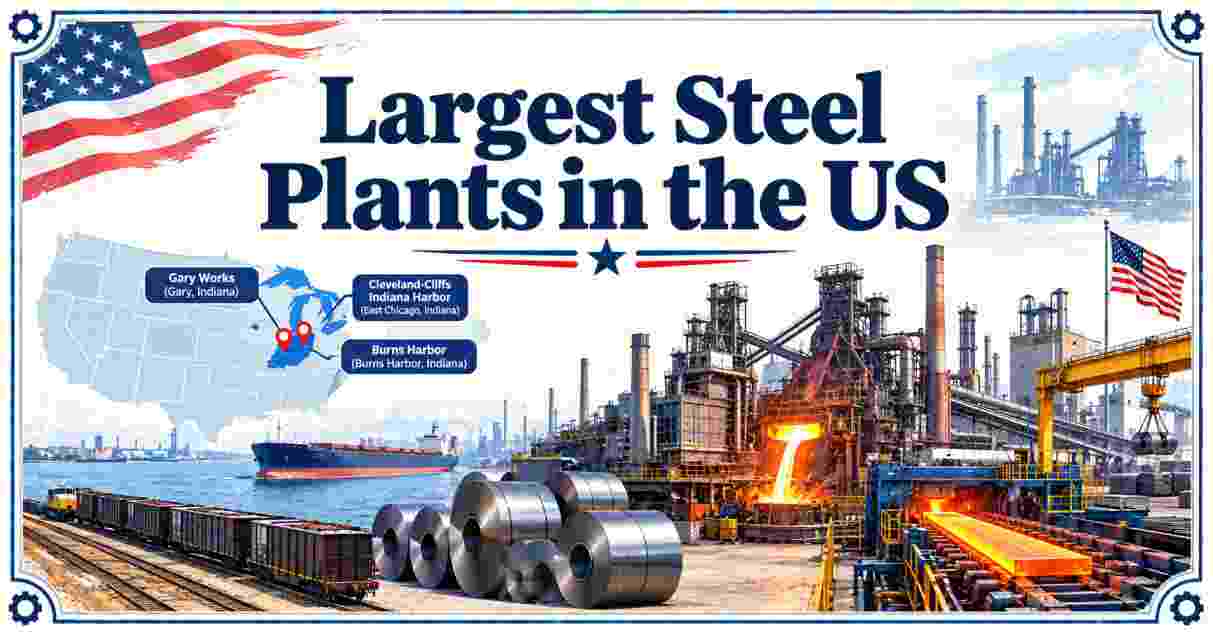
Indiana Harbor Works in East Chicago, Indiana, owned by Cleveland-Cliffs, is the largest integrated steel complex in the United States, with capacity to produce roughly 9.5 million tons of steel annually. Nucor remains America’s largest steel producer overall by tonnage, operating more than 26 mills with combined capacity exceeding 27 million tons.
Steel Plants in the US 2026 – Introduction
The steel plants in the US in 2026 sit overwhelmingly along the industrial shoreline of Lake Michigan in northwest Indiana, where three of the country’s biggest integrated mills, Indiana Harbor Works, Gary Works, and Burns Harbor, operate within roughly 30 miles of one another. This concentration reflects more than a century of steelmaking history in the region, and it takes on fresh significance in 2026 following the completion of Nippon Steel’s $14.1 billion acquisition of US Steel in June 2025, a deal that brought Gary Works, the second-largest plant in the country, under Japanese ownership for the first time while keeping the company’s headquarters and name in Pittsburgh.
This report breaks down the largest steel plants in the US in 2026 across every dimension: the biggest steel companies by production capacity, the specific mega-plants that anchor American steelmaking, the Nippon-US Steel deal reshaping the industry’s ownership structure, state-by-state production concentration, and how the current wave of Section 232 tariffs is reshaping import competition for these domestic producers. Understanding this landscape matters given steel’s foundational role in construction, automotive manufacturing, and the broader industrial base the current administration has prioritized protecting through aggressive trade policy.
Interesting Facts About the Largest Steel Plants in the US in 2026
| Statistic | 2026 Data |
|---|---|
| Largest Single Steel Plant | Indiana Harbor Works (Cleveland-Cliffs), ~9.5 million tons/year |
| Largest US Steel Company by Tonnage | Nucor, 27+ million tons capacity |
| Nucor’s Number of Steel Mills | 26+ EAF-based mills |
| Second-Largest US Steel Company | Cleveland-Cliffs, ~23 million tons capacity |
| Gary Works Annual Capacity | 7.5-7.8 million tons |
| Nippon Steel’s US Steel Acquisition Value | $14.1 billion ($14.9B incl. debt) |
| Nippon’s Committed US Investment Through 2028 | $11 billion |
| Combined Nippon/US Steel Global Capacity | 86 million tons (4th-largest producer worldwide) |
| Steel Dynamics’ Total US Capacity | ~13 million tons (3rd-largest US-owned producer) |
| US Total Crude Steel Production (2024) | 79+ million net tons |
| Current Section 232 Steel Tariff Rate | 50%, effective June 4, 2025 |
Data Source: Company SEC Filings, US Geological Survey, Global Energy Monitor, American Iron and Steel Institute
The numbers above reveal an industry where a small handful of companies and an even smaller cluster of individual plants dominate national output. Nucor remains America’s largest steel producer by sheer tonnage, operating more than 26 electric arc furnace-based mills with combined capacity exceeding 27 million tons annually, while Cleveland-Cliffs holds the title of largest flat-rolled steel producer in North America with roughly 23 million tons of capacity concentrated in fewer, larger integrated facilities. Yet neither company owns the single biggest plant in the country: that distinction belongs to Indiana Harbor Works, Cleveland-Cliffs’ massive East Chicago, Indiana complex, capable of producing approximately 9.5 million tons of steel per year on its own.
The industry’s ownership structure shifted dramatically in 2026 following the finalized Nippon Steel acquisition of US Steel, a $14.1 billion transaction that brought America’s most historically significant steelmaker, founded by Andrew Carnegie in 1901, under foreign ownership for the first time in its 125-year history. That deal came with a $11 billion investment commitment through 2028, the largest single chunk of which, $3.1 billion, is earmarked specifically for upgrading Gary Works, US Steel’s flagship Indiana plant and the second-largest integrated steel facility in the country at 7.5 to 7.8 million tons of annual capacity.
The Largest Steel Companies in the US 2026
Top US Steel Companies by Annual Production Capacity
Nucor               |████████████████████████████████████████ 27+ million tons
Cleveland-Cliffs    |██████████████████████████████████ 23 million tons
Steel Dynamics      |████████████████████ 13 million tons
US Steel (Nippon)   |███████████████████ ~12-15 million tons (US operations)
| Company | Annual US Capacity | Headquarters | Ownership |
|---|---|---|---|
| Nucor Corporation | 27+ million tons | Charlotte, North Carolina | Publicly traded, US-owned |
| Cleveland-Cliffs Inc. | ~23 million tons | Cleveland, Ohio | Publicly traded, US-owned |
| Steel Dynamics Inc. | ~13 million tons | Fort Wayne, Indiana | Publicly traded, US-owned |
| United States Steel Corp. | ~12-15 million tons (domestic) | Pittsburgh, Pennsylvania | Subsidiary of Nippon Steel (Japan) |
Data Source: Company Annual Reports, LinkedIn Corporate Profiles, Wikipedia
America’s steel industry has consolidated around four dominant producers that together account for the overwhelming majority of domestic capacity. Nucor, headquartered in Charlotte, North Carolina, holds the top spot by tonnage, running a network of more than 26 mini-mills that primarily melt recycled scrap steel using electric arc furnace technology, a more flexible and generally lower-emission approach than the traditional blast-furnace method. The company employs more than 31,000 people across its full network of over 300 facilities spanning steel production, finishing, and downstream products.
Cleveland-Cliffs, by contrast, built its roughly 23 million tons of capacity primarily through the traditional integrated steelmaking process, using blast furnaces fed by its own mined iron ore, making it the largest flat-rolled steel producer in North America and the dominant supplier to the automotive industry. Steel Dynamics, the third major US-owned producer at roughly 13 million tons, built much of its recent growth around its flagship Sinton, Texas facility, a modern electric arc furnace plant that began production in 2021 following a $1.9 billion investment. United States Steel, now operating as a subsidiary of Japan’s Nippon Steel following the 2025 acquisition, rounds out the top tier while retaining its historic Pittsburgh headquarters and brand name under the terms of the deal.
The Nippon Steel-US Steel Acquisition 2026 | A Structural Shift
| Detail | Information |
|---|---|
| Acquisition Value | $14.1 billion cash, $14.9B including debt |
| Deal Finalized | June 18, 2025 |
| Total Committed US Investment | $11 billion through 2028 |
| Largest Single Project | $3.1 billion, Gary Works, Indiana |
| New Mini-Mill Commitment | $1 billion, location undecided |
| Combined Global Capacity | 86 million tons (4th-largest steel producer worldwide) |
| Jobs Pledge | Protect and create 100,000 jobs |
Data Source: Manufacturing Dive, Nippon Steel Press Releases, Gary Mayor’s Office
The Nippon Steel acquisition of US Steel, finalized on June 18, 2025, ranks among the most consequential ownership changes in the history of American heavy industry, valued at approximately $14.1 billion in cash, or nearly $14.9 billion once assumed debt is included. The Japanese steelmaker’s $11 billion investment commitment through 2028 spans projects across five states: a new research and development center in Pennsylvania, a pipe and tube mill in Alabama, an electric arc furnace mini-mill in Arkansas, an expanded direct-reduced-iron pellet plant in Minnesota, and upgrades to blast furnace mills in both Indiana and Pennsylvania, with a pledge to protect and create 100,000 jobs across these operations.
The single largest piece of that investment, $3.1 billion, targets Gary Works specifically, including a $350 million project to fully reline Blast Furnace No. 14, the largest of the plant’s four operating furnaces, extending its operational life by up to 20 years, alongside a separate $200 million upgrade to the plant’s hot strip mill aimed at expanding premium product offerings like heavy-gauge line pipe and automotive steel. A separate $1 billion commitment will fund an entirely new mini-mill at a location still to be determined. Community reaction in Gary has been notably positive, with the city’s mayor publicly crediting the deal with securing thousands of union steelworker jobs that many feared were at risk before Nippon’s offer, nearly double what rival Cleveland-Cliffs had proposed months earlier, ultimately won out.
Indiana Harbor Works | The Largest Single Steel Plant 2026
| Metric | Value |
|---|---|
| Plant Name | Indiana Harbor Works |
| Owner | Cleveland-Cliffs |
| Location | East Chicago, Indiana |
| Annual Capacity | ~9.5 million tons |
| Blast Furnaces | 5 |
| Basic Oxygen Furnaces | 6 |
| Largest Furnace (No. 7) Capacity | 4,163 cubic meters, largest in US |
Data Source: Center for Land Use Interpretation, Cleveland-Cliffs Facility Fact Sheets
Indiana Harbor Works, located in East Chicago, Indiana, just 20 miles southeast of Chicago, stands as the single largest integrated steel plant in the United States, with the capacity to produce roughly 9.5 million tons of steel annually. The complex traces its origins to two historically separate operations, now known as the East Works and West Works, with the East Works dating back to Inland Steel’s founding of the site in 1901. At its historical peak in 1978, the site’s capacity reached 8.6 million tons, and the complex now operates five blast furnaces and six basic oxygen furnaces, including Blast Furnace No. 7, whose 4,163 cubic meter capacity makes it the largest blast furnace currently operating anywhere in the United States.
Cleveland-Cliffs acquired Indiana Harbor as part of its 2020 purchase of ArcelorMittal USA, a transaction that added roughly 20.3 million tons of annual capacity to the company’s portfolio in a single deal and included both Indiana Harbor and the nearby Burns Harbor plant. The facility produces a full range of flat-rolled steel products, with particular strength in advanced high-strength steel, API pipe skelp for the energy industry, and automotive-grade sheet products, cementing its role as a critical supplier to the automotive manufacturers concentrated throughout the Midwest.
Gary Works | US Steel’s Flagship Plant 2026
Gary Works Timeline and Scale
Construction Began       |█ 1906
Began Operations         |███ 1908
Current Capacity         |███████████████████████ 7.5-7.8 million tons/year
Current Employment       |████████████████████████ ~4,000 people
| Metric | Value |
|---|---|
| Plant Name | Gary Works |
| Owner | United States Steel Corporation (Nippon Steel subsidiary) |
| Location | Gary, Indiana |
| Annual Capacity | 7.5-7.8 million tons |
| Operating Blast Furnaces | 4 |
| Current Employment | ~4,000 |
| Year Operations Began | 1908 |
Data Source: Global Energy Monitor, Center for Land Use Interpretation, Northwest Indiana Business Magazine
Gary Works, situated on the south shore of Lake Michigan in Gary, Indiana, ranks as US Steel’s largest manufacturing plant and the second-largest integrated steel facility in the country, with a steelmaking capability of 7.5 to 7.8 million tons annually. Construction began in 1906 and the plant began operations in 1908, and for decades afterward it stood as the largest steel mill on Earth, at one point in the late 1930s outproducing the entirety of Germany. Employment has fallen dramatically from its 1970 peak of 30,000 workers to roughly 4,000 today, reflecting the broader automation and consolidation that has reshaped American integrated steelmaking over the past half-century.
The plant currently operates four blast furnaces, and under Nippon Steel’s new ownership, the largest, Blast Furnace No. 14, is scheduled to undergo a $350 million relining beginning in 2026, a project expected to extend the unit’s operational life by up to two decades. Community and environmental groups have pushed back on this specific investment, arguing that reinforcing an aging coal-fueled blast furnace represents a missed opportunity to build lower-emission steelmaking capacity at a moment when major automakers and other large steel buyers are increasingly signaling demand for greener production methods, a tension that captures the broader debate facing legacy American steel plants as they modernize under new ownership.
Other Major Steel Plants by Production Capacity 2026
Additional Major US Steel Plants (Annual Capacity, Million Tons)
Burns Harbor (Cleveland-Cliffs, IN)  |██████████████████████████████ 5.0M
Steel Dynamics Sinton (TX)           |██████████████████ ~3.0M (flagship EAF)
| Plant | Owner | Location | Capacity |
|---|---|---|---|
| Burns Harbor | Cleveland-Cliffs | Portage, Indiana | 5.0 million tons |
| Steel Dynamics Sinton | Steel Dynamics | Sinton, Texas | ~3 million tons (flagship EAF plant) |
| Big River Steel | US Steel (Nippon) | Osceola, Arkansas | Modern EAF, expanding |
Data Source: EPA Facility Records, Global Energy Monitor, Company Fact Sheets
Beyond the two largest single facilities, several other plants round out America’s major steelmaking footprint. Burns Harbor, also owned by Cleveland-Cliffs and located in Portage, Indiana, ranks as the company’s second-largest US facility with capacity to produce 5 million net tons of raw steel annually, operating two blast furnaces and housing what industry sources describe as the largest wide-plate rolling mill currently operating anywhere in the world, a 160-inch plate mill originally built by Bethlehem Steel when the plant opened in 1964.
Steel Dynamics’ Sinton, Texas facility represents the newest major addition to America’s steel plant landscape, having commenced production in 2020 following a roughly $1.9 billion investment, and it exemplifies the industry’s broader shift toward electric arc furnace technology over traditional blast-furnace integrated production. Similarly, US Steel’s Big River Steel in Osceola, Arkansas, acquired in 2019 and now benefiting from Nippon Steel’s capital backing, represents the modern EAF-based mini-mill model increasingly favored for new capacity additions, contrasting with the century-old blast-furnace complexes that still anchor the industry’s total tonnage in northwest Indiana.
Steel Plant Locations by State 2026
Steel Production Capacity Concentration by State
Indiana              |████████████████████████████████████████ Dominant (Gary, Indiana Harbor, Burns Harbor)
Pennsylvania         |████████████████ Significant (Mon Valley Works, Edgar Thomson)
Ohio                 |████████████ Significant (Cleveland-Cliffs coke/coal operations)
| State | Major Facilities |
|---|---|
| Indiana | Gary Works, Indiana Harbor Works, Burns Harbor |
| Pennsylvania | Mon Valley Works (Edgar Thomson, Irvin Plant) |
| Ohio | Cleveland-Cliffs coke-making, corporate headquarters |
| Texas | Steel Dynamics Sinton |
| Arkansas | Big River Steel (US Steel/Nippon) |
Data Source: Company Facility Records, US Steel Corporate Filings
Indiana stands unmatched as the center of gravity for American steel production, hosting three of the country’s largest integrated plants, Gary Works, Indiana Harbor Works, and Burns Harbor, all situated within a roughly 30-mile stretch along Lake Michigan’s southern shore. Combined, these three facilities alone represent well over 20 million tons of annual steelmaking capacity, a concentration so significant that this single Indiana lakeshore region, together with the broader Chicago-area steel corridor, has historically produced roughly 25% of all steel made in the United States.
Pennsylvania ranks as the next most significant steelmaking state, anchored by US Steel’s Mon Valley Works, which includes the Edgar Thomson Steel Works in North Braddock and the Irvin finishing plant, both benefiting from Nippon Steel’s broader modernization investment alongside Gary Works. Ohio carries outsized importance despite hosting fewer primary steelmaking furnaces, since Cleveland-Cliffs’ corporate headquarters and several of its coke-making operations, essential inputs for blast-furnace steelmaking, are located there. Newer capacity has increasingly landed in the South, with Texas and Arkansas hosting modern electric arc furnace facilities from Steel Dynamics and US Steel respectively, reflecting the industry’s gradual geographic diversification away from its traditional Rust Belt core even as that core retains the largest absolute tonnage.
US Steel Tariffs and Import Impact on Domestic Plants 2026
Section 232 Steel Tariff Escalation, 2018-2026
2018 Original Rate      |███████████████ 25%
March 2025              |███████████████ 25% (universal, exemptions removed)
June 2026 (Current)     |██████████████████████████████ 50%
| Metric | Value |
|---|---|
| Current Section 232 Steel Tariff Rate | 50%, effective June 4, 2025 |
| Original 2018 Rate | 25% |
| US Average Effective Tariff Rate | 15.6-15.8%, highest since 1936-37 |
| Total 2025 Steel Imports | 32.5 million tons, +2.5% |
| Finished Steel Import Decline (Projected) | -15% to -35% |
The 50% Section 232 steel tariff, in effect since June 4, 2025, directly shapes the competitive environment for every plant profiled in this report, detailed extensively in the United States Steel Tariffs report. That rate represents a doubling from the 25% tariff first imposed back in 2018, and it arrived alongside the elimination of virtually every country-specific exemption that previously allowed close allies preferential access to the American steel market. The policy has pushed the US average effective tariff rate to roughly 15.6% to 15.8%, the highest level since the mid-1930s, a shift economists estimate adds as much as $50 billion annually in additional import costs across the broader economy.
For domestic plants like Indiana Harbor Works, Gary Works, and Burns Harbor, this tariff wall functions as direct price protection against lower-cost foreign steel, with total US steel imports still reaching 32.5 million tons in 2025 despite the elevated barriers, even as finished steel product imports specifically faced projected declines ranging from 15% to 35% depending on the specific product category. Domestic steel production has responded with an estimated 8% capacity utilization increase in the immediate aftermath of the tariff hike, with projections suggesting a further 15% to 20% increase over the following eighteen months as domestic mills work to fill the gap left by reduced import competition.
Steel Industry Trade and Import Sources 2026
Top Steel-Importing Companies to the US, 2024 ($ Billions)
Nucor Corporation     |████████████████████████████████████████ $3.2B
ArcelorMittal USA     |███████████████████████████████████ $2.8B
Steel Dynamics        |██████████████████████████ $2.1B
United States Steel   |███████████████████████ $1.9B
Cleveland-Cliffs      |████████████ $0.95B
| Company | 2024 Steel Import Value | Headquarters |
|---|---|---|
| Nucor Corporation | $3.2 billion | Charlotte, NC |
| ArcelorMittal USA | $2.8 billion | Chicago, IL |
| Steel Dynamics Inc. | $2.1 billion | Fort Wayne, IN |
| United States Steel | $1.9 billion | Pittsburgh, PA |
| Cleveland-Cliffs | $950 million | Cleveland, OH |
Notably, several of the same companies operating America’s largest domestic steel plants also rank among the country’s largest steel importers, a seemingly counterintuitive pattern detailed in the US Steel and Aluminum Tariffs report. Nucor topped 2024’s import rankings at $3.2 billion, followed by ArcelorMittal USA at $2.8 billion, Steel Dynamics at $2.1 billion, and US Steel at $1.9 billion, reflecting how even the largest domestic producers import specific steel grades, semi-finished slabs, and specialty products that either aren’t cost-effective to produce domestically or fill temporary capacity gaps at specific finishing facilities.
Canada remains by far the largest single source of these imports, supplying roughly a quarter of all US steel import value in recent years, followed by Mexico and Brazil, with the top three countries together accounting for more than 45% of total import value even after the 2025 tariff escalation eliminated the preferential access these North American neighbors had enjoyed under prior trade arrangements. This dynamic illustrates that even fully domesticated, historically self-sufficient companies like Nucor and Cleveland-Cliffs still rely on a globally integrated supply chain for certain inputs, meaning the 50% tariff wall raises costs across the entire industry, including for the same companies it’s designed to protect, not just for their foreign competitors.
US-Japan Steel Trade Context 2026
US-Japan Steel Trade Framework, 2025-2026
General Japanese Tariff Rate    |███████████████ 15%
Japan Steel TRQ (Quota System)  |████████████████████████████████████████ Variable, CBP-Monitored
| Metric | Value |
|---|---|
| General US Tariff on Japanese Goods | 15%, effective July 23, 2025 |
| Japan Steel Tariff Rate Quota System | CBP-monitored, periodically updated |
| Japan’s Total 2024 Exports to US | $141.52 billion |
| Nippon Steel’s Role | Now owns/operates Gary Works via US Steel |
The broader US-Japan trade relationship, detailed in the US Tariffs on Japan report, adds an important layer of context to Gary Works’ new ownership under Nippon Steel. While Japanese goods generally face a 15% tariff under the framework agreement reached in July 2025, steel imports from Japan specifically move through a separate Tariff Rate Quota system administered by US Customs and Border Protection, a quota-based mechanism distinct from the blanket Section 232 rate applied to most other countries’ steel exports.
This arrangement creates a genuinely unusual dynamic: Nippon Steel, a company whose finished steel exports to the US are subject to this quota framework, now simultaneously owns and operates one of the largest steel plants inside the United States through its US Steel subsidiary, meaning the same company sits on both sides of America’s steel trade policy, as both a quota-limited exporter and a tariff-protected domestic producer. How this dual position evolves, particularly whether Nippon shifts additional production capacity toward its now-domestic Gary Works and Big River Steel operations rather than exporting finished steel from Japan directly, will likely shape the next phase of US-Japan steel trade relations through the remainder of the decade.
Largest Steel Plants in the US 2026 – Frequently Asked Questions
What is the largest steel plant in the United States? Indiana Harbor Works, owned by Cleveland-Cliffs and located in East Chicago, Indiana, is the largest integrated steel plant in the US, with capacity to produce roughly 9.5 million tons annually.
Which company is the largest steel producer in the US? Nucor Corporation is the largest US steel producer by tonnage, operating more than 26 mills with combined capacity exceeding 27 million tons.
Who owns US Steel now? US Steel became a subsidiary of Nippon Steel Corporation of Japan following a $14.1 billion acquisition finalized in June 2025, though it retains its Pittsburgh headquarters and name.
What is Gary Works and how big is it? Gary Works is US Steel’s flagship plant in Gary, Indiana, with a steelmaking capability of 7.5 to 7.8 million tons annually, making it the second-largest integrated steel plant in the country.
How much is Nippon Steel investing in US Steel plants? Nippon Steel has committed $11 billion in US investments through 2028, with the largest single project, $3.1 billion, directed toward Gary Works in Indiana.
Which state has the most steel production capacity? Indiana dominates US steel production, hosting three of the country’s largest plants, Gary Works, Indiana Harbor Works, and Burns Harbor, within roughly 30 miles of each other.
What is the current tariff rate on imported steel? The Section 232 steel tariff stands at 50%, effective since June 4, 2025, doubled from the original 25% rate first imposed in 2018.
How many steel mills does Nucor operate? Nucor operates more than 26 electric arc furnace-based steel mills, part of a broader network of over 300 total facilities.
What is Steel Dynamics’ largest plant? Steel Dynamics’ flagship facility is its Sinton, Texas plant, a modern electric arc furnace mill that began production in 2020 following a roughly $1.9 billion investment.
Do major US steel companies still import steel despite tariffs? Yes. Even the largest domestic producers, including Nucor, US Steel, and Cleveland-Cliffs, import specific steel grades and semi-finished products, with Nucor alone importing $3.2 billion worth in 2024.
Disclaimer: The data research report we present here is based on information found from various sources. We are not liable for any financial loss, errors, or damages of any kind that may result from the use of the information herein. We acknowledge that though we try to report accurately, we cannot verify the absolute facts of everything that has been represented.