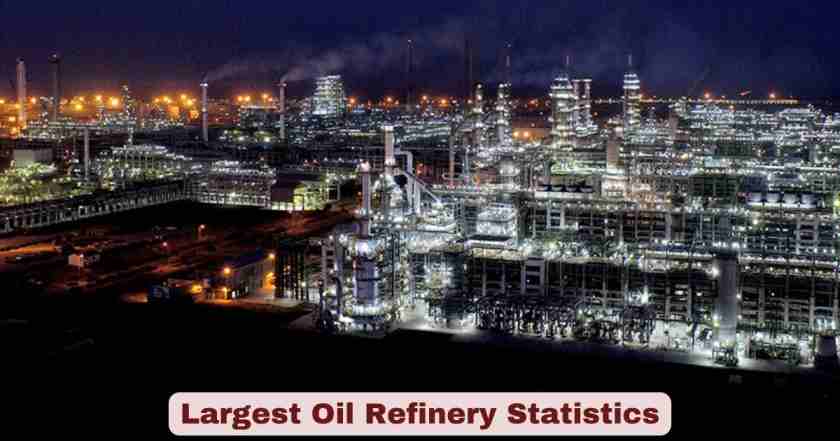
Largest Oil Refinery in the World 2026
When people talk about the backbone of the global energy supply, oil refineries are almost always at the center of the conversation — and the biggest among them are nothing short of industrial civilizations unto themselves. An oil refinery is a processing facility that transforms raw crude oil into usable petroleum products: gasoline, diesel, aviation fuel, liquefied petroleum gas (LPG), lubricants, petrochemical feedstocks, and more. The process involves three core stages — separation (distillation), conversion (cracking and reforming), and treatment (removing sulfur, contaminants, and impurities) — and the scale at which the world’s largest refineries execute all three simultaneously is staggering. As of March 2026, the title of world’s largest oil refinery still belongs to the Jamnagar Refinery Complex in Gujarat, India, operated by Reliance Industries Limited, with a processing capacity of 1.24 million barrels per day (bpd) — accounting for approximately 1.6% of the entire world’s refining capacity. Close behind are the massive complexes of South Korea, Venezuela, the United States, and Nigeria’s transformative Dangote Refinery, which in February 2026 achieved its full nameplate capacity of 650,000 bpd for the very first time, sending shockwaves through global refined product markets.
The global refinery landscape in 2026 is undergoing one of its most consequential periods of reshaping in decades. Global refinery crude throughput reached an all-time high of 86.3 million barrels per day in December 2025, according to the IEA’s February 2026 Oil Market Report, before declining slightly to 85.7 mb/d in January 2026 due to seasonal maintenance cycles. At the same time, the United States — the country with the most individual refineries on earth — recorded a total operable atmospheric distillation capacity of 18.4 million barrels per calendar day as of January 1, 2025, according to the U.S. Energy Information Administration (EIA), essentially flat year-over-year as the industry digests capacity closures in Los Angeles and Houston alongside efficiency gains at Gulf Coast mega-refineries. In this shifting environment, the five largest oil refineries on earth continue to function as the invisible infrastructure that keeps global economies moving — and in 2026, their operational stories are more consequential than ever.
Largest Oil Refinery Interesting Key Facts 2026
| Fact Category | Key Fact / Data Point |
|---|---|
| World’s Largest Single Refinery | Jamnagar, India — Reliance Industries — 1.24 million bpd (1,240,000 barrels per day) |
| Jamnagar Site Area | 7,500 acres (larger than many cities) |
| Jamnagar’s Share of Global Capacity | Approximately 1.6% of total world refining capacity |
| Jamnagar’s Share of India’s Oil Needs | Supplies over 30% of India’s total refined oil consumption |
| Year Jamnagar First Commissioned | July 1999 — completed by Bechtel, becoming the world’s largest petrochemical complex built from greenfield |
| Largest Refinery in Africa | Dangote Refinery, Lekki, Lagos, Nigeria — 650,000 bpd nameplate — reached full capacity February 11, 2026 |
| Dangote Investment Cost | $20 billion+ — largest single-train refinery ever built |
| Dangote Site Area | 6,180 acres (2,500 hectares) at the Lekki Free Trade Zone |
| World’s Largest Single-Train Refinery | Dangote Refinery — first in the world to achieve 650,000 bpd on a single train |
| Largest Refinery in the United States | Motiva Port Arthur Refinery, Texas — 654,000 bpd (expanded capacity, 2025) |
| US Total Operable Refinery Capacity (2025) | 18.4 million barrels per calendar day — 132 operable refineries — per EIA |
| US Largest Refinery by Stream Day | Marathon’s Galveston Bay Refinery, Texas City — 665,000 barrels per stream day |
| Global Refinery Throughput Peak (Dec 2025) | 86.3 million barrels per day — all-time high — per IEA February 2026 |
| Global Refinery Throughput Jan 2026 | 85.7 million barrels per day — seasonal decline from December peak |
| 2024 Global Refinery Throughput | 85.97 mb/d — increase of 0.52 mb/d (+0.6%) over 2023 — per OPEC ASB 2025 |
| IEA Forecast for 2026 Refinery Runs | Average 84.6 mb/d for full year 2026 — up 790 kb/d year-over-year |
| World’s Largest Flexicoker Unit | Paraguaná Refinery Complex, Venezuela — operated by PDVSA |
| World’s Largest Vacuum Distillation Unit | GS-Caltex Yeosu Refinery, South Korea |
| Dangote Expansion Plan | 1.4 million bpd — announced October 2026 — would surpass Jamnagar as world’s largest |
| Refinery with Most Products | Jamnagar — includes hydrodesulfurization, catalytic cracking, TAME units, petrochemicals, captive port, and power plants |
Source: IEA Oil Market Report, February 2026; OPEC Annual Statistical Bulletin 2025; U.S. EIA Refinery Capacity Report 2025; S&P Global Platts, March 2026; Bloomberg, February 2026
The scale of the world’s largest oil refineries is something that statistics alone struggle to fully convey. The Jamnagar Refinery’s 7,500 acres include not just processing units but a fully integrated world — a captive port, petrochemicals complex, captive power plants, and a small town housing 2,500 employees. When Bechtel finished constructing it in the year 2000, it was already the largest petrochemical and refinery complex ever built from an empty plot of land, and it single-handedly transformed India from a net importer of petroleum products to a net exporter. The pipework inside Jamnagar, if laid end to end, would run the entire length of India from north to south. These are not figures pulled from marketing brochures — they are the operational reality of what it takes to refine 1.24 million barrels of crude oil every single day without stopping.
The Dangote Refinery’s achievement of full 650,000 bpd capacity in February 2026 is equally significant, both in numerical and geopolitical terms. The plant conducted intensive 72-hour performance tests with technology partner UOP to verify every production unit was meeting global efficiency standards — and it passed. Managing Director David Bird stated in February 2026 that “this is the year we sustain full nameplate capacity.” Nigeria, which historically exported raw crude oil only to buy back expensive refined products from Europe and the United States, now has a refinery capable of supplying 100% of the country’s refined product needs with surplus remaining for export. The Dangote Refinery’s Nelson Complexity Index of 10.5 exceeds the US average of 9.5 and Europe’s average of 6.5 — meaning it can extract more value from every barrel of crude than most refineries on either continent.
Top 10 Largest Oil Refineries by Capacity in 2026 Rankings
| Rank | Refinery Name | Location | Operator / Owner | Capacity (bpd) | Status 2026 |
|---|---|---|---|---|---|
| #1 | Jamnagar Refinery Complex | Jamnagar, Gujarat, India | Reliance Industries Ltd. | 1,240,000 | Fully Operational |
| #2 | Paraguaná Refinery Complex | Falcón State, Venezuela | PDVSA | 955,000 | Partially Operational (sanctions impact) |
| #3 | SK Energy Ulsan Refinery Complex | Ulsan, South Korea | SK Innovation | 840,000–850,000 | Fully Operational |
| #4 | GS-Caltex Yeosu Refinery | Yeosu, South Korea | GS Caltex | 730,000 | Fully Operational |
| #5 | Onsan (S-Oil) Refinery | Ulsan, South Korea | S-Oil / Saudi Aramco | 669,000 | Fully Operational |
| #6 | Marathon Galveston Bay Refinery | Texas City, Texas, USA | Marathon Petroleum | 665,000 (stream day) | Fully Operational |
| #7 | Motiva Port Arthur Refinery | Port Arthur, Texas, USA | Motiva (Saudi Aramco) | 654,000 | Fully Operational — Largest in US |
| #8 | Dangote Refinery | Lekki, Lagos, Nigeria | Dangote Group | 650,000 | Full Capacity Achieved February 2026 |
| #9 | ExxonMobil Baytown Refinery | Baytown, Texas, USA | ExxonMobil | 609,024 | Fully Operational |
| #10 | ExxonMobil Baton Rouge Refinery | Baton Rouge, Louisiana, USA | ExxonMobil | 520,000 | Fully Operational |
Source: U.S. EIA Refinery Capacity Report (January 2025); S&P Global Platts, March 2026; OPEC ASB 2025; Vanguard News/NES Fircroft refinery capacity data 2025–2026
The global top 10 largest oil refineries in 2026 tell a story of dramatic geographic diversity — from the Gujarat coast of India to the Gulf Coast of Texas to the industrial waterways of South Korea. India holds the top position by an enormous margin: the Jamnagar complex at 1.24 million bpd is roughly 47% larger than the second-place Paraguaná complex, and nearly double the capacity of any single refinery in the United States. South Korea’s presence with three refineries in the top five — SK Energy Ulsan (850,000 bpd), GS-Caltex Yeosu (730,000 bpd), and S-Oil Onsan (669,000 bpd) — reflects the country’s strategic decision decades ago to become a world-class refined products exporter despite having virtually no domestic crude production. South Korea imports nearly all of its crude from the Middle East and processes it into high-value products for domestic use and export across Asia and beyond.
The United States’ dominance at the national level — 18.4 million bpd total capacity across 132 refineries as of January 2025, per the EIA — does not translate into ownership of the world’s biggest individual plants. The largest US refinery, Motiva’s Port Arthur at 654,000 bpd, ranks seventh globally after Jamnagar and the South Korean giants. However, the US’s true strength lies in its sheer number of highly capable refineries concentrated along the Gulf Coast (PADD 3) — the seven largest US refineries are all located in the Gulf Coast region, with four in Texas and three in Louisiana. The Nelson Complexity Index of US refineries, averaging 9.5, means they extract significantly more high-value products per barrel than simpler facilities in other regions, partly explaining why US refinery throughput of approximately 15–16 million bpd consistently generates more economic value than raw capacity figures suggest.
US Oil Refinery Capacity Statistics in 2026
| Metric | Data / Statistic |
|---|---|
| Total US Operable Capacity (Jan 1, 2025) | 18.4 million barrels per calendar day (bpcd) |
| Number of Operable US Refineries (2025) | 132 refineries — unchanged from 2024 |
| Largest Single US Refinery (Calendar Day) | Motiva Port Arthur, Texas — 640,500 bpcd (EIA report) / 654,000 bpd (expanded, per Bloomberg Feb 2025) |
| Largest Single US Refinery (Stream Day) | Marathon Galveston Bay, Texas — 665,000 bpsd |
| Top 3 US Refiners by Total Capacity | Marathon Petroleum (2.96M bpd, 16% of US capacity), Valero, ExxonMobil |
| Marathon Total US Refineries | 13 refineries — 2.96 million bpd combined |
| Year-over-Year US Capacity Change (2024–2025) | Essentially flat — increased by less than 40,000 bpd total |
| All Gulf Coast Refineries (PADD 3) | All 7 of the largest US refineries are located in Gulf Coast region |
| Recent US Refinery Closures (2025) | LyondellBasell Houston (263,776 bpd shut) + Phillips 66 Los Angeles (138,700 bpd closed) |
| Idle US Refinery (2025) | CPI Operations, Paulsboro, NJ — 32,000 bpd listed as idle |
| ExxonMobil Baytown Refinery Capacity | 609,024 bpd — second largest single ExxonMobil US plant |
| ExxonMobil Baton Rouge Refinery | 520,000 bpd — one of North America’s most advanced |
| US Average Nelson Complexity Index | ~9.5 — higher than European average of 6.5 |
Source: U.S. Energy Information Administration, Refinery Capacity Report 2025 (published June 2025); Bloomberg, February 2025; BOE Report, June 2025
The United States oil refinery sector in 2026 sits at an inflection point. The EIA’s 2025 Refinery Capacity Report — based on data as of January 1, 2025 — confirmed that total US operable distillation capacity holds at 18.4 million barrels per calendar day across 132 operable refineries, essentially unchanged from 2024. But the headline figure masks significant underlying movement. The closures of LyondellBasell’s Houston refinery (263,776 bpd) and Phillips 66’s Los Angeles refinery (138,700 bpd) together removed over 400,000 bpd from potential US capacity — a loss partly offset by efficiency-driven de-bottlenecking gains at Gulf Coast heavyweights like Motiva Port Arthur. Marathon Petroleum, which operates 13 refineries with a combined capacity of 2.96 million barrels per day — equal to 16% of total US refining capacity — remains the largest US refining company by total throughput, though Motiva holds the crown for the single largest individual plant.
The Gulf Coast concentration of American refining power has deepened in 2026 following the California and Houston closures. With all seven of the nation’s largest refineries now located along the Gulf Coast, American refining is increasingly a Texas and Louisiana story — and a Saudi Aramco story as well, given that Motiva Enterprises (wholly owned by Aramco since 2017) now operates the single largest US refinery at Port Arthur. The Motiva expansion to 654,000 bpd, accomplished through careful process de-bottlenecking rather than a major capital expansion, is a blueprint for how the industry is managing growth in an era of climate-related pressure on large capital investments. Rather than announcing billion-dollar greenfield projects, US refiners are extracting incrementally more throughput from existing units — a trend the EIA explicitly confirmed in its June 2025 capacity report.
Global Oil Refinery Throughput Statistics in 2026
| Metric | Data / Statistic |
|---|---|
| Global Refinery Throughput Peak | 86.3 million barrels per day — December 2025 (all-time record — IEA) |
| Global Throughput January 2026 | 85.7 mb/d — declined from December peak due to maintenance season |
| 2024 Annual Average Global Throughput | 85.97 mb/d — up 0.52 mb/d (+0.6%) vs. 2023 — per OPEC ASB 2025 |
| IEA 2026 Full-Year Throughput Forecast | Average 84.6 mb/d — up 790 kb/d year-over-year |
| IEA 2025 Annual Throughput Estimate | Average ~83.7–84 mb/d for full year 2025 |
| Non-OECD Refinery Runs | Driving growth — Middle East, Africa (Dangote), India, Other Asia leading gains |
| OECD Refinery Capacity Change (2024) | Increased +0.16 mb/d year-over-year — first increase since 2019 |
| Middle East Refinery Capacity at Risk (March 2026) | More than 4 mb/d — IEA March 2026 report — due to geopolitical conflict near Strait of Hormuz |
| Strait of Hormuz Oil Transit Share | Approximately 20% of global oil supply transits the Strait of Hormuz |
| Global Oil Supply (2026 Forecast) | 108.6 mb/d — up 2.4 mb/d from 2025 — IEA/EIA |
| Global Oil Demand (2024 Actual) | 103.84 mb/d — per OPEC Annual Statistical Bulletin 2025 |
| Global Oil Demand Growth Forecast 2026 | +640 kb/d — revised down from +860 kb/d due to Middle East conflict impact — IEA March 2026 |
Source: IEA Oil Market Report, February 2026 and March 2026; OPEC Annual Statistical Bulletin 2025; U.S. EIA Short-Term Energy Outlook, March 2026
The global refinery throughput data for 2026 presents a picture of supply resilience straining against geopolitical pressure. The all-time record of 86.3 million barrels per day reached in December 2025 — confirmed by the IEA’s February 2026 Oil Market Report — validated that the world’s refinery infrastructure, post-pandemic and post-Ukraine-energy-shock, had fully recovered and expanded. Throughput was being driven by record runs across non-OECD regions, including India, the Middle East, China, and increasingly Africa through the Dangote complex. At the same time, the IEA’s March 2026 Oil Market Report flagged an alarming development: more than 4 million barrels per day of refining capacity in the Middle East was at risk due to conflict near the Strait of Hormuz, through which approximately 20% of the world’s oil supply normally flows. This compression between record throughput capability and acute geopolitical supply risk defines the global refinery market entering the second quarter of 2026.
The IEA’s revised 2026 full-year refinery run forecast of 84.6 mb/d — a downward revision reflecting Middle East disruptions — still represents meaningful growth from the 2025 average. The OPEC Annual Statistical Bulletin, published in 2025, confirmed that 2024 global refinery throughput of 85.97 mb/d was a genuine expansion year, with gains concentrated in OECD Americas and non-OECD regions including Africa, India, the Middle East, and Other Asia. The IEA simultaneously noted that the OECD’s refinery capacity increased for the first time since 2019 in 2024, driven primarily by US Gulf Coast additions — a sign that the long trend of OECD refinery contraction may have reached its floor. With the Dangote Refinery now fully operational at 650,000 bpd and eyeing expansion to 700,000 bpd, and with China’s refining capacity approaching or exceeding 19–20 million bpd, non-OECD refiners are firmly in the driver’s seat of global capacity growth for the foreseeable future.
Dangote Refinery Statistics in 2026 — Africa’s Largest Oil Refinery
| Metric | Data |
|---|---|
| Full Name | Dangote Petroleum Refinery, Lekki, Lagos, Nigeria |
| Owner | Dangote Group (Aliko Dangote, majority owner) |
| Total Investment | $20 billion+ |
| Nameplate Capacity | 650,000 barrels per day |
| Date Opened | May 22, 2023 (inaugurated); commercial fuel production started January 2024 |
| Full Capacity Achieved | February 11, 2026 — following intensive 72-hour UOP performance tests |
| Actual Throughput — August 2025 | 610,000 bpd — per local reports |
| Throughput During Startup Phase (2024–early 2026) | 450,000–485,000 bpd — during ramp-up and planned maintenance |
| Expanded Capacity Target (Near-Term) | 700,000 bpd — design margin already exists; awaiting insurer confirmation |
| Long-Term Expansion Plan | 1.4 million bpd — announced October 26, 2025 by Aliko Dangote — would surpass Jamnagar |
| Site Area | 6,180 acres (2,500 hectares) at Lekki Free Trade Zone |
| Nelson Complexity Index | 10.5 — exceeds US average (9.5) and European average (6.5) |
| Diesel Production Capacity (at 650K bpd) | 157,000 barrels per day equivalent |
| Jet Fuel Production Capacity (at 650K bpd) | 125,800 barrels per day equivalent |
| Gasoline Supply During Holidays (2025) | 45–50 million liters per day |
| Full Gasoline Capacity | 75 million liters per day to domestic market |
| Annual Foreign Exchange Savings for Nigeria | Estimated $10 billion per year when fully operational |
| Structural Steel Used in Construction | ~150,000 tonnes — prefabricated and shipped from China |
| Jobs Created | 135,000 permanent jobs expected in the region at full operation |
Source: Dangote Petroleum Refinery official statements; S&P Global Platts, March 2026; Bloomberg, February 12, 2026; Reuters/CNBC Africa, February 5, 2026; Ecofin Agency, February 2026
The Dangote Refinery’s journey to full capacity is one of the most compelling industrial stories of the decade, and its achievement on February 11, 2026 — confirmed simultaneously by Bloomberg, Reuters, S&P Global, and the refinery’s own management — marks a turning point for African energy independence. The plant ran 72-hour performance tests under the supervision of technology partner UOP to verify that its crude distillation unit (CDU) and motor spirit production block were operating at peak efficiency before the formal announcement. Managing Director David Bird publicly stated that the CDU had been running safely and reliably since January 2024 without interruption — an extraordinary operational achievement for a greenfield facility of this scale. The refinery’s Nelson Complexity Index of 10.5 means that it is more sophisticated than the average American refinery at 9.5, capable of processing heavier crude grades and extracting a wider range of high-value products per barrel.
The numbers behind Dangote’s market impact in 2026 are staggering. At full capacity, the plant can deliver 157,000 bpd of diesel and 125,800 bpd of jet fuel — making it a significant factor in global middle distillate supply at a time when the IEA’s March 2026 report specifically highlighted Dangote’s growing role in filling Middle East supply gaps caused by the Strait of Hormuz crisis. S&P Global’s March 2026 interview with CEO David Bird confirmed that the refinery is “consistently running at 650,000 b/d” and that diesel and jet fuel exports are ramping up rapidly. For Nigeria, the economic implications are transformational: a country that spent decades exporting raw crude only to pay premium prices for imported refined products now controls a refinery capable of generating an estimated $10 billion in annual foreign exchange savings — enough to materially stabilize the Nigerian naira and reshape the country’s economic trajectory. The planned expansion to 1.4 million bpd, if executed, would dethrone Jamnagar as the world’s largest refinery and make Africa the home of the planet’s most powerful refining complex.
Jamnagar Refinery Statistics — World’s Largest Oil Refinery in 2026
| Metric | Data |
|---|---|
| Full Name | Jamnagar Refinery Complex, Jamnagar Special Economic Zone, Gujarat, India |
| Owner / Operator | Reliance Industries Limited (RIL) |
| Total Processing Capacity | 1,240,000 barrels per day (1.24 million bpd) |
| Share of Global Refining Capacity | Approximately 1.6% of total world capacity |
| Share of India’s Refined Oil Needs | Over 30% |
| First Commissioned | July 1999 (first phase; second SEZ refinery added in 2008) |
| Site Area | 7,500 acres |
| Employees Housed On-Site | 2,500 employees in on-site residential town |
| Construction Contractor (Original) | Bechtel — completed 2000 |
| Historical Significance | First-ever major refinery built from greenfield to become world’s largest at inception |
| India’s Status Before Jamnagar | Net importer of petroleum products |
| India’s Status After Jamnagar | Net exporter of petroleum products |
| Key Processing Units | Hydrodesulfurization, Catalytic Cracking, TAME (fuel additive), Aromatics, Petrochemicals |
| Captive Port | Yes — integrated captive port for crude imports and product exports |
| Captive Power Plants | Yes — self-sufficient on power generation |
| SEZ Status | Located within Jamnagar Special Economic Zone — significant tax and regulatory advantages |
| Pipe Network | If laid end to end, would span the entire length of India north to south |
Source: NES Fircroft Refinery Profile; Sterling TT Refinery Analysis; Petro Online; Reliance Industries Annual Report 2024–25
The Jamnagar Refinery Complex did not merely become the world’s largest refinery by incremental growth — it was conceived, designed, and executed at world-record scale from day one. When Bechtel completed the first phase in 2000, the plant was already the largest petrochemical and refinery complex ever built from an entirely vacant site, rewriting the textbook on what was possible in integrated industrial construction. Reliance Industries founder Dhirubhai Ambani drove the project with an urgency that stunned international engineering firms, and the results transformed India’s strategic energy position permanently. The addition of a second refinery within the same Jamnagar Special Economic Zone in 2008 pushed combined capacity to the current 1.24 million bpd — a number that, despite nearly two decades of global refinery expansion, no individual facility or complex has come close to matching in 2026. The SEZ designation has been a crucial commercial advantage, allowing Reliance to export refined products globally without the tax and regulatory friction that domestic refineries face.
What makes Jamnagar’s position so durable heading into 2026 is not just its raw capacity but its depth of integration. Most of the world’s largest refineries specialize in a core set of products and rely on external utilities for power, logistics, and raw material inputs. Jamnagar has none of those dependencies — its captive port, captive power plants, petrochemicals complex, and on-site employee town create a self-contained industrial ecosystem that can operate continuously regardless of external disruptions. The processing units — hydrodesulfurization, catalytic cracking, TAME, aromatics, and petrochemicals — span essentially the full range of modern refinery technology, allowing Reliance to produce everything from high-octane gasoline blending components to advanced polymer feedstocks from the same barrel of crude. The only credible challenger to Jamnagar’s global crown in the near term is the Dangote Refinery, whose owner has announced expansion plans to 1.4 million bpd — but that expansion is years away from completion, leaving Jamnagar’s title secure through at least the late 2020s.
Oil Refinery Industry Global Market Statistics in 2026
| Metric | Data / Statistic |
|---|---|
| Total Global Refinery Capacity (2023, latest confirmed) | Over 100 million barrels per day |
| Country with Largest Refinery Capacity (2023) | China — 18.5 million bpd (surpassed US in 2023) |
| US Refinery Capacity (2023) | 18.4 million bpd — surpassed by China in 2023 |
| China Refinery Capacity Forecast | Expected to reach 19–20 million bpd (overtook US around 2023–2024) |
| Russia Refinery Capacity | Over 6.5 million barrels per day |
| India Refinery Capacity | Approximately 5 million barrels per day total |
| Global Oil Demand (2024) | 103.84 million barrels per day — per OPEC ASB 2025 |
| Global Oil Inventory Build (Full Year 2025) | 477 million barrels (+1.3 mb/d average) — highest since 2020 — IEA |
| Brent Crude Oil Price (Feb 27, 2026) | $71 per barrel |
| Brent Crude Oil Price (March 9, 2026) | $94 per barrel — surge following Middle East conflict |
| IEA Q2 2026 Brent Price Forecast | $91 per barrel average — factoring in Strait of Hormuz risk premium |
| Proven Global Oil Reserves (2025) | 1.77 trillion barrels — approximately 47 years of supply at current consumption |
| Global Oil Consumption (2024) | 37.4 billion barrels / year — approx. 102.6 million barrels per day |
| Crude Oil Refining Market Size (2023) | Estimated at hundreds of billions USD — expected strong growth through 2032 |
| Global Refinery Capacity Growth Trend | Capacity has nearly doubled since 1970 — from approximately 51 mb/d to over 100 mb/d |
Source: IEA Oil Market Reports February–March 2026; OPEC Annual Statistical Bulletin 2025; U.S. EIA Short-Term Energy Outlook March 2026; Energy Institute / Statista 2024; Worldometer Oil Statistics 2025
The global oil refinery industry in 2026 is defined by a fundamental paradox: the world has record crude supply, record refinery throughput capability, and decade-high inventory levels — and yet refined product markets remain tight, refining margins are elevated, and energy security anxiety is running higher than it has been since the 2022 Ukraine energy shock. The IEA February 2026 report documented that global oil inventories built by a staggering 477 million barrels over the course of 2025 — at an average rate of 1.3 million barrels per day, a surplus not seen since 2020. Yet the IEA simultaneously flagged that crude stocks in key pricing hubs remained relatively tight, masking the broader surplus. The reason for this divergence comes down to where the surplus crude is sitting: heavily in China (which built 111 million barrels of crude stocks in 2025 alone) and in sanctioned oil on water (which swelled by 248 million barrels, with sanctioned oil accounting for 72% of that total).
The dramatic price spike from $71/barrel to $94/barrel between February 27 and March 9, 2026 — documented in the EIA’s March 10, 2026 Short-Term Energy Outlook — underscores exactly how precarious the global refinery supply chain remains despite all this headline inventory. The near-closure of the Strait of Hormuz to most shipping traffic — through which nearly 20% of all global oil supply normally flows — immediately threatened more than 4 million barrels per day of Middle East refining capacity, per the IEA’s March 2026 report. Gulf producers had been exporting 3.3 million barrels per day of refined products in 2025; the sudden disruption of those flows sent diesel and jet fuel crack spreads to multi-year highs and forced importers worldwide to scramble for alternative supplies — with eyes turning toward Dangote’s newly full-capacity plant in Lagos and US Gulf Coast refineries as the most credible near-term alternatives. It is in moments like these that the strategic importance of the world’s largest oil refineries moves from being an industrial footnote to the defining variable in global economic stability.
Disclaimer: The data research report we present here is based on information found from various sources. We are not liable for any financial loss, errors, or damages of any kind that may result from the use of the information herein. We acknowledge that though we try to report accurately, we cannot verify the absolute facts of everything that has been represented.