
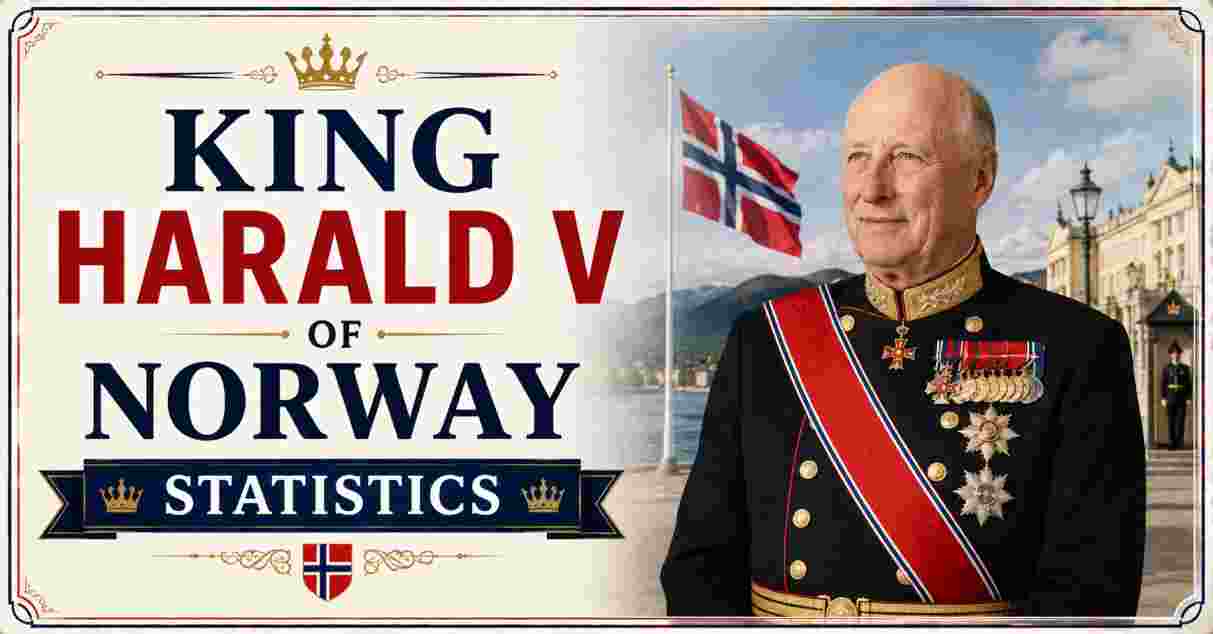
King Harald V of Norway
King Harald V of Norway, Europe’s oldest reigning monarch, died on August 28, 2026, at Oslo University Hospital Rikshospitalet, closing a 35-year reign that began in 1991 and that most living Norwegians had never known life without. He died peacefully at 6:35 a.m. local time at the age of 89, following a rapid decline linked to haemolytic anaemia and a subsequent bloodstream infection. His son, Crown Prince Haakon, was immediately proclaimed King Haakon VIII, while Haakon’s own daughter, Princess Ingrid Alexandra, now stands as heir to the Norwegian throne.
This report compiles the latest verified statistics on King Harald V, covering his age, birth, reign length, marriage, children, grandchildren, health history, and public popularity, drawn from official statements by the Norwegian Royal Court, reporting from NPR, CNN, Al Jazeera, and Reuters, and biographical records including Britannica. Every figure below reflects confirmed, sourced information as this breaking royal transition continues to unfold across Norway and the wider European monarchy.
Interesting Facts About King Harald V in 2026
| Fact | Data Point |
|---|---|
| Date of death | August 28, 2026, at 6:35 a.m. local time |
| Age at death | 89 years old |
| Length of reign | 35 years (1991-2026) |
| Date of birth | February 21, 1937, at the Skaugum estate, Asker, Norway |
| Years married to Queen Sonja | 58 years (married August 29, 1968) |
| Number of children | 2 — Princess Märtha Louise and Crown Prince Haakon |
| Number of grandchildren | 2 direct grandchildren via Haakon — Princess Ingrid Alexandra and Prince Sverre Magnus |
| Successor | His son, now reigning as King Haakon VIII |
| Olympic Games represented in sailing | 3 — Tokyo 1964, Mexico City 1968, Munich 1972 |
| King Harald’s public approval score (Feb 2026 poll) | 9.2 out of 10 — the highest of any senior royal |
Source: Royal House of Norway official statement, NPR, CNN, Al Jazeera, Britannica.
Taken together, these figures confirm that Harald’s death marks the end of one of modern Europe’s longest and most stable monarchical reigns. Having ascended the throne at age 53 in 1991, he spent more than a third of a century as head of state, a tenure exceeded among currently reigning European monarchs only by a small handful of counterparts. His 35-year marriage-turned-reign narrative is inseparable from his personal history: Harald famously threatened to remain unmarried rather than abandon his relationship with commoner Sonja Haraldsen, a stance that reshaped the modern Norwegian monarchy’s relationship with ordinary citizens.
The 9.2 out of 10 approval score Harald received in a February 2026 national poll — recorded just months before his death — stands out starkly against a backdrop of declining overall support for the Norwegian monarchy as an institution, which fell from roughly 80% to 60% amid unrelated royal family scandals during the same period. That gap between Harald’s own soaring personal popularity and the institution’s broader struggles underscores how central his individual standing was to the monarchy’s public standing throughout his final years on the throne, and it raises real questions about how his successor, King Haakon VIII, will work to rebuild that broader institutional trust.
King Harald V Age and Reign Statistics 2026
| Milestone | Date/Age |
|---|---|
| Born | February 21, 1937, at Skaugum, Asker, Norway |
| Became Crown Prince | 1957, at age 20, when his father became King Olav V |
| Married Sonja Haraldsen | August 29, 1968, at age 31 |
| Ascended to the throne | January 17, 1991, at age 53 |
| Formal consecration (benediction) | June 23, 1991, at Nidaros Cathedral, Trondheim |
| Length of reign | 35 years, 7 months |
| Died | August 28, 2026, at age 89 |
| Time as Europe’s oldest reigning monarch | Held the title continuously in his final years |
Source: Royal House of Norway, Britannica, Wikipedia biographical record.
King Harald V’s reign statistics place him among the longest-serving heads of state in modern Norwegian history, spanning 35 years from his 1991 accession to his 2026 death. He acceded to the throne upon the death of his father, King Olav V, becoming monarch at age 53 — a relatively mature age for a European succession, reflecting both his father’s own long reign and Harald’s decades of prior service as Crown Prince starting in 1957, when his grandfather King Haakon VII died and his own father ascended. His formal benediction ceremony, held at Nidaros Cathedral in Trondheim on June 23, 1991, followed centuries-old Norwegian royal tradition and was conducted alongside Queen Sonja.
Harald’s 35-year tenure as king coincided with dramatic changes in Norwegian society, from the country’s emergence as a major oil and gas exporter to its evolving role within European and Nordic politics, all while Harald maintained a consistently understated public persona. He explicitly and repeatedly rejected any suggestion of abdication, even as contemporaries like Queen Margrethe II of Denmark stepped aside in favor of their heirs — telling Norwegian media in 2024 that “I stick by what I’ve always said, that I swore an oath to the Storting and it is for life.” That commitment meant Harald remained on the throne through his final health crisis, dying as a reigning monarch rather than retiring into private life.
King Harald V Marriage and Family Statistics 2026
Royal Family Structure — House of Glücksburg
King Harald V (b. 1937) + Queen Sonja (b. 1937)
        |
        |---- Princess Märtha Louise (b. 1971)
        |---- King Haakon VIII (b. 1973) + Queen Consort Mette-Marit
                    |
                    |---- Princess Ingrid Alexandra (b. 2004) — heir to the throne
                    |---- Prince Sverre Magnus (b. 2005)
| Family Member | Relationship | Born |
|---|---|---|
| Queen Sonja | Wife (married August 29, 1968) | July 4, 1937 |
| Princess Märtha Louise | Daughter | 1971 |
| King Haakon VIII | Son, successor | July 20, 1973 |
| Queen Consort Mette-Marit | Daughter-in-law (married Haakon in 2001) | — |
| Princess Ingrid Alexandra | Granddaughter, new heir to the throne | January 21, 2004 |
| Prince Sverre Magnus | Grandson | December 3, 2005 |
Source: Royal House of Norway, NPR, Wikipedia biographical records.
King Harald V’s family statistics center on a marriage that once threatened to fracture the modern Norwegian monarchy before becoming one of its defining strengths. Harald dated Sonja Haraldsen, the daughter of a Norwegian businessman, for nine years in secret before his father, King Olav V, reluctantly granted permission for the marriage — reportedly only after Harald threatened to give up the throne entirely rather than abandon the relationship. Their wedding at Oslo Cathedral on August 29, 1968, drew 800 guests and three days of national celebration, and by the time of Harald’s death, the couple had been married for 58 years, with Sonja becoming Norway’s first queen consort in over five decades upon Harald’s 1991 accession.
The couple had two children: Princess Märtha Louise, born in 1971, and Crown Prince Haakon, born in 1973, who has now succeeded his father as King Haakon VIII. Haakon’s own marriage to Mette-Marit Tjessem Høiby in 2001 produced two children — Princess Ingrid Alexandra, born in 2004, who becomes the direct heir to the throne under Norway’s 1990 constitutional amendment establishing absolute primogeniture, and Prince Sverre Magnus, born in 2005. That succession change means Ingrid Alexandra, rather than her uncle’s older sister Märtha Louise, stands next in line after her father — a reform passed specifically to ensure gender-neutral succession going forward, though it does not apply retroactively to those born before 1990.
King Harald V Sailing and Sporting Career Statistics 2026
| Athletic Achievement | Detail |
|---|---|
| Olympic Games competed in sailing | 3 — Tokyo 1964, Mexico City 1968, Munich 1972 |
| Role at Tokyo 1964 Olympics | Flag bearer for Norway’s opening ceremony |
| World Championship sailing title | 1987, skippering his own yacht to gold |
| Age of last major international sailing competition | 79 — Sira Cup, Lake Ontario, Canada, 2016 |
| 2016 Sira Cup result | Team finished second |
| Patron role in sailing | Patron of World Sailing, the sport’s global governing body |
Source: Britannica, CNN, Life in Norway.
King Harald’s athletic statistics reveal a sporting career that spanned more than five decades and helped define his public image long before he became king. As Crown Prince, Harald represented Norway in competitive sailing at three consecutive Summer Olympics — Tokyo in 1964, where he also served as Norway’s flag bearer at the opening ceremony, followed by Mexico City in 1968 and Munich in 1972. His father, King Olav V, had himself been an Olympic gold medalist sailor in 1928, making sailing a genuine multi-generational royal tradition rather than a ceremonial hobby, and Harald continued that legacy by skippering his own yacht to a World Championship title in 1987.
Remarkably, Harald’s competitive sailing career continued well into his final decades of life: at age 79, he competed in the Sira Cup on Lake Ontario, Canada, in 2016, with his team finishing second — a level of active athletic participation almost unheard of among reigning heads of state at that age. His long-standing role as patron of World Sailing, the international governing body for the sport, further cemented his identity as one of the sport’s most visible royal supporters globally, a passion that Norwegian media and biographers consistently cited as the throughline connecting the private man to the public monarch across his entire life.
King Harald V Health Timeline Statistics 2026
King Harald V — Major Health Events Timeline
2020: Heart valve operation
2022: COVID-19 diagnosis (mild symptoms)
2024 (Jan): Sick leave — respiratory infection, age 86
2024 (Feb): Hospitalized in Malaysia — infection
2026 (Feb): Hospitalized in Tenerife — infection
2026 (Aug 17): Hospitalized — haemolytic anaemia
2026 (Aug 23): Treated for bloodstream bacterial infection
2026 (Aug 27): Condition declared "very serious"
2026 (Aug 28): Died, age 89
| Health Event | Date |
|---|---|
| Heart valve replacement surgery | 2020 |
| COVID-19 diagnosis | March 2022, mild symptoms |
| Respiratory infection sick leave | January 2024, age 86 |
| Hospitalization in Malaysia | February-March 2024, infection while on vacation |
| Hospitalization in Tenerife | February 2026, infection while on holiday |
| Final hospitalization begins | August 17, 2026 — haemolytic anaemia |
| Bloodstream infection treatment | August 23, 2026 — responded to antibiotics initially |
| Condition declared “very serious” | August 27, 2026 |
| Death | August 28, 2026, 6:35 a.m. |
Source: Royal House of Norway, BBC, Al Jazeera, Malay Mail, CNN.
King Harald’s health statistics across his final years show a pattern of recurring infections and hospitalizations layered on top of longer-standing cardiac issues, including a pacemaker and a heart valve replacement completed in 2020. Despite needing crutches to move independently in his later years and enduring repeated respiratory infections — including hospital stays in Malaysia in 2024 and Tenerife in 2026 while on vacation — Harald consistently returned to active royal duties between episodes, a pattern that led many Norwegians to view him as resilient even as his overall frailty became increasingly visible in public appearances.
His final illness began on August 17, 2026, when he was hospitalized with haemolytic anaemia, a condition in which red blood cells are destroyed faster than the body can replace them, leading to fatigue and shortness of breath. The Royal Court reported on August 23 that he was responding to antibiotic treatment for a related bloodstream bacterial infection, but his condition deteriorated sharply over the following days, with officials describing it as “very serious” by August 27 before his death the following morning. Norwegian Prime Minister Jonas Gahr Støre said afterward that “a whole nation is in mourning,” reflecting how closely the king’s health had been tracked by the public throughout his final two weeks.
Norwegian Royal Succession Statistics 2026
| Succession Metric | Detail |
|---|---|
| New King | Haakon VIII (formerly Crown Prince Haakon) |
| New King’s age at accession | 52 |
| New heir apparent | Princess Ingrid Alexandra, age 22 |
| Second in line | Prince Sverre Magnus, age 20 |
| Constitutional basis for succession | Absolute primogeniture, adopted 1990 |
| National mourning period | Declared by the Norwegian government following the death |
| Royal flag status | Lowered to half-staff at the palace |
Source: Royal House of Norway, CNN, NPR, Al Jazeera.
Norway’s royal succession statistics confirm a smooth, constitutionally established transition following Harald’s death. His son, Crown Prince Haakon, automatically succeeded him as monarch and is now recognized as King Haakon VIII, continuing a numbering tradition tracing back through Norway’s modern monarchical history since its 1905 re-establishment as an independent kingdom. Haakon’s own daughter, Princess Ingrid Alexandra, now becomes heir apparent at age 22, standing to eventually become the first woman to reign as Norway’s monarch under the country’s gender-neutral succession rules — a milestone made possible specifically by the 1990 constitutional reform that Harald’s own reign helped implement and normalize.
The transition arrives at a genuinely difficult moment for the wider Norwegian royal family, coinciding with unrelated controversies involving Queen Consort Mette-Marit’s documented past contact with the late Jeffrey Epstein and a high-profile criminal trial involving her son from a previous relationship. Despite that turbulence, the constitutional mechanics of succession proceeded immediately and without dispute upon Harald’s death, with the government declaring a formal period of national mourning, lowering the royal flag to half-staff, and receiving tributes from fellow royal houses across Sweden, Denmark, and the United Kingdom — royal families to which Harald was himself related through common descent from Queen Victoria, a lineage he shared with Britain’s King Charles III and Spain’s King Felipe VI.
For readers interested in how Norway’s demographic profile is evolving during this royal transition — including the country’s ageing population and shifting immigration patterns — our detailed Norway Population Statistics report breaks down the latest official figures from Statistics Norway.
King Harald V Public Legacy and Approval Statistics 2026
| Legacy Metric | Data Point |
|---|---|
| Personal approval rating (Feb 2026 NRK/Norstat poll) | 9.2 out of 10 |
| Queen Sonja’s approval rating (same poll) | 8.6 out of 10 |
| King Haakon’s approval rating (same poll) | 7.9 out of 10 |
| Overall institutional monarchy support, prior month | ~70% |
| Overall institutional monarchy support, Feb 2026 | 60% — a 10-point monthly drop |
| World Wide Fund for Nature Norway | Harald helped establish the Norwegian branch |
| Public description of Harald’s public style | “Reserved, occasionally mischievous” per biographers |
Source: NRK/Norstat poll via newsinenglish.no, CNN, Life in Norway.
King Harald’s public legacy statistics show a monarch whose personal standing remained remarkably resilient even as the broader institution around him faced turbulence. In a February 2026 national poll conducted by research firm Norstat for Norwegian public broadcaster NRK — taken just six months before his death — Harald earned a “top grade” of 9.2 out of 10 when Norwegians were asked how well he represented the royal family, comfortably ahead of Queen Sonja’s 8.6 and King Haakon’s 7.9. That same survey recorded overall institutional support for the monarchy falling a dramatic 10 percentage points in a single month, from roughly 70% to 60%, driven by unrelated scandals involving other family members — a divergence commentator Harald Stanghelle described as “dramatic… because it’s so big in such a short period of time.”
Beyond politics and polling, Harald’s substantive legacy included environmental advocacy — he helped establish the Norwegian branch of the World Wide Fund for Nature — and a consistently understated public persona that biographers and journalists alike described as “reserved, occasionally mischievous.” His progressive-leaning approach to modernizing the monarchy, most visibly demonstrated through his own marriage to a commoner and his public embrace of the idea that there were “many different ways to be Norwegian,” shaped how the institution positioned itself relative to an increasingly diverse and secularizing Norwegian public over his 35-year reign. Given his genealogical ties to Britain’s and other European royal houses, readers researching the wider network of related monarchies may find useful context in our Britain Population Statistics report, while those interested in the historical roots of the House of Glücksburg’s origins can consult our Germany Population Statistics overview for broader European demographic context.
Disclaimer: The data research report we present here is based on information found from various sources. We are not liable for any financial loss, errors, or damages of any kind that may result from the use of the information herein. We acknowledge that though we try to report accurately, we cannot verify the absolute facts of everything that has been represented.