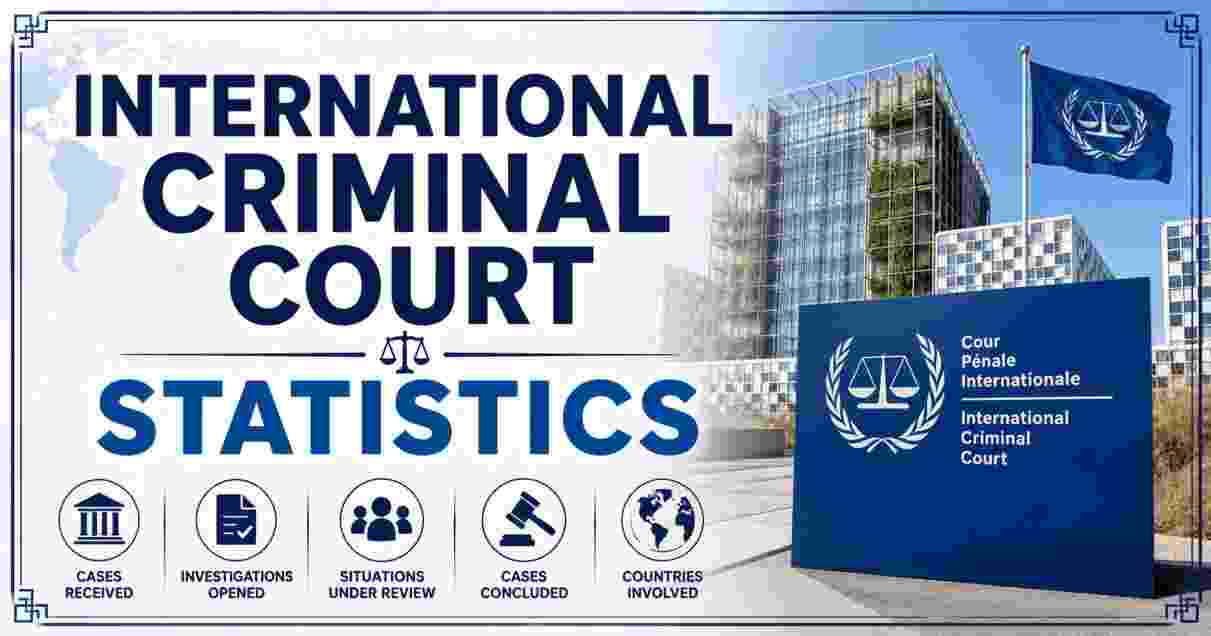
What is the International Criminal Court?
The International Criminal Court (ICC) is a permanent judicial institution based in The Hague, Netherlands, established to investigate and prosecute individuals accused of the world’s most serious crimes: genocide, crimes against humanity, war crimes, and the crime of aggression. Created by the Rome Statute, a treaty adopted in 1998 and put into force on 1 July 2002, the court operates as a body of last resort — it only steps in when a country’s own national courts are unwilling or genuinely unable to prosecute these crimes themselves. Unlike the separate International Court of Justice (ICJ), which settles disputes between states, the ICC’s cases are always brought against individual people, not governments.
The court is funded and governed by its Assembly of States Parties, made up of the countries that have formally ratified the Rome Statute. Its work is carried out through three main bodies: the Presidency and Judicial Divisions, the Office of the Prosecutor, and the Registry, which handles administration, victim support, and courtroom operations. Since opening its doors, the ICC has become one of the most closely watched pieces of international legal infrastructure in the world, drawing staff, legal experts, and observers from more than 100 countries to a single institution built around a shared body of international criminal law.
Key ICC Facts in 2026
| Fact | Figure |
|---|---|
| Year the Rome Statute was adopted | 1998, entered into force 1 July 2002 |
| Countries that are States Parties to the Rome Statute | 125 member states |
| Countries that have signed but not ratified the treaty | 137 total signatories, 29 not yet ratified |
| Number of ICC judges | 18 judges, elected for 9-year terms |
| ICC’s approved 2026 programme budget | €196.85 million |
| Official languages of the court | 6 (Arabic, Chinese, English, French, Russian, Spanish) |
| Working languages of the court | English and French |
| ICC staff nationalities represented | Staff drawn from over 100 countries |
| Cases brought before the court since 2002 | 32 cases, some involving multiple suspects |
Source: International Criminal Court “The Court Today” facts and figures; ICC Assembly of States Parties budget resolution; Rome Statute status records.
Taken together, these figures show an institution that has grown steadily since its founding while staying relatively compact for a body handling some of the most complex legal cases on Earth. The 125 states parties represent well over half of the world’s countries, spanning Africa, the Asia-Pacific, Eastern Europe, Latin America and the Caribbean, and Western Europe, which gives the court a genuinely global membership base even though several large countries remain outside the Rome Statute system.
What stands out most is the gap between the court’s modest €196.85 million annual budget and the scale of what it’s tasked with doing — running investigations, trials, and appeals across multiple continents with only 18 judges overseeing the entire judicial process. The 32 cases brought since 2002 might look like a small number for over two decades of operation, but each ICC case typically involves years of evidence-gathering, witness protection, and multi-stage legal proceedings, which explains why the court moves at a pace very different from a typical domestic courtroom.
ICC Member States and Regional Representation in 2026
| Region | Number of States Parties |
|---|---|
| African States | 33 countries |
| Asia-Pacific States | 19 countries |
| Eastern European States | 20 countries |
| Latin American and Caribbean States | 28 countries |
| Western European and Other States | 25 countries |
| Total States Parties | 125 countries |
Source: Rome Statute status records, Assembly of States Parties Handbook.
ICC Member States by Region (2026)
African States                █████████████████ 33
Latin America & Caribbean     ██████████████ 28
Western Europe & Other        ████████████ 25
Eastern Europe                ██████████ 20
Asia-Pacific                  █████████ 19
The regional breakdown of ICC membership reveals a court whose foundation rests heavily on African and Latin American and Caribbean participation, which together account for 61 of the 125 total member states — nearly half the court’s entire membership. This distribution isn’t accidental: the Rome Statute specifically calls for equitable geographical representation, both in terms of which countries join and in how judges are selected to sit on the bench, ensuring no single region dominates the court’s composition.
The Asia-Pacific region’s 19 member states represent the smallest regional bloc relative to the size of the region’s population, reflecting that several of the world’s most populous nations have not joined the Rome Statute system. Meanwhile, Western Europe and other states contribute 25 members, a group that also happens to provide a significant share of the court’s annual budget contributions, since funding assessments are calculated using the same formula the United Nations applies for its own membership dues, based largely on the size of each country’s economy. This wide geographic spread is also why the court’s field presence extends well beyond The Hague itself, with country and liaison offices supporting outreach, victim engagement, and cooperation activities in multiple regions simultaneously.
Membership composition also shapes how the Assembly of States Parties conducts its annual business, since regional blocs typically coordinate on shared priorities such as judicial candidate nominations, budget positions, and elections to the court’s oversight committees. Each of the five regional groups is guaranteed a role in the court’s governance structure, a design feature meant to keep any single bloc from controlling outcomes and to preserve the sense that the institution genuinely answers to a globally representative membership rather than a narrower coalition of founding states.
ICC Judges and Judicial Structure Statistics in 2026
| Judicial Metric | Figure |
|---|---|
| Total sitting judges | 18 judges |
| Judicial term length | 9 years |
| Judges elected per typical election cycle | 6 judges (staggered terms) |
| Judicial divisions | 3 (Pre-Trial, Trial, Appeals) |
| Minimum judges required from List A (criminal law background) | 9 judges |
| Minimum judges required from List B (international law background) | 5 judges |
| Gender balance requirement | Rome Statute mandates a fair representation of female and male judges |
Source: Rome Statute Article 36; Coalition for the International Criminal Court judicial election records.
ICC Judicial Divisions Structure (18 Judges Total)
Pre-Trial Division     ██████ (assigned per caseload)
Trial Division         ██████ (assigned per caseload)
Appeals Division       ██████ (fixed panel of judges)
Electing judges to the ICC is a carefully staggered process by design: rather than replacing the entire bench at once, roughly 6 judges are elected during each Assembly of States Parties session to nine-year terms, which keeps a mix of experienced and newly appointed judges on the court at any given time. This structure also prevents any single election cycle from reshaping the court’s judicial philosophy too dramatically, since two-thirds of sitting judges remain in place after each cycle.
The List A and List B qualification system is one of the more distinctive features of ICC judicial selection, requiring a minimum of 9 judges with hands-on criminal law and courtroom experience alongside at least 5 judges whose background lies in broader international law fields like human rights or humanitarian law. Combined with the Rome Statute’s explicit requirement for gender-balanced representation and coverage across the world’s principal legal systems, the selection criteria are built to keep the bench diverse across legal tradition, professional background, and geography all at once — a deliberately layered process for a court meant to represent the entire international community.
ICC Budget and Funding Statistics in 2026
| Budget Metric | Figure |
|---|---|
| Approved 2026 programme budget | €196.85 million |
| Year-on-year budget increase, 2025 to 2026 | 1.1% |
| Office of the Prosecutor budget allocation (2026) | €63.08 million |
| Registry budget allocation (2026) | €99.63 million |
| Judiciary budget allocation (2026) | €15.58 million |
| Secretariat of the Assembly of States Parties allocation | €3.35 million |
| Funding source | Assessed contributions from states parties, calculated on a UN-style formula |
Source: ICC-ASP/24/Res.4 budget resolution; ICC Committee on Budget and Finance reports.
ICC 2026 Budget by Major Programme (€ millions)
Registry                    ████████████████████████ €99.6M
Office of the Prosecutor    █████████████████ €63.1M
Judiciary                   █████ €15.6M
Secretariat of ASP          █ €3.4M
The Registry, which handles everything from courtroom logistics and detention facilities to victim and witness protection, receives by far the largest share of the court’s budget at €99.63 million, more than half the entire 2026 appropriation. This makes sense given the scope of its responsibilities: the Registry runs the physical and administrative machinery that keeps trials moving, coordinates with field offices in situation countries, and manages the day-to-day operational needs of a court juggling multiple active cases simultaneously.
The Office of the Prosecutor’s €63.08 million allocation is the second-largest line item, reflecting the resource-intensive nature of gathering evidence and building cases across conflict zones that are often difficult and dangerous to access. With the overall budget rising just 1.1% year-on-year — a notably modest increase compared to previous years — the court’s Committee on Budget and Finance has emphasized prudent resource prioritization, meaning each major programme has had to absorb rising staff and operational costs internally rather than through larger across-the-board increases. Coordinating an annual budget of this size across 125 contributing member countries is itself a significant multilateral exercise, not unlike the kind of coordinated planning that goes into other large recurring international gatherings — our overview of the G20 Summit covers a similar process of dozens of countries aligning on shared priorities and shared costs.
ICC Cases and Judicial Outcomes Statistics in 2026
| Case Metric | Figure |
|---|---|
| Total cases brought before the court since 2002 | 32 cases |
| Arrest warrants and summonses issued since inception | 60+ individuals |
| Convictions issued | 11 convictions |
| Convictions for core crimes (war crimes/crimes against humanity) | 6 convictions |
| Acquittals issued | 4 acquittals |
| Individuals who have appeared before the court | 21 individuals |
| Situations currently under investigation | Approximately 14 to 17 situations |
Source: International Criminal Court case records; Statista defendant tracking data; Reuters/wire service court explainers.
ICC Judicial Outcomes Since 2002 (Individuals)
Convictions                     ███████████ 11
Convictions (core crimes only)  ██████ 6
Acquittals                      ████ 4
The distinction between the 11 total convictions and the 6 convictions specifically for core crimes like war crimes and crimes against humanity is an important one: several of those 11 convictions stemmed from secondary offenses such as witness tampering rather than the primary atrocity crimes the court was created to address. This gap illustrates just how difficult it is to secure a conviction on the court’s founding mandate crimes, which require an extremely high evidentiary bar given the chaotic, often remote conditions under which alleged war crimes and crimes against humanity typically occur.
With 60-plus arrest warrants and summonses issued against individuals but only 21 people having actually appeared before the court, the ICC faces a persistent structural challenge common to international tribunals: it has no independent police force of its own and relies entirely on the voluntary cooperation of national governments to make arrests and transfer suspects into custody. That reliance on state cooperation is a defining, non-political feature of how the court’s enforcement mechanism was designed under the Rome Statute from the very beginning.
ICC Staff and Workforce Statistics in 2026
| Workforce Metric | Figure |
|---|---|
| Countries represented among ICC staff | More than 100 countries |
| Recruitment priority focus | Underrepresented States Parties, incl. Brazil, South Korea, Mexico, Germany, Japan |
| Organizational structure | 3 principal organs: Presidency/Judiciary, Office of the Prosecutor, Registry |
| Total states parties targeted for balanced representation | 125 States Parties |
| Location of headquarters | The Hague, Netherlands |
| First president of the court | Philippe Kirsch (Canada), appointed 2003 |
Source: ICC Careers and Jobs portal; ICC Presidency institutional records.
ICC Institutional Structure (3 Principal Organs)
Registry                     ████████████████████ Largest headcount and budget share
Office of the Prosecutor     ██████████████ Investigations and case-building
Presidency / Judiciary       ███████ Judicial oversight and case management
Drawing staff from over 100 countries to a single institution is a deliberate design choice meant to reinforce the court’s identity as a genuinely international body rather than an extension of any one legal tradition or region. The ICC’s human resources policy specifically prioritizes recruitment from underrepresented member states, aiming to keep the staff composition reasonably proportional to the 125-country membership base rather than letting any single nationality or regional bloc dominate day-to-day operations.
Structurally, the court’s workforce is organized around three principal organs, each with a distinct function: the judiciary handles case adjudication, the Office of the Prosecutor manages investigations and evidence-building, and the Registry — by far the largest in staffing and budget terms — runs everything from courtroom administration to victim and witness support services. This three-part division of labor has remained the operational backbone of the court since Philippe Kirsch became its first president in 2003, and it continues to define how the institution is organized more than two decades later. For readers interested in how legal caseload and staffing statistics are tracked at a smaller, domestic scale, our legal malpractice statistics in the US report offers a useful point of comparison for how case volume and institutional workforce data are measured within a single national court system.
ICC Founding and Historical Timeline Statistics in 2026
| Milestone | Year |
|---|---|
| Rome Statute drafted and adopted | 17 July 1998 |
| Minimum ratifications required for entry into force | 60 countries |
| Rome Statute entered into force | 1 July 2002 |
| First ICC president took office | 2003 |
| Years the court has been operational (as of 2026) | 24 years |
| Location the Rome Statute was signed | Rome, Italy |
Source: Rome Statute treaty records; Britannica institutional history; ICC Presidency archives.
ICC Founding Timeline
1998 ● Rome Statute adopted
2002 ● Treaty enters into force (60 ratifications reached)
2003 ● First President takes office
2026 ● 24 years of continuous operation
The four-year gap between the Rome Statute’s adoption in 1998 and its entry into force in 2002 reflects how treaty-based international institutions typically come together: it took that long for 60 countries to complete their individual domestic ratification processes, the threshold the treaty itself set as a condition for the court to formally begin operating. That threshold-based design is common across international law instruments, ensuring a broad enough coalition of committed states exists before a permanent institution with binding legal authority is switched on.
Now in its 24th year of continuous operation, the ICC has outlasted several of the ad hoc international tribunals — like those for the former Yugoslavia and Rwanda — that operated only for the duration of a single conflict’s aftermath before closing. Unlike those temporary bodies, the ICC was deliberately built as a standing, permanent court with no scheduled end date, meaning its judges, prosecutors, and registry staff continue operating year-round regardless of whether a specific situation is actively in trial, which is a core structural difference from the time-limited tribunals that preceded it.
ICC Compared to Other International Judicial Bodies in 2026
| Comparison Metric | ICC | International Court of Justice (ICJ) |
|---|---|---|
| Established | 2002 | 1945 |
| Cases handled since founding | 32 cases (individuals) | 201 cases (as of Sept. 2025, state disputes) |
| Number of judges | 18 judges | 15 judges |
| Judicial term length | 9 years | 9 years |
| Who can be a defendant | Individual persons only | States, not individuals |
| Shared headquarters city | The Hague, Netherlands | The Hague, Netherlands |
Source: Rome Statute records; International Court of Justice institutional data.
Cases Handled Since Founding: ICC vs ICJ
ICJ (since 1945)   ███████████████████████████████ 201 cases
ICC (since 2002)   ██████ 32 cases
Although the ICC and ICJ are often confused with one another, the comparison table above makes the structural difference clear: the ICJ has handled roughly six times more cases than the ICC, but that’s largely because it has been operating for 57 more years and resolves disputes between countries rather than prosecuting individuals through lengthy criminal trials. A state-versus-state legal dispute at the ICJ can often move through the court’s process faster than a full criminal prosecution requiring evidence collection, witness testimony, and proof beyond reasonable doubt at the ICC.
Both institutions share the same host city of The Hague, reinforcing the Netherlands’ role as a global hub for international legal bodies, and both rely on 18-to-15-judge benches serving nine-year terms — a structural similarity that reflects shared design principles across post-war international judicial architecture, even though their day-to-day case work looks very different in practice.
Tracking these two courts side by side is also a useful reminder that “international court” is not a single category — the ICC and ICJ serve fundamentally different purposes despite sharing a city, a similar judicial term structure, and a broadly overlapping pool of legal scholars and practitioners who move between the two institutions over the course of their careers. Much like other treaty-based international bodies that bring together dozens of countries around a shared framework — a structure our coverage of the COP28 Global Climate Summit also explores — both the ICC and ICJ depend on sustained multilateral cooperation to function, since neither court can compel action on its own without the continued participation of its member states.
Disclaimer: The data research report we present here is based on information found from various sources, including the International Criminal Court’s own published records and independent institutional reporting current as of 2026. We are not liable for any errors or damages of any kind that may result from the use of the information herein. We acknowledge that though we try to report accurately, we cannot verify the absolute facts of everything that has been represented.