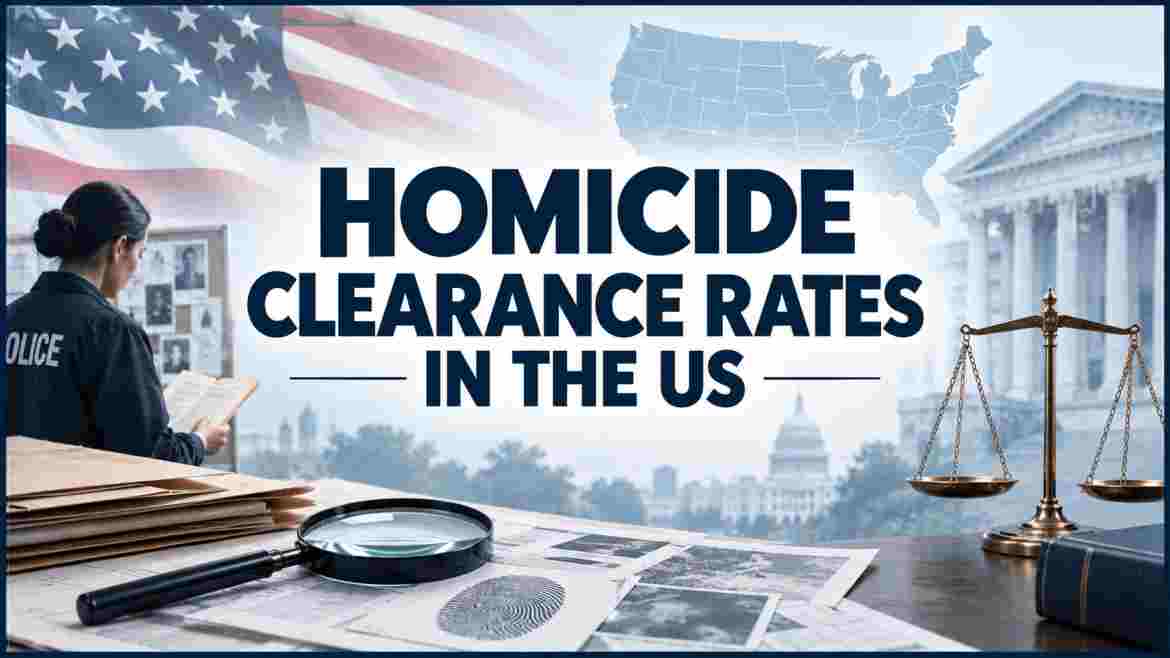
In 2025, US police cleared 68.8% of murders, up from 61.4% in 2024 and the highest rate since 1988, according to the FBI’s August 2026 report on crime in the nation. Estimated murders fell 18% to 14,085, a rate of 4.1 per 100,000 that ties the lowest on record, which left detectives with fewer new cases to work.
Homicide Clearance Rates in America 2026 – Introduction
Homicide clearance rates in the US hit a 37-year high in 2025. The FBI’s figure of 68.8% comes from its Reported Crimes in the Nation report, released on August 14, 2026, and it follows 61.4% in 2024, 57.8% in 2023, and a low of 52.3% in 2022. The Murder Accountability Project calls it the largest one-year improvement on record. Police clear a case when they arrest and charge a suspect, or close it by exceptional means, such as the suspect’s death. A clearance is not a conviction.
The headline number hides a long decline and large local gaps. Police cleared about 90% of murders in the mid-1960s. Roughly 352,000 homicides have gone uncleared since 1965. Philadelphia reports 82% for 2025, Chicago 71.2%, and the FBI’s own homicide caseload sits below 47%. This report covers the national trend, unsolved murders, city results, the reasons for the 2025 jump, federal cases, and the limits of the statistic. Every table names its source and period.
Interesting Facts about Homicide Clearance Rates in the US
US MURDER CLEARANCE RATE BY YEAR (%)
2022   █████████████████████████  52.3
2023   ███████████████████████████████  57.8
2024   ███████████████████████████████████  61.4
2025 ██████████████████████████████████████████ 68.8| Fact | Latest Data |
|---|---|
| National murder clearance rate, 2025 | 68.8% (highest since 1988) |
| Murder clearance rate, 2024 | 61.4% |
| Gain since the 2022 low | 16.5 points (from 52.3%) |
| Estimated murders, 2025 | 14,085, down 18.1% |
| Murder rate, 2025 | 4.1 per 100,000, tying 1955 and 1956 |
| Homicides uncleared, 1965 to 2024 | 352,390 |
| Philadelphia clearance rate, 2025 | 82% |
| Chicago clearance rate, 2025 | 71.2% (13-year high) |
| FBI’s own homicide caseload cleared, through 2024 | 111 of 237 (under 47%) |
The 2025 gain is large by any measure. The rate rose 7.4 points in one year and 16.5 points since 2022. It reversed a six-decade slide that the Murder Accountability Project says started with clearance near 90% in 1965 and reached a low of 52.3% in 2022. The FBI’s report puts the 2025 rate above every year since 1988, and the violent crime clearance rate, at 47%, is the best in a decade.
The improvement came with fewer murders. The FBI estimates 14,085 murders in 2025, an 18% drop, the lowest murder rate since FBI estimates began. Fewer new cases mean detectives can spend more time on each one, and a clearance rate divides cases closed in a year by crimes recorded that year. Both effects push the percentage up, which is why the rate and the murder count should be read together.
National Homicide Clearance Rate in 2026
US MURDER CLEARANCE RATE OVER TIME (%)
1965   █████████████████████████████████████████  ~90
1980   █████████████████████████                   72
2018   ██████████████                              62
2020   ██████████                                  54
2022   ████████                                   52.3
2025 ██████████████████████ 68.8| Year | Murder Clearance Rate | Note |
|---|---|---|
| 1965 | About 90% | Mid-1960s level reported by the FBI |
| 1980 | 72% | Stateline analysis of FBI data |
| 2018 | 62% | FBI estimate |
| 2020 | 54% | Reported at the time; later estimates differ |
| 2022 | 52.3% | Lowest on record, per the Murder Accountability Project |
| 2023 | 57.8% | FBI estimate |
| 2024 | 61.4% | FBI estimate |
| 2025 | 68.8% | Highest since 1988 |
Data Source: FBI Uniform Crime Reporting Program, Reported Crimes in the Nation 2025 (August 2026); Murder Accountability Project; Stateline
The long arc runs from about 90% in 1965 to 52.3% in 2022 and back to 68.8% in 2025. The FBI revises its national estimates as more agencies report, which is why early readings, such as 54% for 2020, differ from later ones. Violence drove much of the fall. Murders jumped nearly 30% in 2020, and the Murder Accountability Project says that surge overwhelmed detective units and pushed clearance to its low two years later.
The 2025 level still sits below the 1980 level of 72% and far below the 1960s. The Murder Accountability Project notes that the US trails most industrialized countries. International comparisons need care because countries define clearance differently. The domestic comparison is cleaner: the gain since 2022 is 16.5 points, and it puts the national rate back above the 57% average of the decade from 2015 through 2024.
Unsolved Murders in the US in 2026
HOMICIDES NOT CLEARED BY YEAR
2024 (INITIAL ESTIMATE)   ████████████████████████████████████████  6,280
2025 (OUR CALCULATION)    ████████████████████████████              ~4,400
| Metric | Figure |
|---|---|
| Homicides not cleared, 1965 to 2024 | 352,390 |
| Homicides without a charge since 1980 (Murder Accountability Project) | More than 250,000 |
| Reported homicides, 2024 (initial estimate) | 16,135 |
| Cleared, 2024 | 61% |
| Not cleared, 2024 | 6,280 |
| Estimated murders, 2025 | 14,085 |
| Murders not cleared, 2025 (our estimate) | About 4,400 (31.2% of 14,085) |
| Illinois and New York clearance data | Partial, so state totals are estimates |
Data Source: Murder Accountability Project analysis of FBI Uniform Crime Report data, via Project: Cold Case; FBI Reported Crimes in the Nation 2025
More than 352,000 homicides have gone uncleared since 1965, and the Murder Accountability Project counts more than 250,000 since 1980 in which nobody was charged. In 2024, the early estimate of 16,135 homicides left 6,280 uncleared at the 61% rate. For 2025, 31.2% of 14,085 murders comes to about 4,400, a figure we calculated. It is a rough guide, because clearances in a year include cases from earlier years, and the FBI revised its 2024 murder count upward.
An uncleared case is not necessarily cold. Some cases close later, and others stay open for decades. Illinois and New York report only partial clearance data, so their totals are estimates. The count of unsolved killings still grows each year the rate stays below 100%, and even the 2025 rate leaves nearly one murder in three uncleared.
Homicide Clearance Rates by City in 2026
2025 HOMICIDE CLEARANCE RATES (%)
LOS ANGELES (LAPD)    ████████████████████████████████████████████████████  101
WASHINGTON, DC        ██████████████████████████████████████████            85
PHILADELPHIA          █████████████████████████████████████████             82
CHICAGO               ███████████████████████████████████                   71.2
PITTSBURGH            ██████████████████████████████████                    69
| City | 2025 Clearance Rate | Detail |
|---|---|---|
| Los Angeles (LAPD) | 101% | 156 of 230 same-year homicides (68%) plus 78 earlier cases |
| Washington, DC | 85% | Reported by The Trace |
| Philadelphia | 82% | Up from 45% in 2016 |
| Chicago | 71.2% | 13-year high; 56% in 2024 |
| Pittsburgh | 69% | 24 of 35 homicides, as of January 1, 2026 |
| New York, Chicago, Houston, Baltimore | 65% to 79% | Range reported by The Trace |
Data Source: The Trace; Chicago Office of Inspector General; Los Angeles Police Department; Pittsburgh Bureau of Police figures as reported by the New Pittsburgh Courier
City rates vary because of method as much as results. Los Angeles reported 101% because it counted 78 older cases it solved in 2025 on top of 156 of that year’s 230 killings. Philadelphia’s 82% compares with 45% in 2016, and The Trace found police solved only 47% of the 562 homicides committed in 2021. WHYY reported a rate near 90% earlier, so figures vary by source and date. Check the method before comparing.
Chicago’s number rose from 56% in 2024 to 71.2% in 2025, the best since 2013, when it cleared 56.8% of 458 cases. The Inspector General’s dashboard counts 423 homicides, while the police department reported 416, so small count differences exist even within one city. Chicago had its fewest murders in at least six decades. Smaller departments post volatile rates because a handful of cases can move a percentage by double digits.
Why Homicide Clearance Rates Rose in 2025
FBI CLEARANCE RATES BY OFFENSE, 2025 (%)
MURDER                ████████████████████████████████████████████████████████████████████████  68.8
VIOLENT CRIME (ALL)   ██████████████████████████████████████████████████                        47
ROBBERY               ██████████████████████████████████████                                    35.8
BURGLARY              ██████████████████                                                        17.4
| Measure | 2025 Figure |
|---|---|
| Murder clearance rate | 68.8% (highest since 1988; +16.5 points since 2022) |
| Violent crime clearance rate | 47% (highest in a decade) |
| Robbery clearance rate | 35.8% (highest since 1965) |
| Burglary clearance rate | 17.4% (best since 1975) |
| Estimated murders | 14,085 (-18.1%) |
| Estimated violent crimes | 1,119,768 (-9.3%) |
| Population covered by reporting agencies | More than 96% |
Data Source: FBI Uniform Crime Reporting Program, Reported Crimes in the Nation 2025 (released August 14, 2026); analysis by Jeff Asher, AH Datalytics
The gains were not limited to murder. Robbery clearance hit 35.8%, its best since 1965, and burglary 17.4%, its best since 1975, which points to broad improvement in investigations. The Murder Accountability Project credits staffing. Cities hired investigators and forensic technicians to handle the 2020 spike, and much of that capacity stayed in place as murders declined from 2023 through 2025. Its chairman says clearance rates will fall again if departments cut homicide units.
WHYY’s reporting on Philadelphia points to a wider network of surveillance cameras, better data sharing among units, and new forensic tools. Fewer murders also lift the percentage. The FBI estimates 14,085 murders in 2025, so each detective carried fewer new cases. An Axios analysis of FBI data found the 2025 drop was unusually broad, touching cities of every size. For the wider decline, see our Violent Crime Rate Statistics in US report, which tracks the FBI’s 2025 violent crime figures.
Federal Homicide Cases and Reporting Gaps in 2026
HOMICIDES INVESTIGATED BY THE FBI, THROUGH 2024
REPORTED       ████████████████████████████████████████  237
CLEARED        ██████████████████                        111
NOT CLEARED    ██████████████████████                    126
| Metric | Figure |
|---|---|
| Homicides the FBI reported as its own caseload (through 2024) | 237 |
| Cleared by arrest or other means | 111 (46.8%) |
| National average clearance, 2015 to 2024 | 57% |
| Share of FBI caseload with Native American victims | About two-thirds |
| Native American homicides reported to the UCR after the lawsuit | More than 80% (historically about half unreported) |
| 2022 homicides counted by the CDC | 24,835 |
| 2022 homicides reported to the Justice Department | 20,018 (81%) |
Data Source: Murder Accountability Project (May 2026 and October 2023 releases); CDC mortality data; FBI Uniform Crime Reporting Program
The Murder Accountability Project settled a seven-year Freedom of Information Act lawsuit in 2026 that forced the FBI and other federal agencies to report their own homicide caseload to the Uniform Crime Report. The data showed that only 111 of 237 homicides the FBI investigated through 2024 were cleared, 46.8% and well below the national average of 57% for 2015 through 2024. Two-thirds of that caseload involves Native American victims. Reporting of Native American homicides to the UCR has risen above 80%.
The gap highlights how incomplete the national data can be. In 2022, the CDC counted 24,835 homicides from death certificates, while only 20,018 reached the Justice Department, a reporting rate of 81%. The FBI estimates national totals to fill the gaps. Our United States Homicide Statistics report covers the early 2026 decline and how the FBI and the Council on Criminal Justice track it.
How Homicide Clearance Rates Are Measured in 2026
WHAT COUNTS AS "CLEARED" UNDER FBI RULES
ARREST AND CHARGE          ████████████████████████████████████████  Standard path
EXCEPTIONAL MEANS          ████████████████                          Suspect dies, extradition refused, etc.
CLEARANCE RATE OVER 100%   ██████████                                Older cases solved in the same year
| Rule | How It Works |
|---|---|
| Cleared by arrest | At least one person arrested, charged, and referred for prosecution |
| Cleared by exceptional means | Suspect identified but cannot be arrested, such as the suspect’s death |
| Same-year or earlier cases | Clearances in a year can include cases from earlier years |
| Rates above 100% | Possible when older solved cases exceed new homicides |
| Convictions | Not part of the definition |
| FBI national figure | An estimate that fills in for agencies that do not report |
Data Source: FBI Uniform Crime Reporting definitions; The Trace; Stateline; Murder Accountability Project
A clearance is a police action, not a court outcome. A case counts as cleared when police arrest and charge a suspect or close it by exceptional means, and prosecutors may still decline it. The rate divides all clearances in a year by that year’s murders, so a department that solves older cases can exceed 100%, as Los Angeles did. A measure that counts only the year’s own homicides, which The Trace uses, gives a lower result. A former Memphis police officer quoted by Stateline says clearance also reflects community trust, since witnesses must be willing to talk to police.
Use the number with care. The national rate depends on FBI estimates for agencies that do not report, and it moves partly because the denominator shrinks when murders fall. Compare a city’s rate across years and methods before drawing a ranking. For how clearance connects to local homicide rates, see our Homicide Rates in US Cities report, which covers city-by-city homicide trends and firearm shares.
Frequently Asked Questions
What is the homicide clearance rate in the US in 2026?
The FBI reports a national murder clearance rate of 68.8% for 2025, released in August 2026. That is the highest since 1988 and up from 61.4% in 2024.
What does “cleared” mean for a homicide?
A homicide is cleared when police arrest and charge a suspect, or close the case by exceptional means, such as the suspect’s death. A clearance is not a conviction.
How many murders go unsolved in the US each year?
At the 2025 rate of 68.8%, about 31% of murders were not cleared, roughly 4,400 of 14,085 by our estimate. In 2024, an early estimate put the number at 6,280.
How many unsolved murders are there in the US?
The Murder Accountability Project counts 352,390 homicides uncleared from 1965 to 2024 and estimates more than 250,000 since 1980 in which nobody was charged.
Why did the homicide clearance rate go up in 2025?
Murders fell 18%, so detectives had fewer new cases. The Murder Accountability Project also credits investigator staffing added after the 2020 surge, and Philadelphia officials point to cameras, data sharing, and forensic tools.
Which cities have the highest homicide clearance rates?
In 2025, Los Angeles reported 101%, Washington, DC 85%, and Philadelphia 82%. Chicago reported 71.2%. Methods differ, so compare cities carefully.
Can a clearance rate be over 100%?
Yes. The rate counts all cases cleared in a year, including older ones, against that year’s new homicides. The LAPD reported 101% for 2025 for that reason.
What is the lowest homicide clearance rate on record?
The Murder Accountability Project reports a low of 52.3% in 2022, based on FBI estimates. Earlier estimates put 2020 at 54%.
How often does the FBI solve its own homicide cases?
Through 2024, the FBI cleared 111 of the 237 homicides it reported as its own caseload, 46.8%, according to the Murder Accountability Project.
Disclaimer: The data research report we present here is based on information found from various sources. We are not liable for any financial loss, errors, or damages of any kind that may result from the use of the information herein. We acknowledge that though we try to report accurately, we cannot verify the absolute facts of everything that has been represented.