Hearing Loss in America
Hearing loss is the third most common chronic physical condition in the United States — more widespread than diabetes or cancer, yet far less discussed in mainstream public health conversations. It is defined as a reduced ability to hear sounds across frequencies, ranging from mild difficulty catching certain words in conversation to profound deafness. The condition takes many forms: sensorineural hearing loss (caused by damage to the inner ear or auditory nerve — the most common type in adults), conductive hearing loss (caused by blockages or structural problems in the outer or middle ear), and mixed hearing loss (a combination of both). The single greatest driver of hearing loss in the United States is aging, making it first and foremost a condition that escalates steeply with every decade of life — though noise exposure, genetics, certain medications, and chronic illness all play significant contributing roles at every age. According to the CDC, approximately 37.5 million Americans aged 18 and over — roughly 15% of all US adults — report some trouble hearing, while the Hearing Loss Association of America (HLAA) puts the total figure across all ages at over 50 million Americans, or roughly 1 in 7 people nationwide.
What makes hearing loss in America in 2026 such a defining public health challenge is not just its prevalence, but its staggering rate of undertreatment. An estimated 28.8 million US adults could benefit from hearing aids right now — yet fewer than 1 in 5 of those who need them actually use them. The consequences of this treatment gap extend far beyond inconvenient conversations: untreated hearing loss is now recognized as the largest single modifiable risk factor for dementia in adults aged 45–65, with affected individuals facing 2 to 5 times greater dementia risk than those with normal hearing, according to research published in JAMA. It is linked to depression, social isolation, reduced employment rates, and significant income loss. The landmark FDA ruling in October 2022 creating an over-the-counter (OTC) hearing aid category was designed to close this gap — and in 2026, the downstream effects of that decision are reshaping the hearing care landscape in ways that Americans of every age are beginning to feel.
Interesting Facts About Hearing Loss in the US 2026
HEARING LOSS FAST FACTS — US 2026
=====================================

  Americans with Hearing Loss     ████████████████████  50+ Million (1 in 7)
  Adults Reporting Trouble Hearing ████████████████████  37.5 Million (15%)
  Could Benefit from Hearing Aids  ████████████████████  28.8 Million
  Actually USE Hearing Aids        ████                  <1 in 5 (20%)
  Adults 71+ with Hearing Loss     ████████████████████  65.3% (21.5 Million)
  Adults 75+ with Disabling HL    ████████████████████  ~50%
  Men vs Women Risk (ages 20-69)  ████████████          Men ~2x more likely
  Hearing Aid Satisfaction        ████████████████      ~80%+

  Scale: Each █ ≈ ~5 percentage points or proportional units
| Fact | Statistic / Detail |
|---|---|
| Total Americans with hearing loss | Over 50 million — approximately 1 in 7 people in the US (NIDCD & US Census) |
| US adults 18+ reporting trouble hearing | ~37.5 million (15%) of all US adults (CDC) |
| Hearing loss rank as a chronic condition | 3rd most common chronic physical condition in the US — more prevalent than diabetes or cancer (CDC) |
| Americans who could benefit from hearing aids | 28.8 million US adults (NIDCD) |
| Adults who actually use hearing aids | Fewer than 1 in 5 — a vast treatment gap (NIDCD) |
| Adults 71 and older with hearing loss | 65.3% — representing 21.5 million Americans (HLAA / peer-reviewed data) |
| Adults 75+ with disabling hearing loss | ~50% of all Americans aged 75 and older (NIDCD) |
| Adults 65–74 with disabling hearing loss | ~22–25% — roughly 1 in 4 in this age range (NIDCD) |
| Adults 55–64 with disabling hearing loss | 8.5% (NIDCD) |
| Adults 45–54 with disabling hearing loss | ~2–5% (NIDCD) |
| Men vs. women hearing loss risk (ages 20–69) | Men are almost twice as likely to have hearing loss as women in the same age range (NIDCD/NHANES) |
| Non-Hispanic White adults | Most likely racial/ethnic group to experience hearing loss in the US (NIDCD) |
| Non-Hispanic Black adults | Lowest prevalence of hearing loss among adults ages 20–69 (NIDCD) |
| Americans with tinnitus | ~27 million — 11.2% of the US population experience tinnitus (Frontiers in Audiology, 2025) |
| Workers exposed to hazardous noise annually | 30 million US workers (CDC/NIOSH) |
| Veterans receiving hearing loss/tinnitus benefits | 3.6 million veterans — the most common service-connected disability (HLAA / VA) |
| Children and teens (6–19) with hearing loss | More than 1 in 10 — over 5.1 million (ASHA) |
| Newborns screened for hearing loss annually | 98% of all US newborns screened (CDC) |
| Cochlear implants in US adults and children | ~183,100 as of 2022, including ~118,100 adults and 65,000 children (NIDCD) |
| Hearing aid satisfaction rate | Over 80% of hearing aid owners report satisfaction with their devices (MarkeTrak 2022 survey) |
Source: CDC (National Center for Health Statistics); NIDCD (National Institute on Deafness and Other Communication Disorders); Hearing Loss Association of America (HLAA) 2025 data; NIOSH/CDC occupational noise data; ASHA; VA Annual Benefits Report; MarkeTrak 2022 survey; Frontiers in Audiology & Otology (2025)
The breadth of hearing loss in America in 2026 is difficult to fully absorb: over 50 million Americans — a population larger than the entire state of California — live with some degree of hearing loss, making it easily the most underappreciated chronic health crisis in the country. The CDC’s figure of 37.5 million adults reporting trouble hearing reflects only self-reported cases; audiometric testing data consistently reveals that the true clinical prevalence is substantially higher, particularly among older adults who may normalize gradual hearing decline as a natural part of aging. The fact that hearing loss is twice as common as diabetes or cancer and yet receives a fraction of the public health attention and insurance coverage of those conditions speaks to a systemic blind spot in American healthcare that the 2022 FDA OTC ruling has begun — but only begun — to address.
The treatment gap is the most urgent story embedded in these facts. With 28.8 million Americans identified by NIDCD as candidates for hearing aids, and fewer than 1 in 5 of them actually wearing devices, approximately 23 million Americans are walking around with treatable hearing loss and doing nothing about it. The reasons are well-documented: cost, stigma, lack of awareness, and limited insurance coverage. But the downstream consequences of this gap are now equally well-documented — from the 2–5 times elevated dementia risk linked to untreated hearing loss in JAMA research, to the employment data showing that only 57.1% of adults with hearing loss are employed compared to 73.3% of those with typical hearing (National Deaf Center), to income data showing people with hearing loss earn approximately 25% less than their hearing peers.
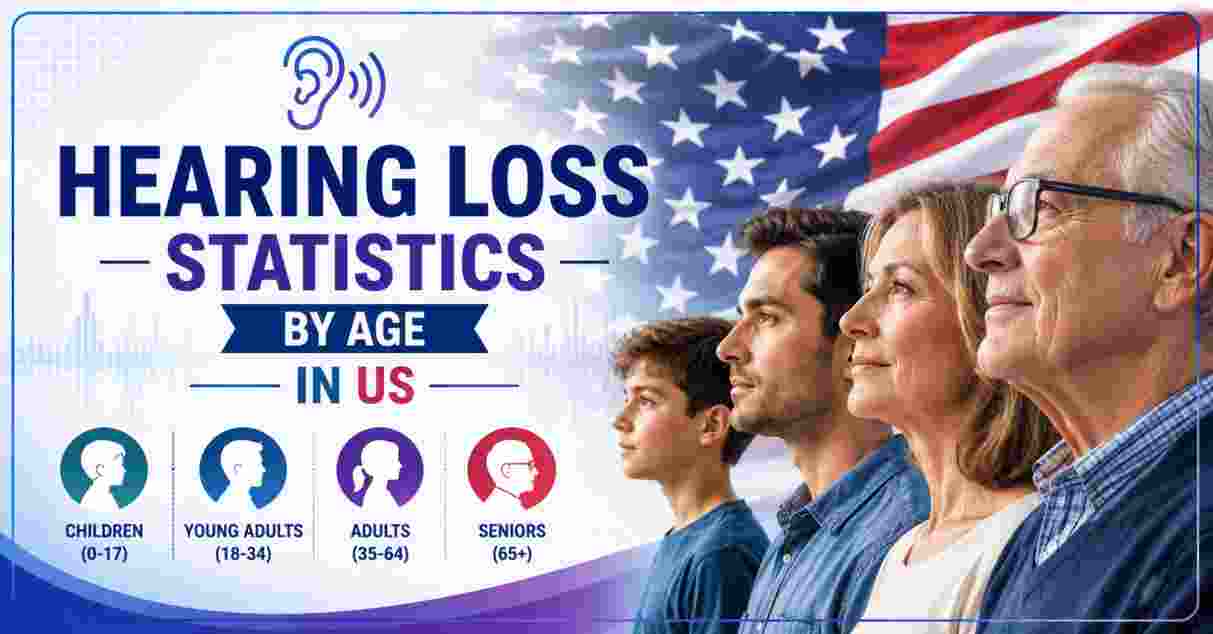
Hearing Loss Prevalence by Age Group in US 2026
DISABLING HEARING LOSS PREVALENCE BY AGE — US 2026
=====================================================

  Ages <18      ▌                         ~0.1–0.3% (congenital/early onset)
  Ages 20–44    ▌                         <2% (primarily noise-induced)
  Ages 45–54    ██                        ~2–5%
  Ages 55–64    ████████                  ~8.5%
  Ages 65–74    █████████████████████     ~22–25%
  Ages 75–84    ████████████████████████████████  ~50%
  Ages 85+      ████████████████████████████████████████  ~90%+
  Ages 71+      ████████████████████████████████  65.3% (all hearing loss)

  Source: NIDCD (NHANES data); NIH Ear & Hearing Journal (2024)
  Scale: Each █ ≈ ~5 percentage points
| Age Group | Hearing Loss Prevalence (US) | Notes / Source |
|---|---|---|
| Newborns / Infants | ~2–3 per 1,000 born with detectable hearing loss | NIDCD; 1 in 500 develop it in early childhood (CDC) |
| Children & teens (6–19) | More than 1 in 10 — over 5.1 million have some degree | ASHA; 1 in 8 show noise-induced hearing loss signs (HHF) |
| Adults ages 12+ | 1 in 8 — 13%, or ~30 million — have bilateral hearing loss | NIDCD (NHANES standard audiometric examination data) |
| Adults ages 20–69 (overall) | ~14% annual prevalence (down from 16% in 1999–2004) | NIDCD / JAMA Otolaryngology, NHANES 2011–2012 |
| Adults ages 20–44 | Very low — primarily noise-related when present | NHANES; <2% disabling hearing loss |
| Adults ages 45–54 | ~2–5% have disabling hearing loss | NIDCD Quick Statistics (NHANES data) |
| Adults ages 55–64 | ~8.5% have disabling hearing loss | NIDCD Quick Statistics (NHANES data) |
| Adults ages 65–74 | ~22–25% — approximately 1 in 4 — have disabling hearing loss | NIDCD; some estimates 25%, others 22% (updated research) |
| Adults ages 71 and older | 65.3% — representing 21.5 million Americans — have hearing loss | HLAA citing peer-reviewed epidemiological data |
| Adults ages 75 and older | ~50% have disabling hearing loss | NIDCD; some updated estimates up to 55% |
| Adults ages 80 and older | ~66–81% have measurable hearing loss | NHANES/NIH data; prevalence increases sharply |
| Adults ages 85 and older | Nearly all experience some degree of hearing loss | PMC study on age-related hearing loss; near-universal at this age |
| Adults 83.0% of US hearing loss | Over age 50 — the overwhelming majority | Ear & Hearing Journal (NIH, 2024) — GBD modeling |
Source: NIDCD Quick Statistics About Hearing (updated 2024); CDC NHIS and NHANES audiometric data; HLAA (Hearing Loss Association of America) 2025; ASHA (American Speech-Language-Hearing Association); NIH Ear & Hearing Journal (2024); PMC study on prevalence among Medicare beneficiaries 71+
The age-stratified picture of hearing loss in the United States is one of the most dramatic exposure-response relationships in all of chronic disease epidemiology. The jump from just ~5% disabling hearing loss among adults aged 45–54 to ~8.5% among those aged 55–64, then to ~22–25% for those aged 65–74, and finally ~50% or more for those aged 75 and older represents a near-exponential acceleration of risk with each passing decade of life. The 2024 data from the Ear & Hearing journal — drawing on Global Burden of Disease modeling — confirms that 83% of all Americans with hearing loss are over age 50, which means the hearing loss epidemic is fundamentally, structurally an aging phenomenon that will intensify dramatically as the US population grows older. By age 85 and beyond, hearing loss becomes nearly universal, with studies consistently showing that virtually all adults at this age have measurable auditory decline.
What makes these age-stratified numbers especially consequential for public health planning in 2026 is the demographic context surrounding them. The US population aged 65 and over now exceeds 58 million and is growing rapidly, while the Baby Boomer generation continues aging through its 70s and 80s — precisely the decades where hearing loss risk accelerates most steeply. Even the relatively modest-looking 8.5% disabling hearing loss rate among 55–64-year-olds translates to millions of Americans in absolute terms given the size of that cohort. Younger cohorts, meanwhile, are not immune: the data that 1 in 8 children ages 6–19 already show signs of noise-induced hearing loss suggests that the next generation of hearing-impaired older adults is already being shaped by today’s headphone and earbuds culture — a trend that WHO estimates puts 1 billion young adults worldwide at risk of permanent, avoidable hearing loss from unsafe listening practices.
Hearing Aid Costs & Access in US 2026
HEARING AID PRICE RANGES — US 2026 (PER PAIR)
===============================================

  Basic OTC / PSAP         ██                    $20–$199
  Average OTC (ASHA survey) ██                   ~$233 average paid
  OTC (typical range)       ████████              $200–$2,000
  OTC average paid          ████                  ~$502 (survey data)
  Costco / Club model       ████████              ~$1,000–$1,700
  Prescription (private)    ████████████████████  $2,000–$8,000+
  Prescription national avg ████████████████████  ~$4,727 (traditional clinic)
  Overall market average    ████████████          ~$2,694 (all channels)
  Apple AirPods Pro (FDA OTC) ██                  $249/pair

  Source: HearingTracker 2025/2026 survey; ASHA survey; FDA OTC ruling data
  Scale: Each █ ≈ ~$400
| Hearing Aid Category / Channel | Cost Range / Average (US 2026) | Notes |
|---|---|---|
| OTC hearing aids (typical range) | $200–$2,000 per pair | FDA-approved for mild-to-moderate loss; no prescription required |
| OTC average price paid (ASHA survey) | ~$233 per pair | American Speech-Language-Hearing Association consumer survey data |
| OTC average paid (HearingTracker survey) | ~$502 per pair | Broader consumer survey including higher-tier OTC devices |
| Apple AirPods Pro (FDA-recognized OTC) | $249 per pair | FDA clinical-grade OTC recognition; does not include professional support |
| Costco / warehouse club model | ~$1,000–$1,700 per pair | Average $1,674 at Costco vs. $5,225+ for similar tech at traditional clinics |
| Prescription hearing aids (clinic-fit) | $2,000–$8,000+ per pair | Includes testing, fitting, follow-ups, warranty, and bundled services |
| Traditional clinic average (2025, no insurance) | ~$4,727 per pair | Consistent with 2018 average of $4,672 — minimal change at this channel |
| Prescription average (private pay) | ~$3,432 per pair | HearingTracker survey, prescription channel including Costco |
| Overall market average (all channels) | ~$2,694 per pair | Blended across OTC, Costco, online, and traditional clinic channels |
| OTC savings vs. prescription (projected) | Up to $2,800 per pair savings | Policymaker projections at time of FDA OTC ruling (2022) |
| State insurance mandates for hearing aids (adults) | Fewer than 10 states require any coverage for adult hearing aids | HearingTracker: mandates sparse and inconsistent |
| Medicare coverage for hearing aids | Not covered under Original Medicare (Parts A and B) for most adults | Medicare Advantage plans may offer some benefits |
| VA hearing aid access | Fully covered for eligible veterans | VA provides hearing aids as a core benefit; 3.6M veterans receive hearing-related benefits |
| Hearing aid market CAGR (to 2030) | ~5% per year | ConsumerAffairs; growth driven primarily by OTC sales expansion |
| Hearing aid user satisfaction | ~77–82% across all purchase channels | MarkeTrak 2022; ~80%+ say aids are helpful in daily life |
Source: HearingTracker 2025/2026 consumer survey data; FDA OTC hearing aid ruling (October 2022); ASHA consumer survey; MarkeTrak 2022 national survey; VA Annual Benefits Report; HearingTracker “Trends in US Hearing Aid Coverage and Access 2024–2025”
The cost landscape for hearing aids in America in 2026 has been fundamentally reshaped by the FDA’s October 2022 ruling creating an over-the-counter hearing aid category for adults with mild-to-moderate hearing loss — and the effects are now clearly visible in consumer spending data. While traditional clinic-fit prescription hearing aids have barely budged in price (averaging around $4,727 per pair in 2025, nearly identical to the $4,672 average recorded in 2018), the proliferation of OTC devices has dragged the overall market average down to approximately $2,694 per pair across all channels. Shoppers who go the OTC route report paying an average of just $233–$502 per pair depending on which survey you consult, while Costco’s warehouse model delivers prescription-equivalent technology at roughly $1,674 per pair — saving buyers approximately 65% compared to traditional clinics for comparable devices. Apple’s AirPods Pro, now FDA-recognized as clinical-grade OTC hearing aids at $249 per pair, has brought hearing assistance into an entirely new consumer context.
The insurance picture, however, remains deeply problematic for millions of Americans. Original Medicare covers no hearing aid costs whatsoever for most beneficiaries, and fewer than 10 states have mandates requiring any adult hearing aid coverage from private insurers. This coverage gap hits hardest for the Americans most likely to need hearing aids — those aged 65 and older on fixed incomes — and is a primary driver of the massive treatment gap identified by NIDCD data. The VA stands as a notable exception, providing full hearing aid coverage for eligible veterans as a core benefit, which partly explains why veterans are more likely than the general population to actually use hearing aids when they have hearing loss. The hearing aid market is projected to grow at a ~5% CAGR through 2030, with OTC sales driving the majority of that expansion as the new category matures, competition intensifies, and consumer awareness of affordable options continues to build.
Hearing Loss Demographics by Gender & Race in US 2026
HEARING LOSS BY GENDER & RACE — US ADULTS 20–69 (NIDCD/NHANES)
================================================================

  GENDER (Ages 20–69)
  Men      ████████████████████  ~Nearly 2x more likely than women
  Women    ████████████          Baseline reference group

  RACE/ETHNICITY — Relative Prevalence (Adults 20–69)
  Non-Hispanic White  ████████████████████  Highest prevalence
  Non-Hispanic Other  ████████████████      Moderate
  Hispanic            ████████████          Moderate-lower
  Non-Hispanic Black  ████████              Lowest prevalence

  AGE 65+ — Adults w/ "Some Difficulty Hearing" (NCHS 2019)
  White 65+   ████████████████████████████████  ~Higher
  Black 65+   ████████████████████              19% some difficulty (NCHS)
  Asian 65+   ████████████████                  ~16.2% some difficulty (NCHS)

  Scale: Each █ ≈ ~5 percentage points (relative, not absolute)
| Demographic Category | Statistic / Data Point | Source |
|---|---|---|
| Men ages 20–69 — hearing loss risk | Almost twice as likely as women to have hearing loss | NIDCD (NHANES 2015–2020 data) |
| Non-Hispanic White adults | Most likely racial/ethnic group to have hearing loss among adults 20–69 | NIDCD Quick Statistics 2024 |
| Non-Hispanic Black adults | Lowest prevalence of hearing loss among adults ages 20–69 | NIDCD Quick Statistics 2024 |
| Black adults 65+ — “some difficulty” | ~19% have some difficulty hearing vs. ~1.9% with a lot of difficulty | NCHS Data Brief #414 (CDC, 2019) |
| Asian adults 65+ — “some difficulty” | ~16.2% have some difficulty hearing; ~3.6% a lot of difficulty | NCHS Data Brief #414 (CDC, 2019) |
| Occupational noise exposure — bilateral HL | ~18% of adults exposed to loud noise 5+ years at work have bilateral speech-frequency hearing loss | NIDCD (NHANES) |
| Adults with no occupational noise exposure | 5.5% have bilateral speech-frequency hearing loss | NIDCD (NHANES) — comparison baseline |
| Hearing loss + lower education link | Hearing loss more prevalent among those who did not complete high school | NHANES cross-sectional trend analysis (PMC, 2024) |
| Employment rate — adults with hearing loss | Only 57.1% employed vs. 73.3% of hearing adults | National Deaf Center data |
| Income gap — hearing loss vs. hearing peers | People with hearing loss earn ~25% less; mean wage $23,481 vs. $31,272 | HLAA citing National Deaf Center research |
| Average annual income loss (unaided) | Those with unaided hearing loss earned on average $20,000 less than those using hearing aids or cochlear implants | Hearing loss economic research |
| Men 45–64 — difficulty with hearing aid | ~21.9% of men 45–64 still experience difficulty even when using hearing aids | NCHS data (compared to 15.8% of women) |
| Veterans with hearing loss benefits | ~2.3 million veterans receive hearing loss benefits | VA / HLAA |
| Veterans with tinnitus benefits | ~1.3 million veterans receive tinnitus compensation | VA / HLAA |
Source: NIDCD Quick Statistics About Hearing (2024); CDC NCHS Data Brief #414 — Hearing Difficulties Among Adults: United States, 2019; National Deaf Center employment and wage data; HLAA (Hearing Loss Association of America) 2025; CDC/NIOSH occupational noise data; VA Annual Benefits Report
The gender and racial disparities in hearing loss prevalence across the United States are consistent, well-documented, and deeply tied to patterns of occupational noise exposure, socioeconomic status, and biological factors. The most striking finding from NIDCD’s NHANES-based data is that men aged 20–69 are nearly twice as likely as women in the same age range to have hearing loss — a gap that is directly attributable to higher rates of occupational and recreational noise exposure among men, particularly in industries like construction, manufacturing, mining, and military service. The fact that approximately 18% of adults with 5+ years of occupational noise exposure have bilateral speech-frequency hearing loss — compared to just 5.5% of those with no noise exposure — makes noise the single most preventable driver of hearing loss in working-age Americans, and the finding that 53% of noise-exposed workers still don’t wear hearing protection on the job (per CDC/NIOSH data) represents an enormous missed opportunity for prevention.
The racial prevalence pattern is less intuitive but equally well-established: non-Hispanic White adults have the highest rates of hearing loss, while non-Hispanic Black adults have the lowest rates among US adults aged 20–69, based on NIDCD’s NHANES analysis. However, this prevalence advantage for Black Americans does not translate into uniform healthcare access — significant disparities in hearing aid uptake, cochlear implant access, and audiology care exist along both racial and socioeconomic lines. The employment and income data paint a particularly stark economic picture: with hearing-impaired adults 16.2 percentage points less likely to be employed and earning an average of $7,791 less per year than their hearing peers, untreated hearing loss in the US represents a significant drag on individual economic productivity — one that accumulates across millions of working-age Americans to constitute a substantial macroeconomic burden.
Noise-Induced & Occupational Hearing Loss in US 2026
OCCUPATIONAL & NOISE-INDUCED HEARING LOSS — US 2026
=====================================================

  Workers exposed to hazardous noise (annually)   ████████████████  30 Million
  Workers NOT wearing hearing protection           ████████████████  53%
  Bilateral HL from occupational noise (5+ yrs)   ████████          ~18%
  Bilateral HL — no occupational noise             ██                ~5.5%
  Coal miners with hearing loss                    ████████████████████  ~90%
  Construction workers with HL                    ████████          ~14%
  Young adults (12–35) at risk from loud audio    ████████████████████  ~50%
  Children (6–19) with noise-induced HL signs     ████████          1 in 8

  Scale: Each █ ≈ ~5 percentage points or million workers proportionally
| Occupational / Noise-Induced HL Metric | Statistic | Source |
|---|---|---|
| Most common work-related injury in US | Noise-induced hearing loss — the leading occupational injury | CDC |
| Workers exposed to hazardous noise (annually) | 30 million US workers at risk (some sources: 22 million) | CDC/NIOSH |
| Workers NOT wearing hearing protection | 53% of noise-exposed workers report not wearing protection on the job | CDC/NIOSH |
| Workers in high chemical exposure risk industries | 13+ million Americans in industries with hearing risk from chemical exposure | CDC |
| Occupational noise share of severe HL in adults | ~16% of severe adult hearing loss attributed to occupational noise | NIH |
| People with any hearing damage from occupation | 1 in 4 with any hearing damage have occupational hearing loss | CDC |
| Coal miners with hearing loss | ~90% have some degree of hearing loss | NIOSH |
| Construction workers — occupational HL | ~14% experience occupational hearing loss | CDC |
| Law enforcement / military / first responders | 8–15% have hearing loss linked to occupational exposure | CDC |
| Adults 20–69 with 5+ years loud occupational noise | ~18% have bilateral speech-frequency hearing loss | NIDCD (NHANES) |
| Adults with no occupational noise exposure | 5.5% bilateral speech-frequency hearing loss — baseline comparison | NIDCD (NHANES) |
| Young adults (12–35) at risk from loud listening | ~50% are at risk from prolonged exposure to loud sounds | WHO; audibel.com citing NIH |
| Young people using headphones at unsafe volumes | ~50% of ages 12–35 use headphones at volumes that risk hearing damage | American Journal of Medicine (AJM) |
| Children (6–19) with noise-induced HL signs | 1 in 8 children show evidence of noise-induced hearing loss | Hearing Health Foundation |
| Veterans — hearing issues are #1 disability | 3.6 million veterans receive hearing-related benefits (loss + tinnitus) | VA Annual Benefits Report / HLAA |
Source: CDC / NIOSH (National Institute for Occupational Safety and Health); NIDCD NHANES occupational noise data; Hearing Loss Association of America (HLAA) 2025; VA Annual Benefits Report; American Journal of Medicine; Hearing Health Foundation
Noise-induced hearing loss is the most preventable form of hearing loss in the United States — and yet it remains the single most common work-related injury in the country, a fact that speaks to a persistent gap between knowledge and behavior at both the individual and institutional level. The CDC/NIOSH data is unambiguous: 30 million American workers are exposed to hazardous noise levels every year, and 53% of noise-exposed workers still don’t wear hearing protection on the job. The consequences play out starkly in sector-specific data: 90% of coal miners have some degree of hearing loss, 14% of construction workers experience occupational hearing loss, and 8–15% of law enforcement, military personnel, and first responders carry hearing damage from their careers. The gap between workers with 5+ years of occupational noise exposure — 18% with bilateral hearing loss — and those with no such exposure — 5.5% — quantifies exactly how much of the hearing loss burden in working-age America is occupational in origin and therefore, in principle, preventable.
The noise threat is not limited to workplaces. The data on younger Americans and recreational noise exposure is increasingly alarming: approximately 50% of individuals aged 12–35 are at risk of hearing damage from prolonged exposure to loud sounds through headphones and earbuds, and 1 in 8 children aged 6–19 already show signs of noise-induced hearing loss according to the Hearing Health Foundation. The WHO estimates that 1 billion young adults worldwide face permanent, avoidable hearing loss from unsafe listening practices — a staggering public health failure driven by the ubiquity of personal audio technology without sufficient public awareness about safe listening thresholds. For the 3.6 million US veterans who collectively receive benefits for hearing loss and tinnitus — their conditions overwhelmingly linked to combat noise, blast exposure, and traumatic brain injuries — hearing damage is the defining occupational health legacy of military service in America.
Hearing Loss Health Consequences & Treatment Gaps in US 2026
HEALTH CONSEQUENCES OF UNTREATED HEARING LOSS — US 2026
=========================================================

  Dementia risk increase (untreated HL)   ████████████████████  2–5x greater
  Dementia risk reduction (hearing aids)  ██████████████████    ~50% slower decline
  Fall risk increase (untreated HL)       ████████████          3x greater risk
  Adults 70+ with HL using hearing aids   ██████████            ~29.2%
  Adults 20–69 with HL using hearing aids █████                 ~16%
  Employment gap (HL vs. hearing adults)  ████████████          16.2 percentage pts
  Income gap (HL vs. hearing)             ████████████          ~25% less earnings
  Workers w/ tinnitus (US)                ████████████          ~27 Million (11.2%)

  Scale: Each █ ≈ 5 percentage points (risk ratios shown as proportional)
| Health & Treatment Metric | Statistic / Data | Source |
|---|---|---|
| Hearing loss as dementia risk factor | Largest single modifiable risk factor for dementia in adults aged 45–65 | Lancet Commission on Dementia Prevention |
| Dementia risk — untreated hearing loss | 2 to 5 times greater risk of developing dementia vs. normal hearing | JAMA research; Hearing Health Foundation |
| Hearing aid use effect on cognitive decline | Hearing aid use can slow cognitive decline by ~50% in older adults at high risk of dementia | JAMA Otolaryngology / audibel.com citing research |
| Fall risk — untreated hearing loss | 3 times greater risk of falling vs. those without hearing loss | Hearing Health Foundation |
| Adults 70+ with HL using hearing aids | Only 29.2% of Medicare beneficiaries 71+ with hearing loss use hearing aids | Senior Living / NIDCD |
| Adults 20–69 with HL using hearing aids | Only 16% have ever worn a hearing aid | NIDCD |
| Hearing aid adoption rate increase | Rose from 30.2% in 2015 to higher levels recently | MarkeTrak tracking data |
| Adults who could benefit but don’t use aids | Approximately 23 million Americans — the treatment gap | NIDCD calculation |
| Tinnitus prevalence in US | ~27 million Americans — 11.2% of the US population | Frontiers in Audiology & Otology (2025) |
| Tinnitus + hearing loss co-occurrence | 90% of tinnitus cases occur with an underlying hearing loss | Hearing Health Foundation |
| 10 dB hearing loss — cognitive link | Significant decrease in cognitive ability for every 10 dB decrease in hearing | Hearing Health Foundation |
| Depression and isolation | Hearing loss strongly associated with depression, social isolation, reduced QoL | Multiple JAMA and NIH-linked studies |
| Hearing loss cases treatable with hearing aids | ~80% of hearing loss cases can be treated with hearing aids | Hearing Health Foundation |
| Cochlear implants — adults and children (US, 2022) | ~183,100 total: ~118,100 adults, ~65,000 children | NIDCD |
| Cochlear implants — adult share of new implants (2024) | Adults captured 57.23% of cochlear implant market revenue in 2024 | Mordor Intelligence market data |
| North America cochlear implant market share (2024) | 42.12% of global cochlear implant revenue | Mordor Intelligence |
Source: Lancet Commission on Dementia Prevention, Intervention and Care (2024 report); JAMA Otolaryngology; Hearing Health Foundation; NIDCD Quick Statistics 2024; Frontiers in Audiology & Otology (2025); MarkeTrak 2022 national hearing aid survey; Mordor Intelligence cochlear implant market data (2025)
The health consequences of untreated hearing loss extend far beyond inconvenient conversations — the emerging research consensus places it at the center of some of the most severe and costly health outcomes facing older Americans in 2026. The Lancet Commission on Dementia Prevention identifies hearing loss as the largest single modifiable risk factor for dementia in adults between the ages of 45 and 65, and the underlying data is striking: adults with untreated hearing loss face 2 to 5 times the risk of developing dementia compared to those with normal hearing. Crucially, however, the data runs in both directions — research cited in major audiology literature shows that hearing aid use can slow cognitive decline by approximately 50% in older adults at high risk of dementia, meaning treatment is not merely a quality-of-life intervention but a potentially disease-modifying one. Similarly, fall risk is three times greater in people with untreated hearing loss, a finding with profound implications for the healthcare costs associated with fall-related fractures and hospitalizations among older adults.
Against this backdrop of serious, documented health consequences, the hearing aid adoption numbers are a genuine public health failure. Only 29.2% of Medicare beneficiaries aged 71 and older with hearing loss actually use hearing aids, and among the broader adult population aged 20–69 who could benefit, that figure drops to just 16%. The key structural barrier is insurance: Original Medicare does not cover hearing aids, and fewer than 10 states mandate any private insurance coverage for adult hearing devices. Meanwhile, the tinnitus burden — experienced by ~27 million Americans (11.2% of the population) — adds a parallel layer of suffering to the hearing health crisis, with 90% of tinnitus cases occurring alongside underlying hearing loss. The cochlear implant sector is one area showing genuine momentum: 42.12% of global cochlear implant revenues come from North America, and expanded Medicare eligibility criteria for cochlear implants are gradually removing historical reimbursement barriers for adults with severe-to-profound hearing loss.
Disclaimer: The data research report we present here is based on information found from various sources. We are not liable for any financial loss, errors, or damages of any kind that may result from the use of the information herein. We acknowledge that though we try to report accurately, we cannot verify the absolute facts of everything that has been represented.