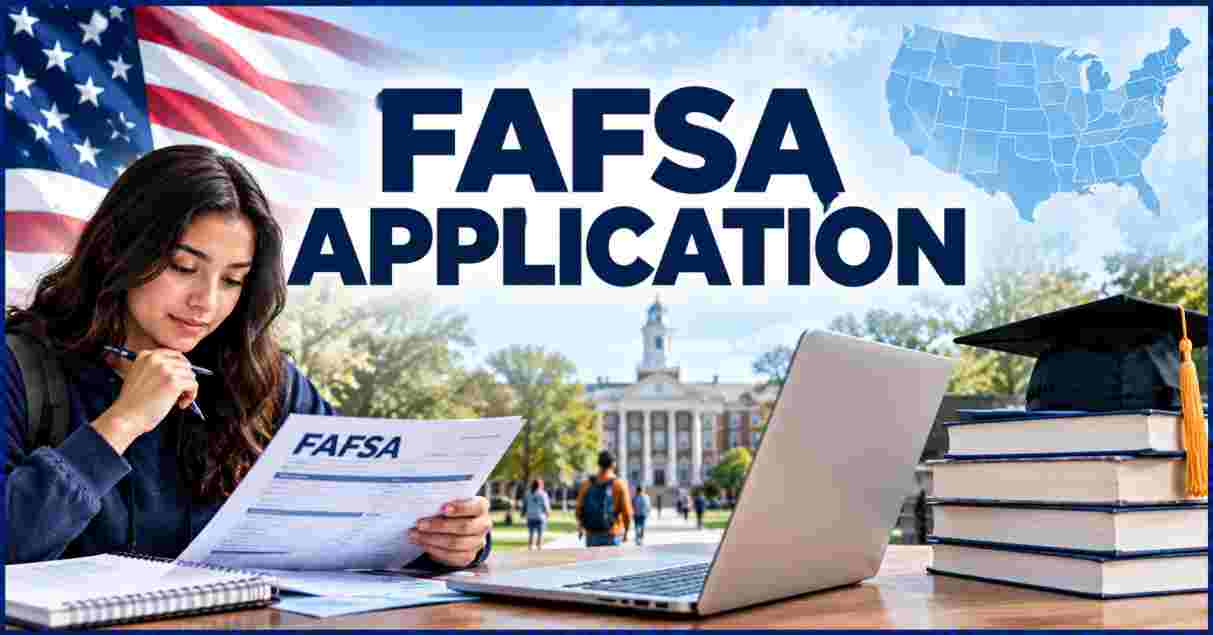
The FAFSA Application 2027–28 opened on September 23, 2026 at StudentAid.gov, covers July 1, 2027 to June 30, 2028, and reports 2025 tax data. The federal deadline is June 30, 2028, but state and college priority dates, such as Texas on January 15, 2027 and California on March 2, 2027, arrive much sooner.
FAFSA Application 2027–28 – Introduction
The FAFSA Application 2027–28 is open, and it opened earlier than any form in program history. The U.S. Department of Education released it to every family on September 23, 2026, one day ahead of last year’s record and 8 days before the October 1 legal deadline. Students who start classes between July 1, 2027 and June 30, 2028 use this form. It reports 2025 tax information, and most filers pull that data straight from the IRS.
Early access matters because aid runs out. About a dozen states award money until funds are gone, and many colleges set their own priority dates. This report covers FAFSA 2027–28 dates, FAFSA income limits, Student Aid Index math, loan caps, and completion data. Every figure comes from federal agencies or national education groups. Where the Department has not published a 2027–28 number yet, the report says so and uses the 2026–27 figure as the reference point. Each section pairs a chart with a data table, so you can compare numbers at a glance. The FAQ at the end answers the questions families type most often.
Interesting Fact(s): FAFSA Application 2027–28 Confirmed Data 2026
Days Open Before the October 1 Legal Deadline (each █ = 1 day)
Legal minimum  | 0 days
2026–27 cycle  | ███████ 7 days
2027–28 cycle  | ████████ 8 days
| Fact | Confirmed 2026 Data |
|---|---|
| Public launch date | September 23, 2026 |
| Legal launch deadline | October 1, 2026 |
| Aid year covered | July 1, 2027 – June 30, 2028 |
| Tax year reported | 2025 |
| Typical completion time | 12–15 minutes |
| Federal filing deadline | June 30, 2028 |
| Maximum Pell Grant (2026–27 reference) | $7,395 |
Source: U.S. Department of Education, Federal Student Aid (StudentAid.gov), 2026.
The September 23, 2026 launch beat the October 1, 2026 legal deadline by 8 days. It also beat the September 24, 2025 launch of the prior cycle, so this is the second straight year the Department opened early. The form covers the aid year from July 1, 2027 to June 30, 2028. It asks for 2025 tax data, which families already have on file. The early release gives colleges more time to package aid and gives families more time to compare offers before spring enrollment decisions.
Most applicants finish their section in 12 minutes or less, and many families complete the whole form in about 15 minutes. The filing window is long. The federal deadline of June 30, 2028 leaves roughly 21 months of access. The maximum Pell Grant of $7,395 is the 2026–27 figure. The Department has not announced the 2027–28 award, so treat that number as a planning estimate. Treat any dollar figure labeled 2026–27 as a reference until the Department publishes the new award year.
FAFSA Application 2027–28 Dates 2026: When Does the Form Open and Close?
Days From the September 23, 2026 Launch to Each Deadline (each █ = 20 days)
Texas priority    | ██████ 114
California        | ████████ 160
Federal deadline  | ████████████████████████████████ 646
| Milestone | Date | Set By |
|---|---|---|
| Beta testing opens | August 2026 | Department of Education |
| Public launch | September 23, 2026 | Department of Education |
| Legal launch deadline | October 1, 2026 | Federal law |
| Texas priority date | January 15, 2027 | State |
| California priority date | March 2, 2027 | State |
| Federal filing deadline | June 30, 2028 | Department of Education |
| Correction deadline | September 12, 2028 | Department of Education |
Source: U.S. Department of Education, Federal Student Aid; The College Investor state deadline tracker, 2026.
The Department tested the form in August 2026 before opening it to all users on September 23, 2026. Federal law required availability by October 1, 2026, and the Department cleared that mark. Two state dates matter most for early planning. Texas sets January 15, 2027, and California sets March 2, 2027. Both fall in the middle of senior year, long before the federal cutoff. Mark both dates on a calendar now, then work backward to schedule document gathering.
The federal deadline is June 30, 2028, and corrections stay open until September 12, 2028. The chart shows the real gap. Texas leaves 114 days after launch, California leaves 160 days, and the federal deadline leaves 646 days. File in October 2026 and you clear every state date with room to spare. Waiting for the federal date puts state grants at risk. About a dozen states award aid until funds run out, so a late filer in those states can miss money while still meeting every federal date.
FAFSA Income Limits 2026: Pell Grant Eligibility Thresholds by Family Size
Maximum Pell Parent AGI at the 225% Limit (each █ = $4,000)
2 people  | ████████████ $47,588
3 people  | ███████████████ $59,963
4 people  | ██████████████████ $72,338
5 people  | █████████████████████ $84,713
| Family Size | 2025 Poverty Guideline | Maximum Pell AGI (175% / 225%) | Minimum Pell AGI (275% / 325%) |
|---|---|---|---|
| 2 | $21,150 | $37,013 / $47,588 | $58,163 / $68,738 |
| 3 | $26,650 | $46,638 / $59,963 | $73,288 / $86,613 |
| 4 | $32,150 | $56,263 / $72,338 | $88,413 / $104,488 |
| 5 | $37,650 | $65,888 / $84,713 | $103,538 / $122,363 |
Source: U.S. Department of Education 2027–28 SAI and Pell Grant Eligibility Guide; U.S. Department of Health and Human Services 2025 Poverty Guidelines (48 contiguous states). Thresholds calculated from the published percentages and rounded.
There is no income limit to file the FAFSA Application 2027–28. Income only matters for Pell Grants. Pell eligibility compares parent adjusted gross income to the 2025 poverty guideline for the family. The guideline is $21,150 for two people, $26,650 for three, $32,150 for four, and $37,650 for five. The lower percentage in each pair applies to married or two-parent households. The higher percentage applies to single parents. The table uses the 48 contiguous states, and Alaska and Hawaii use higher guideline amounts.
Take a family of four. A two-parent household reaches the maximum Pell Grant at $56,263 and the minimum grant at $88,413. A single parent reaches the maximum at $72,338 and the minimum at $104,488. A family of five moves each line up by about $9,625 to $17,875. These are estimates built from the percentages, so check the final Department table before you plan around a cutoff. Filing still pays off above these limits. Colleges use the Student Aid Index for their own grants, and many states use it for theirs.
Student Aid Index 2026: How the FAFSA Application 2027–28 Sets Your Aid Eligibility
Calculated Pell Grant by Student Aid Index (each █ = $500)
SAI $0      | ███████████████ $7,395
SAI $2,000  | ███████████ $5,395
SAI $4,000  | ███████ $3,395
SAI $6,000  | ███ $1,395
SAI $6,655  | █ $740
| SAI Metric | Value |
|---|---|
| Lowest possible SAI | −$1,500 |
| Highest possible SAI | $999,999 |
| SAI assigned to maximum Pell recipients | $0 or lower |
| Maximum Pell Grant (2026–27 reference) | $7,395 |
| Minimum Pell Grant (2026–27 reference) | $740 |
| SAI where Pell hits the minimum | $6,655 |
| SAI ceiling for any Pell Grant | $14,790 |
Source: U.S. Department of Education, 2027–28 SAI and Pell Grant Eligibility Guide; Federal Student Aid Handbook 2026–27, Volume 7.
The Student Aid Index is a number, not a bill. Colleges subtract it from the cost of attendance to measure need. It runs from −$1,500 to $999,999. Students with the lowest incomes receive an SAI of $0 or less if they qualify for the maximum Pell Grant. A calculated Pell Grant equals the maximum award minus the SAI, so every dollar of SAI cuts the grant by a dollar.
Using 2026–27 award levels, the grant runs from $7,395 down to $740. An SAI of $6,655 lands on that $740 floor. Students above it can still earn the minimum grant if they meet the income tests, but only when the SAI stays under $14,790, which is twice the maximum award. The Department has not published 2027–28 award amounts, so these figures will shift if the maximum changes. Assets and untaxed income feed the formula alongside wages, so two families with the same salary can land on different SAI values.
Federal Student Loan Limits 2026: How Much Can You Borrow on the FAFSA Application 2027–28?
Annual Federal Loan Limits by Borrower (each █ = $2,500)
Dependent, year 1    | ██ $5,500
Independent, year 1  | ████ $9,500
Parent PLUS          | ████████ $20,000
Graduate student     | ████████ $20,500
Professional student | ████████████████████ $50,000
| Borrower Type | Annual Limit | Aggregate Limit |
|---|---|---|
| Dependent undergraduate (years 1 / 2 / 3+) | $5,500 / $6,500 / $7,500 | $31,000 |
| Independent undergraduate (years 1 / 2 / 3+) | $9,500 / $10,500 / $12,500 | $57,500 |
| Graduate student | $20,500 | $100,000 |
| Professional student | $50,000 | $200,000 |
| Parent PLUS (per student) | $20,000 | $65,000 |
| Lifetime cap, all federal loans | None | $257,500 |
Source: U.S. Department of Education, Federal Student Aid; One Big Beautiful Bill Act loan provisions effective July 1, 2026.
The One Big Beautiful Bill Act changed federal borrowing on July 1, 2026, and the FAFSA Application 2027–28 falls under those rules. Undergraduate annual limits stay at $5,500, $6,500, and $7,500 for dependent students. Independent students borrow $9,500, $10,500, and $12,500. The big shifts hit graduate students and parents. Graduate PLUS loans ended for new borrowers, graduate students face a $20,500 annual cap, and professional students face $50,000.
Parent PLUS loans now stop at $20,000 a year and $65,000 per student. Aggregate caps are $31,000 for dependent undergraduates, $57,500 for independent undergraduates, $100,000 for graduate students, and $200,000 for professional students. All federal borrowing counts toward a $257,500 lifetime cap. Undergraduate loans first paid between July 1, 2026 and June 30, 2027 carry a 6.52% fixed rate, up from 6.39% a year earlier. The 2027–28 rate will not be set until spring 2027. Subsidized loans stop interest from accruing while the student is enrolled, during the six-month grace period, and during approved deferment. Lower caps push families to compare award letters before they borrow.
FAFSA Completion Statistics 2026: How Many Students File and How Much Aid Goes Unclaimed
High School FAFSA Completion Rate (each █ = 2 percentage points)
Class of 2024, by June 30  | ███████████████████████ 46.0%
Class of 2018, by June 30  | ███████████████████████████ 54.4%
Class of 2026, by May 1    | ███████████████████████████ 54.7%
| Completion Metric | Figure |
|---|---|
| Class of 2026 completion rate, by May 1, 2026 | 54.7% |
| Previous record (class of 2018, by June 30) | 54.4% |
| Class of 2024 completion rate, by June 30 | 46% |
| Class of 2026 completions, by January 2026 | 1.6 million |
| Total 2026–27 FAFSAs, December 2025 | 5 million |
| Total 2026–27 FAFSAs processed, by January 30, 2026 | 7.6 million |
| Unclaimed Pell Grants, class of 2024 | $4.4 billion |
Source: National College Attainment Network FAFSA Tracker; U.S. Department of Education; NASFAA, 2026.
The class of 2026 set an all-time record. By May 1, 2026, 54.7% of seniors had filed, which beat the old mark of 54.4% set by the class of 2018. The class of 2024 reached only 46% by June 30 after the troubled rollout of the revised form. Early launch drove the rebound. The National College Attainment Network also credits three years of experience with the revised form and universal FAFSA policies in states such as Texas, Alabama, and Illinois. The class of 2026 had 1.6 million completions by January 2026, and every state posted more filers than the year before.
Volume tells the same story. The 2026–27 form passed 5 million submissions in December 2025, against roughly 2 million at the same point a year earlier. The Department had processed 7.6 million applications by January 30, 2026. The cost of skipping the form is large. Students in the class of 2024 left $4.4 billion in Pell Grants unclaimed. The FAFSA Application 2027–28 gives the class of 2027 the same early start. Students in that class can expect the same early window, which gives counselors a full autumn to help families file.
FAFSA Application 2027–28 Documents 2026: What Do You Need to File the Form?
Typical Minutes to Finish the FAFSA Application 2027–28 (each █ = 1 minute)
Student section (maximum)  | ████████████ 12
Full family form (typical) | ███████████████ 15
| Requirement | Who Provides It | Detail |
|---|---|---|
| StudentAid.gov account (FSA ID) | Student and each contributor | Signs in and signs the form |
| 2025 federal tax information | Student and contributors | Transfers from the IRS with consent |
| Social Security numbers | Student and contributors | Matches each person to federal records |
| Contributor invitation | Parent or spouse | Sent by text or email |
| Asset records | Student and parents | Cash, savings, checking, and investments |
| Time to finish | Each filer | 12 minutes or less per section |
Source: U.S. Department of Education, Federal Student Aid (StudentAid.gov), 2026.
Every filer starts with a StudentAid.gov account. The student and each contributor need their own login, because each person signs their own section. The FAFSA Application 2027–28 asks for 2025 federal tax information. Contributors who consent can pull that data directly from the IRS, which saves time and cuts typing errors. Social Security numbers tie each person to federal records, and asset records cover cash, savings, checking accounts, and investments.
The redesigned form uses simpler language and a streamlined flow. Students invite a parent or spouse by text or email, and the contributor completes a separate section. The student section takes 12 minutes or less, and the full form takes about 15 minutes. Gather the documents first, send the contributor invitation on day one, and check the FAFSA Submission Summary after you submit to confirm the form went through.
FAFSA Application 2027–28 FAQs 2026
When does the FAFSA Application 2027–28 open?
The FAFSA Application 2027–28 opened to all students and contributors on September 23, 2026 at StudentAid.gov. The Department tested it in August, and no beta sign-up is needed now.
What is the deadline for the FAFSA Application 2027–28?
The federal deadline is June 30, 2028, and corrections close September 12, 2028. State and school deadlines come earlier. Texas uses January 15, 2027, and California uses March 2, 2027.
What tax year does the FAFSA Application 2027–28 use?
The form uses 2025 federal tax information. Most filers consent to transfer that data directly from the IRS, which cuts typing and reduces errors.
Is there an income limit to file the FAFSA?
No. StudentAid.gov tells every student to file, whatever the income, if they want federal, state, or school aid. Income limits apply only to Pell Grant tiers.
What is the maximum Pell Grant for 2027–28?
The Department has not announced the 2027–28 amount. The 2026–27 maximum is $7,395, and the minimum is $740. Pell Grants do not need repayment, and the award depends on the Student Aid Index and enrollment.
How long does the FAFSA Application 2027–28 take?
Most applicants finish their section in 12 minutes or less. Many families complete the full form in about 15 minutes. Gather your documents first to finish much faster.
What do I need to file the FAFSA Application 2027–28?
You need a StudentAid.gov account, Social Security numbers, 2025 tax information with IRS consent, and records of cash, savings, and investments. Parents or spouses receive an invitation by text or email to add their section.
Do I have to refile the FAFSA every year?
Yes. Each aid year needs a new form. Students who attend in 2027–28 file this form, then file the 2028–29 version when it opens. Returning students should refile as soon as the form opens to protect aid for the following year.
What changed on the FAFSA Application 2027–28 form?
The Department rewrote the form in simpler language based on user research. Students can invite a parent or spouse contributor by text or email. The goal is fewer errors and a faster finish.
Does the FAFSA cover state aid and college scholarships?
Yes. Many states and colleges use FAFSA data to award their own grants and scholarships. Some require the form before they will review you, so file even if you expect little federal aid.
Can I submit the FAFSA Application 2027–28 before I choose a college?
Yes. You list the schools that should receive your results, and you can add or remove schools later through a correction. The correction window stays open until September 12, 2028.
What happens if I miss a state priority deadline?
You can still file by the federal deadline of June 30, 2028, but state grants may be gone. About a dozen states award aid until funds run out, so a late form can cost real money.
How do I know my FAFSA went through?
Check your FAFSA Submission Summary and Student Aid Report on StudentAid.gov. The summary shows what you submitted and lets you confirm the form was processed.
Is the FAFSA Application 2027–28 free?
Yes. The form is free at StudentAid.gov. Anyone who asks for payment to file it is not using the official site.
Disclaimer: The data research report we present here is based on information found from various sources. We are not liable for any financial loss, errors, or damages of any kind that may result from the use of the information herein. We acknowledge that though we try to report accurately, we cannot verify the absolute facts of everything that has been represented.