
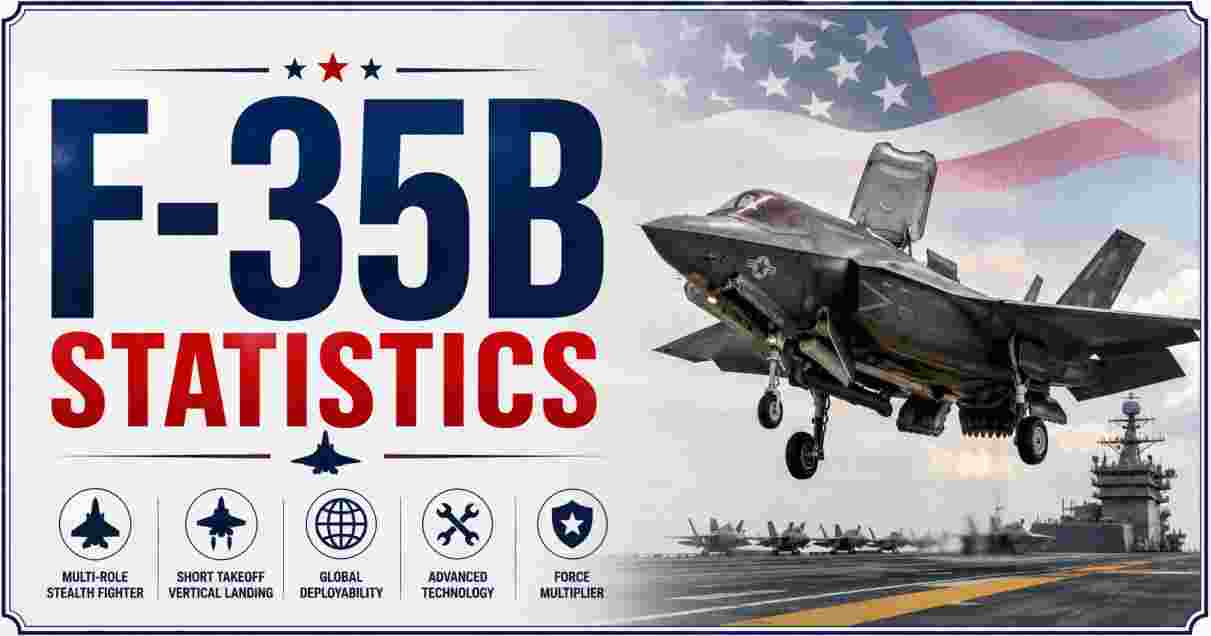
F-35B in America 2026
The F-35B Lightning II is the short takeoff and vertical landing (STOVL) variant of the Lockheed Martin F-35 family, built specifically to give the US Marine Corps — along with the UK Royal Navy, Royal Air Force, and the Italian and Japanese air arms — a fifth-generation stealth fighter capable of operating from amphibious assault ships, aircraft carriers without catapults, and austere forward airstrips. Powered by a shaft-driven lift fan developed with Rolls-Royce, the F-35B is the only supersonic STOVL aircraft ever to reach operational service, a technical achievement that lets it combine low-observable stealth design with the basing flexibility of a much older jump-jet like the AV-8B Harrier it replaced.
As of 2026, the F-35B statistics tell a story of an aircraft simultaneously at the center of expanding allied stealth airpower and a fresh safety scare. The US Marine Corps is closing in on its target fleet of 205 F-35Bs, the UK has just completed its initial order of 48 aircraft, and Japan has become the first nation since World War II to operate fixed-wing combat aircraft from a carrier deck using the type. At the same time, a Marine Corps F-35B crashed at MCAS Miramar in San Diego on July 31, 2026, a reminder that even the most advanced fighter jet ever built still carries real operational risk. This article brings together the latest verified figures on the F-35B’s price, specifications, range, weapons, global fleet, and safety record.
F-35B Statistics 2026: Interesting Facts & Key Figures
| Key Statistic | Figure |
|---|---|
| Average flyaway cost (Lots 15–17) | $109 million |
| Total unit cost including F135 engine | ~$129 million |
| Maximum speed | Mach 1.6 (~1,200 mph) |
| Combat radius (internal fuel) | ~450 nautical miles |
| Ferry range | ~900 nautical miles |
| Empty weight | 32,300 lbs (14,650 kg) |
| Maximum takeoff weight | 60,000 lbs (27,215 kg) |
| US Marine Corps target fleet (end of 2026) | 205 F-35Bs |
| UK initial order completed | 48 F-35Bs (April 30, 2026) |
| Most recent notable crash | July 31, 2026 — MCAS Miramar, San Diego |
Source: Lockheed Martin/f35.com, US Marine Corps 2026 Aviation Plan, USNI News, Bolt Flight
Looking at these F-35B statistics for 2026 as a content writer, what stands out first is the price gap between the F-35B and its sister variants: at $109 million flyaway and roughly $129 million once the $20.4 million F135 engine is included, the F-35B remains the single most expensive of the three F-35 variants to buy, a direct consequence of the added engineering complexity of the shaft-driven lift fan system. That cost premium buys real capability, but it also comes with trade-offs baked directly into the numbers: a combat radius of roughly 450 nautical miles, noticeably shorter than the F-35A’s, because internal volume that would otherwise hold fuel is instead occupied by the lift fan.
The fleet figures tell an equally important story about where the F-35B program stands right now. The US Marine Corps’ 205-aircraft target for the end of 2026, combined with the UK’s newly completed 48-jet order delivered to RAF Marham on April 30, 2026, show a program that has moved well past its early development troubles into steady-state fielding across multiple allied air arms. That progress makes the July 31, 2026 crash at MCAS Miramar — a Marine Corps F-35B that went down short of the runway with the pilot ejecting safely — a particularly current and relevant data point for anyone tracking the aircraft’s real-world safety record alongside its technical specifications.
F-35B Price & Unit Cost Statistics 2026
| Cost Metric | Figure |
|---|---|
| Average flyaway cost (Lots 15–17, official) | $109 million |
| F135-PW-600 engine cost | $20.4 million |
| Total unit cost including engine | ~$129 million |
| Ancillary cost estimate (incl. spares, support gear) | $135.8 million per unit |
| Full sustainment cost per flight hour | ~$35,000–$42,000 |
| Comparison: F-35A flyaway cost | $82.5 million — F-35B costs ~32% more |
| Comparison: F-35C flyaway cost | $102.1 million — F-35B still the priciest |
F-35 VARIANT FLYAWAY COST COMPARISON (LOTS 15-17)
════════════════════════════════════════════════════════════
F-35A   ████████████████░░░░░░░░  $82.5M
F-35C   ████████████████████░░░░  $102.1M
F-35B   ██████████████████████░░  $109M   (most expensive)
════════════════════════════════════════════════════════════
Source: Lockheed Martin/f35.com official pricing, Center for Arms Control and Non-Proliferation, Bolt Flight
The F-35B price statistics for 2026 confirm what defense analysts have said for years: the STOVL variant is consistently the most expensive of the three F-35 models to build, at $109 million flyaway in the most recent Lots 15–17 pricing versus $82.5 million for the F-35A and $102.1 million for the F-35C. That roughly 32% premium over the F-35A reflects the added manufacturing complexity of the lift fan, the roll-post ducting, and the three-bearing swivel nozzle that together let the aircraft take off in a few hundred feet and land vertically on a ship deck.
Once the $20.4 million F135-PW-600 engine is factored in separately, as it typically is in program cost accounting, the true unit cost of an F-35B climbs to roughly $129 million, and older Government Accountability Office figures that bundle in depot maintenance equipment, ground support gear, and spare parts have put the all-in figure as high as $135.8 million. On the operating side, full sustainment costs of $35,000 to $42,000 per flight hour sit at the higher end of the F-35 family’s already well-documented cost-per-flight-hour range, a gap largely attributable to the additional mechanical systems the STOVL configuration requires to keep serviceable.
F-35B Technical Specifications 2026 | Dimensions, Weight & Engine
| Specification | F-35B Figure |
|---|---|
| Engine | Pratt & Whitney F135-PW-600 + lift fan |
| Engine thrust (dry) | 27,000 lbs |
| Engine thrust (afterburner) | 43,000 lbs |
| Wingspan | 35 ft (10.7 m) |
| Length | 51.3 ft (15.6 m) |
| Height | 14.3 ft (4.36 m) |
| Empty weight | 32,300 lbs (14,650 kg) |
| Maximum takeoff weight | 60,000 lbs (27,215 kg) |
| Internal fuel capacity | ~13,500 lbs |
| Airframe service life | 8,000 flight hours |
F-35B EMPTY WEIGHT VS MAX TAKEOFF WEIGHT
════════════════════════════════════════════════════════════
Empty weight        ████████████████░░░░░░░░░░  32,300 lbs
Max takeoff weight  ████████████████████████████  60,000 lbs
════════════════════════════════════════════════════════════
Source: F-35 Joint Program Office (f35.com), Wikipedia, Lockheed Martin technical data
The F-35B’s 2026 technical specifications are dominated by one design decision: the Rolls-Royce shaft-driven LiftSystem, which draws power directly off the F135-PW-600 engine through a clutch-driven shaft to a forward-mounted lift fan, while a rear three-bearing swivel nozzle and wing-mounted roll posts provide the remaining thrust needed for vertical flight. That system is why the F-35B’s empty weight of 32,300 lbs runs roughly 10% heavier than the F-35A despite sharing the same overall length and wingspan, and why its maximum takeoff weight of 60,000 lbs sits well below the F-35A and F-35C’s 70,000-lb ceiling.
The tradeoff shows up most clearly in internal fuel capacity, which at roughly 13,500 lbs is meaningfully smaller than the F-35A’s fuel load, since space that would otherwise hold jet fuel is instead occupied by the lift fan and its associated ducting. Even so, Lockheed Martin and the F-35 Joint Program Office rate the airframe for the same 8,000-hour service life as the other two variants, and the shared F135 engine family across all three models keeps the logistics and maintenance-training footprint largely common across the fleet, a deliberate design choice that has helped keep the overall F-35 program’s parts commonality intact despite the B model’s structural differences.
F-35B Range, Speed & Performance Statistics 2026
| Performance Metric | F-35B Figure |
|---|---|
| Maximum speed | Mach 1.6 (~1,200 mph / 1,930 km/h) |
| Combat radius (internal fuel) | ~450 nautical miles |
| Ferry range | ~900 nautical miles |
| Service ceiling | 50,000 ft (15,240 m) |
| Rate of climb | ~62,000 ft/min |
| Vertical landing “bring-back” capability | Reserve fuel + 2 AIM-120s + 2 precision bombs |
| Comparison: F-35A combat radius | ~590 nautical miles |
| Comparison: F-35C combat radius | ~615 nautical miles |
COMBAT RADIUS COMPARISON — F-35 VARIANTS (INTERNAL FUEL, NAUTICAL MILES)
════════════════════════════════════════════════════════════
F-35B   ████████████████░░░░░░░░░░  ~450 nm
F-35A   █████████████████████░░░░░  ~590 nm
F-35C   ██████████████████████░░░░  ~615 nm
════════════════════════════════════════════════════════════
Source: F-35 Joint Program Office, defensefeeds.com, Lockheed Martin F-35B fact sheet
The F-35B’s range and performance statistics put the aircraft’s central operational compromise in clear numerical terms. Its maximum speed of Mach 1.6 matches the other two F-35 variants exactly, since all three share the same core F135 powerplant, but its combat radius of roughly 450 nautical miles trails the F-35A by about 140 nautical miles and the F-35C by around 165 nautical miles — a direct consequence of the smaller internal fuel tank that the lift fan system requires. Defense analysts have noted this shortfall matters most in Indo-Pacific planning scenarios, where the distances between potential Marine Corps expeditionary bases and contested targets can exceed what the F-35B can reach on internal fuel alone without aerial refueling.
What the F-35B trades away in range, it recovers in basing flexibility that no fixed-wing stealth fighter can match: a 50,000-ft service ceiling and roughly 62,000 feet per minute climb rate identical to its siblings, combined with the ability to land vertically while still carrying a “bring-back” load of reserve fuel plus unexpended munitions — typically two AIM-120 AMRAAMs and two precision-guided bombs — directly onto an amphibious assault ship deck. That bring-back capability, engineered specifically to avoid the costly and dangerous practice of dumping unused expensive munitions into the ocean before landing, is one of the F-35B’s most operationally significant performance figures even though it rarely appears in headline spec sheets.
F-35B Weapons & Payload Capacity Statistics 2026
| Weapons Metric | F-35B Figure |
|---|---|
| Internal weapons bay configuration | 1 main bay, 2 internal stations |
| Internal payload (stealth-clean) | ~3,000 lbs |
| Maximum total payload (all hardpoints) | 15,000 lbs |
| Total hardpoints | 8 (2 internal + 6 external) |
| Internal cannon | None — external gun pod only |
| Primary radar | AN/APG-81 AESA |
| Distributed Aperture System | AN/AAQ-37 DAS — 360-degree infrared |
| Comparison: F-35A/C maximum payload | 18,000 lbs — F-35B carries 17% less |
MAXIMUM WEAPONS PAYLOAD — F-35B VS F-35A/C (TOTAL, ALL HARDPOINTS)
════════════════════════════════════════════════════════════
F-35B          ████████████████████████░░░░  15,000 lbs
F-35A / F-35C  ████████████████████████████  18,000 lbs
════════════════════════════════════════════════════════════
Source: F-35 Joint Program Office, Bolt Flight internal weapons bay analysis
The F-35B’s weapons statistics for 2026 reflect the same structural compromise that shapes its fuel and range figures. Because the lift fan occupies space directly behind the cockpit, the F-35B’s internal weapons bays run roughly 14 inches shorter than the F-35A and F-35C’s, limiting each outboard station to lighter munitions and ruling out internal carriage of larger 2,000-lb class weapons like the GBU-31 JDAM or AGM-154 JSOW, which must instead be carried externally at the cost of the aircraft’s stealth profile. That translates into a maximum total payload of 15,000 lbs against 18,000 lbs for the A and C models — a roughly 17% reduction — even though the F-35B retains full compatibility with two internally carried AIM-120 AMRAAM missiles, matching the baseline air-to-air loadout of its siblings.
Where the F-35B loses ground in raw bomb-bay volume, it makes up for it with the same sensor suite that defines the rest of the F-35 family: the AN/APG-81 AESA radar for simultaneous air-to-air and air-to-ground tracking, and the AN/AAQ-37 Distributed Aperture System, which stitches together six infrared sensors embedded around the airframe to give the pilot a complete 360-degree view regardless of which way the nose is pointed. Unlike the F-35A, the F-35B has no internal cannon at all, relying instead on an external gun pod when gun support is required for a mission — one more example of how every design choice on the STOVL variant traces back to the same underlying need to save weight and internal volume for the lift fan.
F-35B Global Operators & Fleet Statistics 2026
| Operator | F-35B Fleet Data |
|---|---|
| United States Marine Corps | 205 aircraft target by end of 2026 |
| United Kingdom | 48 aircraft — initial order completed April 30, 2026 |
| Italy | 40 F-35Bs ordered (plus 75 F-35As) |
| Japan | 42 F-35Bs ordered; first 3 delivered Aug 7, 2025 |
| Singapore | First F-35 (A & B) delivery expected end of 2026 |
| USMC primary F-35B bases | MCAS Beaufort (SC), MCAS Yuma (AZ), MCAS Iwakuni (Japan) |
| Global F-35 program (all variants) fleet size | ~1,300 aircraft across 17 nations |
F-35B FLEET SIZE BY OPERATOR (CONFIRMED / ORDERED, 2026)
════════════════════════════════════════════════════════════
US Marine Corps   ████████████████████████████  205 (target)
United Kingdom    ██████████████████░░░░░░░░░░  48 (completed order)
Japan             ████████████░░░░░░░░░░░░░░░░  42 (ordered)
Italy             ███████████░░░░░░░░░░░░░░░░░  40 (ordered)
════════════════════════════════════════════════════════════
Source: US Marine Corps 2026 Aviation Plan, US Naval Institute News, GlobalMilitary.net, AviationNews.eu
The F-35B’s global fleet statistics for 2026 show a program that has grown well beyond its original Marine Corps customer. The US Marine Corps’ target of 205 F-35Bs by the end of 2026 — part of a broader 261-aircraft program that also includes 56 carrier-capable F-35Cs — arrives alongside the retirement of the Corps’ last AV-8B Harrier II jump jets, completing a multi-decade transition to an all-stealth fixed-wing fighter fleet.
Internationally, the United Kingdom’s completion of its initial 48-aircraft F-35B order — with the final three jets landing at RAF Marham on April 30, 2026 — marks a major milestone for a program that has previously discussed expanding toward 74 or even 80 aircraft. Japan’s operation of F-35Bs from its modified Izumo-class helicopter destroyers represents the country’s first fixed-wing carrier aviation capability since World War II, while Italy’s 40-aircraft order and Singapore’s expected first delivery by the end of 2026 round out a STOVL operator community that, unlike the F-35A’s wide 17-nation spread, remains a comparatively exclusive club of countries with the amphibious ships or short-runway requirements that justify the type’s added cost and reduced range.
F-35B vs F-35A vs F-35C Comparison Statistics 2026
| Comparison Metric | F-35A | F-35B | F-35C |
|---|---|---|---|
| Takeoff mode | Conventional | Short takeoff / vertical landing | Carrier catapult / arrested |
| Flyaway cost | $82.5 million | $109 million | $102.1 million |
| Empty weight | 29,300 lbs | 32,300 lbs | 34,800 lbs |
| Combat radius | ~590 nm | ~450 nm | ~615 nm |
| Maximum payload | 18,000 lbs | 15,000 lbs | 18,000 lbs |
| Internal cannon | GAU-22/A, 182 rounds | None (external pod only) | None (external pod only) |
| Primary operator | US Air Force | US Marine Corps, UK, Italy, Japan | US Navy |
FLYAWAY COST VS COMBAT RADIUS — F-35 VARIANTS AT A GLANCE
════════════════════════════════════════════════════════════
              Cost ($M)         Combat Radius (nm)
F-35A         ████████████ 82.5     █████████████████ 590
F-35B         ████████████████ 109  █████████████ 450
F-35C         ███████████████ 102.1 ██████████████████ 615
════════════════════════════════════════════════════════════
Source: F-35 Joint Program Office, TheDefenseWatch.com, our F-16 Fighter Jet Statistics 2026 coverage
Set directly against its two siblings, the F-35B’s 2026 comparison statistics confirm it occupies a genuine middle ground in some respects and a clear outlier in others. It is the most expensive of the three variants at $109 million flyaway, yet it carries the least fuel and the shortest combat radius, and its 15,000-lb payload capacity trails both the conventional and carrier variants. None of that makes the F-35B a lesser aircraft — it simply reflects that the STOVL configuration optimizes for basing flexibility rather than range or bring-back weapons load, a tradeoff the Marine Corps and its allied STOVL operators have consistently judged worthwhile given the amphibious and expeditionary missions the type is built to fly.
That specialization becomes clearer when set against a fourth-generation aircraft rather than its own siblings: readers comparing the F-35B’s Mach 1.6 top speed and $109 million price tag against a legacy multirole fighter where the F-16V’s roughly $63–70 million unit cost and Mach 2 top speed illustrate just how much of the F-35 family’s price premium comes specifically from stealth and sensor fusion technology rather than raw kinematic performance — a gap that widens further once the F-35B’s added STOVL mechanical systems are factored in.
F-35B Notable Incidents & Safety Record 2026
| Incident | Date | Outcome |
|---|---|---|
| First-ever F-35 crash (F-35B, MCAS Beaufort, SC) | 2018 | Pilot ejected safely |
| F-35B collision with KC-130 tanker, California | September 2025 | Aircraft lost; further details limited |
| F-35B crash, MCAS Miramar, San Diego | July 31, 2026 | Pilot ejected, non-life-threatening injuries; “Class A mishap” |
| Marine Corps F-35Bs in service (as of Jul 2024) | — | 150 aircraft |
| Combined US F-35 fleet (A+B+C), 2024 GAO analysis | — | 630+ aircraft |
| Total Air Force F-35 “Class A mishaps” since 2000 | — | At least 17 (Air Force Safety Center data) |
F-35B "CLASS A MISHAP" CLASSIFICATION THRESHOLD
════════════════════════════════════════════════════════════
Class A mishap defined as:
  - Damage exceeding $2.5 million, OR
  - Aircraft destroyed, OR
  - Fatality or permanent total disability
════════════════════════════════════════════════════════════
Source: USNI News, Associated Press, CNN, Breaking Defense, UPI
The most current entry in the F-35B’s 2026 safety statistics happened just one day before this report was compiled: on July 31, 2026, a Marine Corps F-35B assigned to Marine Aircraft Group 11, 3rd Marine Aircraft Wing crashed short of the runway at Marine Corps Air Station Miramar in San Diego, erupting into flames as it went down in a dirt field near the base. The pilot ejected safely and was transported to a local medical facility in stable condition with non-life-threatening injuries, and the Marine Corps classified the event as a “Class A mishap” — the military’s most severe accident category, reserved for incidents involving over $2.5 million in damage, a destroyed aircraft, or loss of life.
That incident joins a short but notable list of prior F-35B mishaps, including the program’s first-ever F-35 crash in 2018 at MCAS Beaufort, South Carolina — also a B-model, also with a safe ejection — and a September 2025 collision between an F-35B and a KC-130 tanker over California. Against a backdrop of at least 17 total Air Force F-35 Class A mishaps recorded since 2000 and a combined US fleet of more than 630 F-35s across all three variants as of the most recent GAO analysis, the July 2026 Miramar crash represents a small but real data point in an aircraft safety record that, while broadly strong given the type’s flight-hour totals, continues to draw close scrutiny each time an incident makes headlines given the F-35B’s cost and strategic importance to Marine Corps and allied expeditionary airpower.
Disclaimer: The data research report we present here is based on information found from various sources. We are not liable for any financial loss, errors, or damages of any kind that may result from the use of the information herein. We acknowledge that though we try to report accurately, we cannot verify the absolute facts of everything that has been represented.