
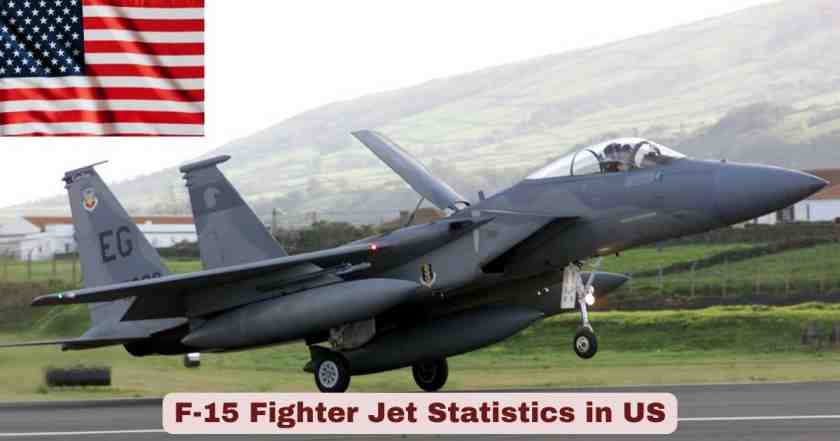
What Is the F-15 Fighter Jet in the US?
The McDonnell Douglas F-15 Eagle — now manufactured by Boeing following the 1997 merger — is the most successful air-superiority fighter in the history of modern warfare, and it remains one of the most operationally important aircraft in the United States Air Force today. First flown on July 27, 1972, and entering operational service in 1976, the F-15 was designed from the outset to be the answer to a generation of Soviet fighters that threatened US air dominance in the skies over Europe and the Pacific. What emerged from that requirement was an aircraft of extraordinary performance: Mach 2.5 top speed, a 60,000-foot service ceiling, twin Pratt & Whitney engines delivering a thrust-to-weight ratio exceeding 1:1 even under combat load, and a weapons system that proved lethal beyond anything its designers had dared hope. The Eagle’s combat record is, without exaggeration, the most dominant in the history of jet aviation — 106 air-to-air kills and zero losses in aerial combat across more than five decades of operation and more than a dozen conflicts. No other fighter jet in history has accumulated anything close to that kill-to-loss ratio at comparable scale.
In 2026, the F-15 story is not one of a platform entering retirement — it is one of active reinvention and expanding investment. The F-15EX Eagle II, Boeing’s radically upgraded 4.5th-generation variant, entered operational service with the Oregon Air National Guard’s 142nd Wing in July 2024 and is now the current baseline of US F-15 production. The FY2026 defense budget allocates $3 billion for 21 additional F-15EXs, bringing the planned total US fleet to 129 aircraft — a number that has been growing, not shrinking, as the Trump administration has embraced the Eagle II as a cost-effective complement to the F-22 and F-35 against near-peer adversaries. At a flyaway cost of $90–$97 million per aircraft depending on production lot, the F-15EX is paradoxically more expensive per unit than the fifth-generation F-35A — yet it offers capabilities the F-35 simply cannot match: the world’s highest payload capacity of any Western fighter at 29,500 pounds, the ability to carry up to 22 air-to-air missiles simultaneously, a 20,000-hour airframe life (more than twice most competitors), and compatibility with hypersonic weapons including the AGM-183A ARRW. This is the F-15’s story in 2026: a Cold War design that refuses to become obsolete, kept relevant by a half-century of continuous upgrade and an operational record that no other fighter on earth can challenge.
Interesting Facts About the F-15 Fighter Jet in the US
Before the detailed statistics, here are the most striking and verified facts about the F-15 Eagle and F-15EX Eagle II — the numbers that define one of history’s greatest combat aircraft.
| # | Fact | Detail |
|---|---|---|
| 1 | Air-to-air combat record | 106 kills, 0 losses — the most dominant kill ratio of any jet fighter in history (through 2026) |
| 2 | Top speed | Mach 2.5 (~1,650+ mph / 2,655 km/h at altitude) — fastest operational US Air Force fighter |
| 3 | Service ceiling | 60,000 feet (F-15C/D); F-15EX: approximately 59,055 feet (18,000 m) |
| 4 | First flight | July 27, 1972 — F-15A maiden flight at Edwards Air Force Base |
| 5 | Entered USAF service | 1976 — with the 555th Tactical Fighter Training Squadron |
| 6 | F-15EX flyaway cost (Lot 2) | ~$90 million per aircraft — confirmed by US Air Force, more than F-35A flyaway cost |
| 7 | F-15EX flyaway cost (Lot 3) | ~$97 million per aircraft |
| 8 | F-15EX flyaway cost (Lot 4) | ~$94 million per aircraft |
| 9 | Fully combat-ready F-15EX cost | Up to $117 million including EPAWSS, targeting pods, and IRST pods |
| 10 | F-15EX payload capacity | 29,500 lbs (13,300 kg) — highest of any fighter in the Western inventory; nearly double the F-35 |
| 11 | F-15EX maximum missiles | Can carry up to 22 air-to-air missiles simultaneously — more than any other USAF fighter |
| 12 | F-15EX airframe life | 20,000 flight hours — more than double the typical fighter jet life of 8,000 hours |
| 13 | F-15EX operational service | July 2024 — Initial operational capability declared at Oregon’s 142nd Wing |
| 14 | F-15EX maiden flight | February 2, 2021 |
| 15 | FY2026 defense budget allocation | $3 billion for 21 additional F-15EX aircraft — planned total grows to 129 |
| 16 | Desert Storm F-15 kills | F-15s accounted for 36 of the 39 air-to-air kills by the USAF against Iraq in 1991 |
| 17 | Israeli kills with F-15 | Over 50% of all F-15 kills achieved by Israeli Air Force pilots |
| 18 | F-15EX procurement history | Originally 144 planned → cut to 80 (2022) → cut to 98 (2024) → raised to 129 (FY2026) |
| 19 | Israel F-15IA contract | Israel signed a contract for 25 F-15IA fighters (based on F-15EX) in December 2025, with option for 25 more |
| 20 | F-15E Strike Eagle flight hour cost | ~$19,000 per flight hour — comparable to the F-35A |
Source: Wikipedia McDonnell Douglas F-15 Eagle (updated 2026); Wikipedia Boeing F-15EX Eagle II; Air and Space Forces Magazine (F-15 fact sheet, October 2025); Breaking Defense (F-15EX cost exclusive, October 2023); Simple Flying (F-15 cost 2025, June 2025); The War Zone (F-15EX fleet size, June 2025); Air and Space Forces Magazine (2026 budget analysis, June 2025); National Security Journal (August 2025); WION News (F-15E flight hour cost, 2025); Boeing F-15EX official page
Reading the F-15’s statistics as a set, what stands out most immediately is the sheer compression of performance into a platform conceived and first built more than 50 years ago. Mach 2.5 — the same top speed a young test pilot hit at Edwards Air Force Base in 1972 — remains faster than almost every other aircraft being manufactured anywhere in the world today. The 20,000-hour airframe life of the F-15EX is not an incremental improvement over its predecessors — it is a complete reimagining of the structural endurance of a combat aircraft. Most fighter jets are expected to fly for 8,000 hours across their service lives. The F-15EX will fly for more than twice as long, which means that even at similar per-unit purchase prices, its cost-per-operational-hour over a career is dramatically lower than competing platforms. And the 29,500-pound payload — nearly double what the F-35 can carry — positions the Eagle II as the platform of choice whenever you need to deliver a lot of weapons to a lot of targets from a lot of distance.
The 106-0 air-to-air combat record is the number that defines the F-15’s legacy, and it deserves more scrutiny than it usually gets. This is not a record built on a handful of engagements or a single war. It spans decades, multiple operators (US, Israel, Saudi Arabia, Japan), multiple conflicts (Lebanon 1982, Gulf War 1991, Operation Allied Force 1999, Operation Iraqi Freedom 2003, Iran-Ukraine air attack on Israel 2024), and dozens of different adversary aircraft types — from MiG-21s to MiG-29s to MiG-25s to Su-22s. The fact that no F-15 has ever been shot down in air-to-air combat, despite the cumulative engagement record of 106 kills, suggests that whatever factors combine to produce that outcome — pilot training, radar advantage, weapons quality, energy management, or some combination of all four — they are remarkably consistent and remarkably durable across different operators, different conflicts, and different adversary quality levels.
F-15 Fighter Jet Cost Statistics 2026
| Cost Parameter | F-15EX Eagle II Data |
|---|---|
| Initial unit cost estimate (pre-production) | ~$80 million — original projection |
| Lot 1 flyaway cost | $80.5 million per aircraft (November 2022 contract) |
| Lot 2 flyaway cost | ~$90 million per aircraft — confirmed by US Air Force to Breaking Defense |
| Lot 3 flyaway cost | ~$97 million per aircraft |
| Lot 4 flyaway cost | ~$94 million per aircraft |
| Pentagon 2023 reported flyaway cost | $94 million per aircraft (assuming 104-unit purchase) |
| Fully combat-capable unit cost | Up to $117 million when adding EPAWSS EW suite, targeting pods, IRST pods |
| F-35A flyaway cost (Lots 15–17) | $82.5 million — cheaper per unit than the F-15EX on flyaway basis |
| F-35B flyaway cost | $109 million — more expensive than F-15EX |
| F-35C flyaway cost | $102.1 million — more expensive than F-15EX |
| F-22 Raptor unit cost (program cost) | $143 million stated unit cost; estimated actual production cost $350 million+ |
| F-15E Strike Eagle original unit cost (late 1990s) | $31.1 million (historical); adjusted for inflation: $65 million+ in current dollars |
| F-15EX flight hour cost | Lower than F-35 operational costs; comparable to ~$19,000/hr (F-15E benchmark) |
| First F-15EX contract (July 2020) | 8 aircraft for $1.2 billion |
| FY2021 F-15EX appropriations | $1.23 billion for 12 aircraft |
| FY2026 F-15EX budget | $3 billion / $3.1 billion for 21 additional aircraft |
| Qatar F-15QA deal (36 aircraft, 2017) | US$12 billion including weapons, support, equipment, and training |
| Initial contract ceiling value (144-plane option) | Approximately $23 billion — announced with July 2020 contract |
Source: Breaking Defense (October 2023 — exclusive cost reporting); Simple Flying (June 2025); Air and Space Forces Magazine (budget analysis, June 2025); The War Zone (June 2025); Wikipedia Boeing F-15EX Eagle II; 19FortyFive (cost analysis, November 2024); National Interest (cost analysis); Boeing F-15EX page; Aerotime (top 10 most expensive fighters, 2025); Asia Pacific Insights
The price trajectory of the F-15EX is one of the most discussed topics in current US Air Force procurement circles, because it defies the intuitive expectation that a fourth-generation aircraft should cost less than a fifth-generation one. When Boeing first proposed the F-15EX in the late 2010s, it positioned the aircraft as an $80 million alternative to the F-35 — cheaper to buy, cheaper to operate, and immediately available from an active production line shared with export customers. The reality has been considerably messier. Lot 2’s $90 million flyaway cost — already $7.5 million more than an F-35A at the time — was the moment that eyebrows began to rise. Lot 3 climbed to $97 million, and while Lot 4 settled back to $94 million, the overall picture is of a programme where costs have risen persistently beyond their original projections. The reasons are well-documented: retooling the production line required significant upfront investment, supply chain disruptions from the pandemic era inflated component costs, and reduced order quantities (the programme went from 144 to 80 to 104 to 98 and eventually back up to 129) meant that economies of scale never materialised as planned.
The comparison with the F-35A is worth examining carefully because it is genuinely paradoxical. The F-35 is arguably the most complex weapons programme in human history — a fifth-generation stealth fighter with active electronically scanned array radar, electro-optical targeting systems, distributed aperture sensors, and a single shared airframe designed to serve three different branches of the US military across carrier, conventional, and short-takeoff/vertical-landing roles. The F-15EX is a heavily upgraded fourth-generation aircraft with no stealth capability. Yet on a simple flyaway-cost comparison, the F-15EX now costs more. The answer lies in production scale: the F-35 programme of record is 1,763 aircraft, and mature production at 100+ units per year creates enormous economies of scale that drive unit costs down. The F-15EX programme at 129 aircraft total, with roughly 14 delivered per year, cannot compete on that basis. The per-unit cost comparison also ignores the F-15EX’s 20,000-hour airframe life — measured across an operational career, the cost-per-flight-hour picture is considerably more favourable for the Eagle II.
F-15 Fighter Jet Performance Specifications
| Performance Parameter | F-15C/D Eagle | F-15E Strike Eagle | F-15EX Eagle II |
|---|---|---|---|
| Role | Air superiority | Multirole strike fighter | Advanced multirole / air superiority |
| Generation | 4th generation | 4th generation | 4.5th generation |
| Crew | 1 (C) / 2 (D) | 2 (pilot + WSO) | 2 (pilot + WSO) |
| Length | 63.8 ft (19.45 m) | 63.8 ft | 63.8 ft |
| Wingspan | 42.8 ft (13.05 m) | 42.8 ft | 42.8 ft |
| Height | 18.7 ft (5.69 m) | 18.5 ft | 18.5 ft |
| Max takeoff weight | 68,000 lb (30,845 kg) | 81,000 lb (36,741 kg) | 81,000 lb (approx.) |
| Engines | 2× P&W F100-PW-220/229 | 2× P&W F100-PW-229 | 2× GE F110-GE-129 |
| Engine thrust (each, with afterburner) | 23,450–29,000 lb | 29,000 lb | 29,000 lb |
| Thrust-to-weight ratio | >1:1 (unloaded) | ~0.93:1 (loaded) | ~1:1 (unloaded) |
| Maximum speed | Mach 2.5 (~1,650 mph) | Mach 2.5 | Mach 2.5 |
| Service ceiling | 60,000 ft | ~50,000 ft | ~59,055 ft |
| Combat radius | ~1,000 nautical miles (with CFTs) | ~700+ nm (with CFTs) | 700+ nm (with CFTs) |
| Ferry range | 2,878 miles (3,450 mi with CFTs + 3 tanks) | 2,400 miles+ | 2,762 miles+ |
| Internal fuel capacity | 13,455 lb | 13,123 lb | 13,455 lb+ |
| Payload capacity | 23,000 lb | 23,000 lb (10,400 kg) | 29,500 lb (13,300 kg) |
| Radar | AN/APG-63 (V)3 AESA | AN/APG-82(V)1 AESA | AN/APG-82(V)1 AESA |
| Electronic warfare | Limited legacy EW | AN/ALQ-239 DEWS | AN/ALQ-250 EPAWSS (full-spectrum) |
| IRST sensor | N/A | AN/AAS-42 | Legion Pod AN/ASG-34(V)1 IRST21 |
| Cannon | M61A1 Vulcan 20mm (940 rounds) | M61A1 Vulcan 20mm | M61A1 Vulcan 20mm (500 rounds) |
| Hardpoints | 11 | 15+ | 15+ (incl. previously dormant outboard stations) |
| Max air-to-air missiles | 8 AIM-120 AMRAAMs | 4–8 AMRAAMs | Up to 22 missiles |
| Airframe life | 8,000 hours (extended) | 8,000–16,000 hours (with depot maintenance) | 20,000 hours |
Source: Air and Space Forces Magazine F-15 fact sheet (October 2025); Wikipedia McDonnell Douglas F-15 Eagle; Wikipedia McDonnell Douglas F-15E Strike Eagle; Wikipedia Boeing F-15EX Eagle II; Boeing F-15EX official specifications; Simple Flying (June 2025); National Interest (September 2025); WION News
The specifications table makes one thing immediately clear: the F-15EX Eagle II is not the same aircraft that flew in 1972, or even 1989. While it shares the airframe geometry and twin-engine configuration of its predecessors, almost everything that makes the F-15EX what it is today is a product of the last five to ten years of development. The AN/APG-82(V)1 AESA radar is the same system used in the F-15E Strike Eagle and represents a quantum leap over the mechanically scanned radars of earlier Eagles — providing simultaneous air-to-air and air-to-ground search, the ability to track multiple targets while continuing to scan, and dramatically enhanced resistance to jamming. The EPAWSS electronic warfare system from BAE Systems gives the F-15EX a full-spectrum electronic warfare capability that allows it to detect, identify, and jam or deceive adversary radar systems across the full frequency range — making it far more survivable in contested airspace than any previous Eagle variant.
The 29,500-pound payload is perhaps the most strategically significant figure in the specifications table. In a contested peer-adversary environment, where stealth fighters like the F-35 can carry only four air-to-air missiles internally (to preserve their radar cross-section), the F-15EX operating as a “missile truck” — carrying 22 AMRAAMs or a combination of missiles and stand-off weapons — can dramatically multiply the firepower available to a mixed formation. The tactical concept is straightforward: F-22s and F-35s penetrate defended airspace using stealth, acquire targets, and share targeting data over Link 16 to F-15EXs operating at stand-off range, which then fire salvoes of long-range missiles from beyond the threat envelope. No single aircraft type optimised for stealth can match what this combination of complementary capabilities achieves.
F-15 Combat Record and Operational History Statistics
| Combat Parameter | Data |
|---|---|
| Total air-to-air kills (all variants, all operators) | 106 confirmed kills (through 2026) |
| Air-to-air losses | 0 — no F-15 has been lost in air-to-air combat |
| Kill-to-loss ratio | 106:0 — unmatched by any jet fighter in history |
| First F-15 kill | 1979 — scored by Israeli Air Force ace Moshe Melnik |
| Operators with combat kills | Israel (majority), United States, Saudi Arabia |
| Israeli F-15 kills | Over 50% of all 106 kills — primarily in Lebanon conflicts 1979–1982 |
| Lebanon War 1982 kills (Israel) | 40+ Syrian aircraft downed with no Eagles lost — Operation Peace for Galilee |
| Operation Desert Storm kills (USAF) | 36 of USAF’s 37 air-to-air kills in the 1991 Gulf War attributed to F-15s |
| Desert Storm F-15C kills | 34 confirmed kills — MiG-29s, MiG-25s, MiG-23s, Su-22s, Mirage F1s, and others |
| F-15E Strike Eagle — only air-to-air kill | February 14, 1991 — destroyed Iraqi Mi-24 helicopter with a 2,000-lb laser-guided bomb |
| Operation Allied Force (Yugoslavia 1999) | F-15C destroyed 2 MiG-29s — including kills by Capt. Jeff “Claw” Hwang of 493rd FS |
| April 2024 — Iranian drone attack on Israel | USAF F-15Es helped shoot down over 70 Iranian one-way attack drones alongside Israeli forces |
| Non-combat losses (USAF, through January 2024) | 131 F-15s destroyed in mishaps; 59 fatalities — lifetime average 2.93 losses per year |
| Non-combat loss rate | 1.99 aircraft destroyed per 100,000 flight hours |
| F-15E Desert Storm sorties | ~2,200 sorties flown during Gulf War; destroyed 60% of Iraqi Medina Republican Guard total force |
| F-15C/D active duty retirement | All active duty F-15Cs retired April 2025; F-15Ds some still in service |
| F-15E Strike Eagle retirement (planned) | 2030s — expected to remain in service for over a decade |
| F-15EX IOC declared | July 10, 2024 — at Portland ANGB, Oregon (142nd Wing) |
| Notable feat | In 1983, Israeli F-15D landed with only one wing after mid-air collision — fuselage lift sufficient to maintain flight |
Source: Wikipedia McDonnell Douglas F-15 Eagle (2026 update); Wikipedia List of F-15 losses; Air and Space Forces Magazine; National Security Journal (December 2025); Wikipedia McDonnell Douglas F-15E Strike Eagle; The Aviation Geek Club
The F-15’s combat record is not simply a statistic — it is an argument about what constitutes effective air superiority fighter design. The 106-0 record was not achieved by stealth. The F-15 is one of the most radar-visible aircraft in the Western inventory — its large twin-engine fuselage and broad wing surface generate a radar cross section many times larger than an F-22 or F-35. What it achieved its record through was a combination of superior situational awareness (driven by the best radar of its generation at every stage of development), superior speed and energy management (that Mach 2.5 ceiling and thrust-to-weight ratio above 1:1 mean that an F-15 pilot can almost always choose the terms of engagement), and the most rigorous pilot training doctrine in the world. The lesson that the Israeli Air Force drew from its F-15 experience — that training and tactics matter more than raw airframe specifications — is one that has fundamentally shaped Western air combat doctrine ever since.
The Desert Storm numbers are particularly striking in their scale. In the 42-day air campaign, USAF F-15s accounted for 36 of 37 coalition air-to-air kills. These were not happening in a fair fight between roughly matched opponents — they were happening in engagements where American pilots had decisive radar, missile, and training advantages. But the fact that the F-15 was the platform through which that dominance was expressed — not the F-111, not the A-10, not any other aircraft — is a testament to the aircraft’s fundamental design philosophy: maximum performance in air combat above all else. The April 2024 Iranian drone and missile attack on Israel, in which F-15Es (alongside Israeli F-15Is and other platforms) helped neutralise over 300 incoming projectiles, added another chapter to an operational record that now spans five decades and shows no signs of concluding.
F-15EX Eagle II Procurement and Production Statistics 2026
| Procurement Parameter | Data |
|---|---|
| Original USAF procurement plan (2019) | 144 aircraft |
| Revised procurement (May 2022) | Reduced to 80 aircraft |
| Revised procurement (March 2024) | Further reduced to 98 aircraft (fiscal constraints) |
| FY2026 procurement addition | 21 additional aircraft — announced June 2025 |
| Current total program of record (FY2026) | 129 aircraft (includes reconciliation bill funding) |
| FY2026 budget allocation | $3 billion / $3.1 billion for 21 F-15EXs |
| Initial contract awarded | July 2020 — 8 aircraft for $1.2 billion; $23 billion ceiling for up to 144 |
| Full-rate production approval | June 2024 — DoD approved full-rate production (FRP) |
| Annual delivery rate (recent) | ~14 per year (14 delivered in 2024, 9 in 2023, 12 in 2022, 16 in 2021, 4 in 2020) |
| Production facility | Boeing Defense, Space & Security, St. Louis, Missouri |
| F-15EX first delivery | March 2021 — to Eglin Air Force Base, Florida |
| Units delivered to Oregon ANG (142nd Wing) | First arrived June 5, 2024; second July 2024 |
| FY2026 reduced F-35 purchase | Only 24 F-35s planned for USAF in FY2026 — half of previously planned 48 |
| Michigan ANG — Trump announcement | Michigan’s 107th Fighter Squadron to replace A-10s with 21 F-15EXs |
| A-10 retirement | All A-10s to retire 2 years ahead of schedule under FY2026 budget |
| Airframes replacing | F-15EX replacing all F-15C/D variants (all active duty F-15Cs retired April 2025) |
| Israeli F-15IA contract (December 2025) | 25 F-15IA fighters (based on F-15EX) with option for 25 more |
| Egypt talks (November 2025) | Talks for up to 46 F-15EX fighters, deliveries starting as early as 2028 |
| Saudi Arabia potential sale | 54 F-15EXs discussed during 2024 World Defense Show in Riyadh |
| Indonesia | US State Dept approved sale of up to 36 F-15IDN fighters; deal in advanced stages |
Source: Wikipedia Boeing F-15EX Eagle II (updated 2026); The War Zone (June 2025); Air and Space Forces Magazine (June 2025); National Security Journal (August 2025); DOD 2024 Annual Report (reviewed by Simple Flying, February 2025); Asia Pacific Insights (June 2025); National Interest (August 2025)
The procurement story of the F-15EX is a case study in how military programmes navigate the tension between budget realities, strategic requirements, and political priorities. The initial 144-aircraft programme of record was set in 2019 based on DoD analysis that the USAF needed a certain number of fighters to maintain fleet size as legacy F-15C/Ds aged out of service. Then the budget constraints hit: the Fiscal Responsibility Act and competing priorities between the F-35, the F-22 upgrade programme, and the emerging Next Generation Air Dominance (F-47) programme squeezed the F-15EX budget. By 2024 the programme was down to 98 jets — barely two-thirds of the original requirement. The FY2026 reversal, adding 21 aircraft and taking the total to 129, reflects both a Pentagon assessment that the F-15EX is performing better than expected (the DoD’s Director of Operational Test & Evaluation gave it a glowing review, finding it “operationally effective in all its air superiority roles, including… against surrogate fifth-generation adversary aircraft”) and a political dynamic driven by Trump’s announcement that the Michigan Air National Guard’s A-10 fleet would be replaced by Eagle IIs.
The export picture for the F-15EX is increasingly significant, both because it generates revenue for Boeing and because it drives down per-unit costs through increased production volume. Israel’s December 2025 contract for 25 F-15IAs with an option for 25 more came during an active regional conflict in which F-15s have been performing critical missions daily. Egypt’s talks for up to 46 aircraft would represent one of the largest new F-15 export deals in years. The Saudi Arabia potential purchase of 54 aircraft — already discussed at the 2024 World Defense Show — would be transformative for the production line. And Indonesia’s 36-aircraft deal would add another major Pacific operator. Together, these potential export orders could eventually push F-15EX total production well above 200 aircraft, significantly improving the economics of the entire programme.
F-15 Variants and Operators Statistics 2026
| Variant / Operator | Key Details |
|---|---|
| F-15A/B (original, retired) | Air superiority; F-15A single-seat, F-15B two-seat trainer; retired from US service September 16, 2009 |
| F-15C/D (US Air Force / ANG) | Upgraded air superiority; F-15C single-seat, F-15D two-seat; all active duty F-15Cs retired April 2025 |
| F-15E Strike Eagle (USAF) | Multirole deep strike; entered service 1989; to retire 2030s; nuclear capable (B61-12 bombs) |
| F-15EX Eagle II (USAF) | Most advanced variant; entered service July 2024; program of record 129 aircraft |
| F-15J/DJ (Japan — Mitsubishi) | Japanese licensed variant; air defence; ~213 F-15Js in Japan Air Self-Defense Force |
| F-15SA (Saudi Arabia) | Saudi Advanced Eagle; 84 aircraft purchased in 2011; AESA radar, digital EW |
| F-15QA (Qatar) | Qatari Advanced; 36 ordered in 2017 ($12B deal); 33 of 36 delivered; direct F-15EX predecessor |
| F-15I (Israel — “Ra’am”) | Israeli Strike Eagle variant; 25 aircraft; first flew 1997 |
| F-15IA (Israel — ordered 2025) | New Israeli variant based on F-15EX; 25 ordered December 2025 with option for 25 more |
| F-15IDN (Indonesia) | Export variant for Indonesia; up to 36 approved by US State Department |
| F-15SG (Singapore) | Singapore variant; 40 aircraft; advanced avionic suite |
| F-15EX global operators (as of Feb 2026) | 4 countries operating F-15EX variant; approximately 147 Advanced Eagle aircraft in active service |
| Total F-15s produced (all variants) | Over 1,500 F-15s produced since 1972 |
| Total US Air Force F-15s (all variants) | ~400+ aircraft including all variants |
| Countries operating F-15 variants | United States, Israel, Japan, Saudi Arabia, Qatar, Singapore (F-15EX baseline) |
| US Air Force — F-15EX units (as of 2026) | 142nd Wing (Portland, Oregon); additional ANG units receiving aircraft |
Source: Wikipedia McDonnell Douglas F-15 Eagle; Wikipedia Boeing F-15EX Eagle II; Air and Space Forces Magazine; Global Military (F-15EX specs, February 2026); National Security Journal (August 2025); Wikipedia McDonnell Douglas F-15E Strike Eagle
The F-15 family’s global operator list tells the story of four decades of American aerospace export dominance in the high-performance air-superiority segment. Japan, which licenses and manufactures its own F-15Js through Mitsubishi, fields by far the largest non-American F-15 fleet with over 200 aircraft — a strategic choice that reflects Tokyo’s need for a domestic production capability as much as its preference for the platform’s performance. Saudi Arabia’s 84 F-15SAs represent one of the largest foreign military sales in the aircraft’s history and have provided Boeing with revenue that helped keep the St. Louis production line active even during periods when US domestic orders were low. Qatar’s $12 billion deal for 36 F-15QAs — which included weapons, training, and support — was the direct commercial and technical predecessor to the F-15EX, because many of the digital flight control systems, large-area displays, and avionics integrated for Doha first appeared on the QA before being incorporated into the US Air Force variant.
The retirement of all active-duty USAF F-15Cs in April 2025 marked the end of a 49-year chapter in American air power history. For nearly five decades, the single-seat F-15C was the backbone of US air superiority — the aircraft that pilots flew in the Gulf War, enforced no-fly zones over Iraq and Bosnia, and maintained combat air patrols over the United States after September 11. Its replacement by the F-15EX in Air National Guard units is not a downgrade — the Eagle II’s capabilities comprehensively exceed the C model’s. But the C model’s retirement represents something symbolic: the original Eagle, the aircraft designed to counter Soviet fighters in Central European skies that may have never come, is gone from active service. What remains is the platform’s legacy in the form of a fundamentally different but unmistakably related aircraft, carrying the same name into a threat environment its designers could never have imagined.
F-15 vs Comparable Fighters Cost and Performance Comparison 2026
| Aircraft | Country | Generation | Unit Cost (approx.) | Top Speed | Payload | Stealth |
|---|---|---|---|---|---|---|
| F-15EX Eagle II | USA | 4.5th gen | $90–$117M (flyaway–combat ready) | Mach 2.5 | 29,500 lb | No |
| F-35A Lightning II | USA | 5th gen | $82.5M (flyaway, Lots 15–17) | Mach 1.6 | 18,000 lb (internal + external) | Yes |
| F-35B | USA / UK / others | 5th gen | $109M | Mach 1.6 | Limited | Yes |
| F-35C | USA (Navy) | 5th gen | $102.1M | Mach 1.6 | Limited | Yes |
| F-22 Raptor | USA | 5th gen | $143M stated; $350M+ actual | Mach 2.25 | 2,000 lb (internal) | Yes |
| F-15E Strike Eagle | USA | 4th gen | ~$65M (inflation-adjusted) | Mach 2.5 | 23,000 lb | No |
| Eurofighter Typhoon | UK / EU | 4.5th gen | $90–$110M | Mach 2.0 | 16,500 lb | No |
| Dassault Rafale | France | 4.5th gen | $85–$125M | Mach 1.8 | 21,000 lb | No |
| China J-20 | China | 5th gen | $100–$150M (estimated) | Mach 2.0+ | Limited | Yes |
Source: Breaking Defense (F-15EX cost); Simple Flying (June 2025); Aerotime (2025 most expensive fighters); The War Zone; WION News (F-15E inflation cost); National Interest; Air and Space Forces Magazine
The cost and performance comparison table reveals the central paradox of the F-15EX’s position in 2026: it costs more per unit than the F-35A despite having no stealth capability, yet it offers capabilities in speed, payload, and airframe endurance that the F-35A genuinely cannot match. These are not competing aircraft serving the same role — they are complementary platforms designed for different aspects of a complex multi-domain air campaign. The F-35 penetrates; the F-15EX delivers mass and persistence. The F-35 identifies targets through its sensor fusion; the F-15EX destroys them with the volume of weapons it carries. The F-22 achieves air superiority through stealth and supercruise; the F-15EX achieves it through overwhelming firepower at stand-off range. Together, these three aircraft form a complementary system that no single-type air force can replicate.
The comparison with the F-22 Raptor is particularly instructive about the cost trap of cancelled programmes. The F-22’s stated unit cost of $143 million — with estimated actual production costs of $350 million or more per aircraft — reflects what happens when a programme of 750 aircraft is truncated to 187: all the fixed development and tooling costs get spread across far fewer units, driving per-plane costs to extraordinary heights. The F-15EX’s $94 million looks expensive until it is placed alongside the $350 million economic reality of the aircraft it was purchased to supplement. Had the F-22 been produced at the originally planned scale, the cost differential would look very different — and the USAF would not need to be buying F-15EXs at all. The Eagle II is, in a very real sense, the consequence of a budget decision made in 2009 that the US Air Force is still working around in 2026.
Disclaimer: The data research report we present here is based on information found from various sources. We are not liable for any financial loss, errors, or damages of any kind that may result from the use of the information herein. We acknowledge that though we try to report accurately, we cannot verify the absolute facts of everything that has been represented.