
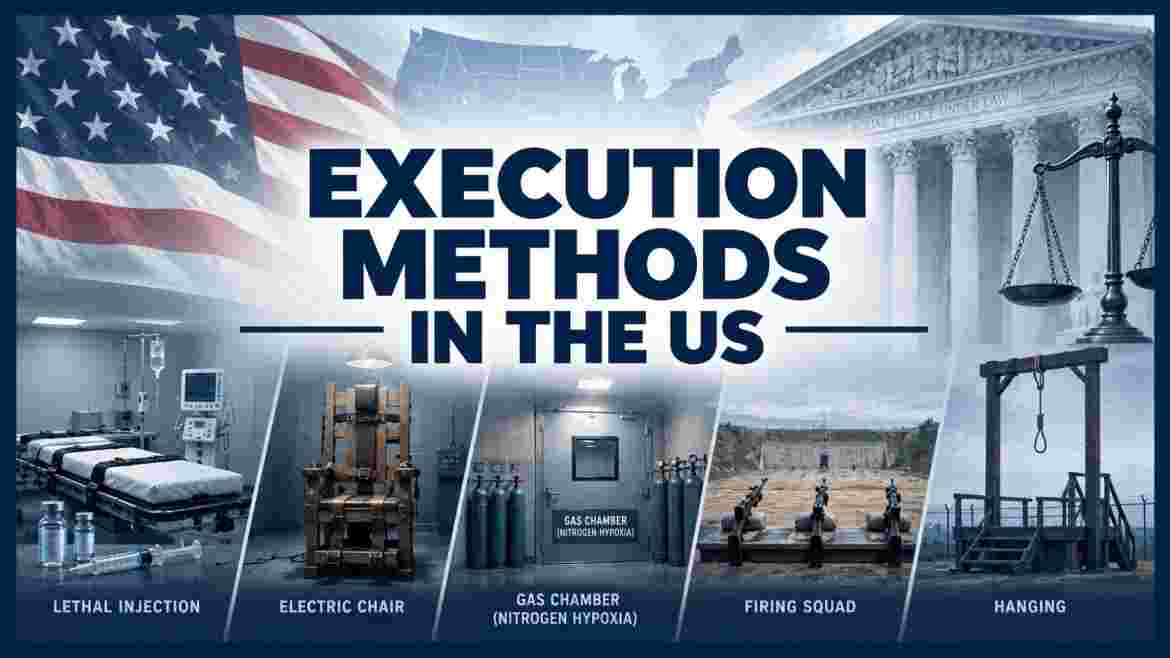
Lethal injection remains the primary execution method in 28 US states and the federal government, but 2026 has seen the fastest expansion of alternative methods in decades. Idaho became the first state to make firing squad its primary execution method on July 1, 2026, while a federal judge permanently blocked Alabama’s nitrogen gas protocol and Tennessee death row inmate Christa Pike survived two doses of lethal injection drugs.
Execution Methods in the US 2026
Execution methods in the United States are shifting faster in 2026 than at any point in the past two decades. Lethal injection has dominated American capital punishment since the 1980s, but a combination of drug shortages, botched procedures, and renewed legal and political interest in older methods has pushed states toward firing squads, nitrogen gas, and electrocution as genuine backup options rather than historical footnotes. Idaho crossed a line no state has crossed before on July 1, 2026, when firing squad became its primary method of execution rather than a last-resort alternative.
This report breaks down exactly which methods are legal where, how many executions each method has actually carried out, and what’s driving 2026’s unusually turbulent year for execution protocol. It covers the federal government’s own push to expand its execution options, the Alabama nitrogen gas case a federal judge just struck down, and the survived lethal injection in Tennessee that reopened the entire national conversation. Every figure below comes from the Death Penalty Information Center, court records, or named news reporting on official state and federal data, not from independent estimates.
A useful distinction runs through nearly every section below: the gap between a method being legally authorized in a state and that method actually being used. Nine states authorize electrocution, for instance, but only one treats it as a default rather than a rarely invoked backup, and the method saw zero actual executions in 2025. Readers should treat the authorization figures and the actual-use figures in this report as answering two different questions, not interchangeable versions of the same statistic.
Interesting Facts About Execution Methods in 2026
EXECUTIONS SINCE 1976 BY METHOD (approximate, as of early 2026)
Lethal injection     ████████████████████████████████████ 1,492
Electrocution        █████ 163
Gas chamber                 11
Nitrogen hypoxia             8
Firing squad                 6
Hanging                      3
| Fact | Detail |
|---|---|
| States that authorize lethal injection | 28, plus the federal government |
| States that authorize electrocution | 9 (as an alternative, except South Carolina) |
| States that authorize nitrogen hypoxia | 5: Alabama, Arkansas, Louisiana, Mississippi, Oklahoma |
| States that authorize firing squad | 5: Idaho, Mississippi, Oklahoma, South Carolina, Utah |
| States with the death penalty | 27, plus the federal government |
| States that have abolished the death penalty | 23 |
| States actively carrying out executions | 21 |
| Executions in 2025 (most recent full year) | 47, the highest total since 2009 |
Source: Death Penalty Information Center; Axios, “Christa Pike survived lethal injection,” October 2, 2026; Nolo legal analysis, October 2026.
Lethal injection remains overwhelmingly the dominant method, accounting for roughly 83% of the 47 executions carried out in 2025 and effectively all 29 executions carried out so far in 2026. But that dominance sits on increasingly shaky ground: pharmaceutical manufacturers have restricted sales of lethal injection drugs for execution use for years, forcing states to improvise substitute protocols, obtain drugs through secrecy laws, or turn to the alternative methods detailed throughout this report.
2026 alone has produced more execution-method news than most entire prior decades combined: Idaho’s switch to firing squad as its primary method took effect, a federal judge permanently blocked Alabama’s nitrogen gas protocol, the Department of Justice formally proposed expanding federal execution methods, and a Tennessee inmate’s survival of a lethal injection attempt reopened scrutiny of the method that still carries out the vast majority of American executions.
Lethal Injection Statistics and Problems in 2026
LETHAL INJECTION SHARE OF US EXECUTIONS
2025 executions by method      ██████████████████████████████ 83% lethal injection
2026 executions through Oct    █████████████████████████████ ~100% lethal injection (so far)
| Lethal Injection Metric | Figure |
|---|---|
| States/jurisdictions authorizing lethal injection | 28 states + federal government |
| Total lethal injection executions since 1976 | 1,492 |
| Share of 2025 executions | 83% (39 of 47) |
| 2026 executions, all by lethal injection (as of early Oct) | 29 |
| Notable 2026 incident | Christa Pike survived two doses, Tennessee |
| Federal lethal injection drug under DOJ review | Pentobarbital (single-drug protocol) |
Source: Death Penalty Information Center; Axios; SMU execution tracker, 2026.
Every death-penalty state authorizes lethal injection, and it remains the method actually used in the overwhelming majority of executions, including all 29 carried out in the US through early October 2026. That consistency masks a method under real strain: ongoing difficulty sourcing execution drugs has pushed several states to experiment with single-drug pentobarbital protocols, while others have faced documented complications during the procedure itself.
The clearest 2026 example came in Tennessee, where death row inmate Christa Pike survived after receiving two separate doses of lethal injection drugs, an incident Axios reported put “state execution protocols nationwide under new scrutiny” when it became public in early October. Tennessee currently authorizes only lethal injection and electrocution as execution methods, and the incident immediately revived discussion of expanding the state’s options: House Speaker Cameron Sexton is now pushing Tennessee lawmakers to consider adding firing squad as a third method following Pike’s survival.
Pike’s case is notable for another reason beyond the procedural failure itself: she has reportedly asked to be executed by firing squad specifically, a request Tennessee currently cannot legally grant since state law authorizes only lethal injection and electrocution. That gap between what a condemned inmate requests and what state law actually permits has become one of the clearest practical arguments firing-squad advocates are using in state legislatures nationally, framing method expansion as giving inmates genuine choice rather than simply adding another way for the state to carry out a sentence.
Firing Squad Executions and Idaho’s New Primary Method in 2026
FIRING SQUAD EXECUTIONS SINCE 1976 (by year)
2010 (Utah, Ronnie Lee Gardner)        █    1
2025 (South Carolina, 3 inmates)       ███  3
2026 (none yet, as of early Oct)            0
| Firing Squad Metric | Figure |
|---|---|
| States authorizing firing squad | 5: Idaho, Mississippi, Oklahoma, South Carolina, Utah |
| State where firing squad is now the primary method | Idaho, effective July 1, 2026 |
| Total firing squad executions since 1976 | 6 |
| 2025 firing squad executions | 3, all in South Carolina |
| Prior firing squad execution before 2025 | 2010, Ronnie Lee Gardner, Utah |
| South Carolina execution distance | Shooters stand up to 25 feet away |
| SC Supreme Court ruling on firing squad (2024) | Constitutional; death occurs within roughly 15 seconds |
Source: Death Penalty Information Center; Associated Press via Newsweek, October 2026; deathpenaltyinfo.org Execution Method Descriptions.
Idaho made history on July 1, 2026 by becoming the first state in the modern death penalty era to designate firing squad as its primary execution method rather than a backup option used only when lethal injection drugs are unavailable. That shift followed a botched 2024 lethal injection attempt on Idaho inmate Thomas Eugene Creech, an incident state lawmakers cited directly when pushing the firing squad legislation through.
South Carolina’s three 2025 firing squad executions, Brad Sigmon on March 7, Mikal Mahdi on April 11, and Stephen Bryant on November 14, marked the first firing squad executions anywhere in the country since Utah’s Ronnie Lee Gardner in 2010, and all three inmates chose the method themselves under a 2021 South Carolina law giving condemned prisoners a choice between firing squad, the electric chair, or lethal injection. South Carolina’s protocol calls for three shooters, each provided live rounds, with the condemned bound to a chair and shot through the heart from up to 25 feet away; the state’s Supreme Court ruled in 2024 that the method does not constitute cruel and unusual punishment since death occurs within approximately 15 seconds. For broader context on how execution methods intersect with the wider criminal justice system, the crime statistics by year report tracks how violent crime trends have shifted alongside the death penalty’s own evolving legal landscape.
Nitrogen Hypoxia and the Alabama Court Ruling in 2026
NITROGEN HYPOXIA EXECUTIONS, 2024-2026
Alabama          ███████ 7
Louisiana        █ 1
TOTAL            ████████ 8
| Nitrogen Hypoxia Metric | Figure |
|---|---|
| States authorizing nitrogen hypoxia | 5: Alabama, Arkansas, Louisiana, Mississippi, Oklahoma |
| First nitrogen gas execution | January 2024, Kenneth Smith, Alabama |
| Total nitrogen hypoxia executions, nationally | 8 (7 Alabama, 1 Louisiana) |
| 2025 nitrogen hypoxia executions | 5, 11% of that year’s total |
| Federal court ruling date (Alabama) | June 9, 2026 |
| Judge | U.S. District Judge Emily C. Marks |
| Alabama’s response | Appealing; case likely headed to the Supreme Court |
Source: PBS NewsHour; SCOTUSblog, May 2026; Death Penalty Information Center.
Nitrogen hypoxia, which replaces breathable air with pure nitrogen gas to cause oxygen deprivation, emerged as the newest American execution method when Alabama carried out the first nitrogen gas execution of Kenneth Smith in January 2024. Alabama went on to conduct a total of 7 nitrogen gas executions, with Louisiana carrying out a single additional nitrogen execution, bringing the nationwide total to 8 as of the method’s use being halted.
That halt came on June 9, 2026, when U.S. District Judge Emily C. Marks permanently enjoined Alabama from using nitrogen gas to execute inmate Jeffery Lee, ruling the method violates the U.S. Constitution. Supreme Court Justice Sonia Sotomayor had separately described firsthand accounts from the method’s prior use as depicting “violent movements” and gasps for air during a painful, extended death, concerns echoed in the DOJ’s own April 2026 report even as the department simultaneously defended the method’s continued use elsewhere. Alabama Attorney General Steve Marshall confirmed the state is appealing Judge Marks’s ruling, a case most legal observers expect will eventually reach the Supreme Court given the method’s novelty and the conflicting signals lower courts have issued about its constitutionality.
Electrocution and the Electric Chair in 2026
ELECTROCUTION AS EXECUTION METHOD, STATE STATUS 2026
South Carolina     default method (lethal injection/firing squad as alternatives)
8 other states     alternative/backup method only
| Electrocution Metric | Figure |
|---|---|
| States authorizing electrocution | 9: Alabama, Arkansas, Florida, Kentucky, Louisiana, Mississippi, Oklahoma, South Carolina, Tennessee |
| State where electrocution is the default method | South Carolina |
| Total electrocution executions since 1976 | 163 |
| Electrocutions in 2025 | 0 |
| Last electrocution carried out | 2020, Tennessee |
| State where electrocution was once the sole method | Nebraska (until ruled unconstitutional, February 2008) |
Source: Death Penalty Information Center; Wikipedia, “Electric chair.”
Electrocution remains legally authorized in 9 states, but it has fallen almost entirely out of active use: not a single electrocution was carried out in 2025, and the method’s most recent actual use was in Tennessee in 2020. In every one of those nine states except South Carolina, electrocution now functions purely as a backup option, available only if lethal injection, and in some states nitrogen hypoxia or firing squad, are found unconstitutional or become practically unavailable.
South Carolina stands alone as the only state where electrocution remains the default method, with condemned inmates able to choose lethal injection or firing squad instead under the same 2021 law that enabled the state’s 2025 firing squad executions. Nebraska offers a useful historical marker for how far electrocution has fallen from favor nationally: it was once the sole method of execution in that state until Nebraska’s own State Supreme Court ruled electrocution unconstitutional in February 2008, years before most other states began seriously reconsidering the method’s legal and practical viability.
The fact that electrocution persists on the books in nine states despite essentially never being used reflects a broader pattern across this entire report: most states treat multiple execution methods as a kind of legal insurance policy, keeping older methods authorized specifically so that a court ruling against the state’s primary method, most often lethal injection, doesn’t leave the state with no constitutional way to carry out a death sentence at all. That insurance-policy logic is precisely what’s driving 2026’s broader method-expansion trend, not any sudden preference for older methods over lethal injection on their own merits.
The Federal Death Penalty and DOJ Method Expansion in 2026
DOJ PROPOSED FEDERAL EXECUTION METHOD EXPANSION, APRIL 2026
Current federal method     Lethal injection (pentobarbital)
Proposed additions         Firing squad, electrocution, lethal gas
| Federal Policy Metric | Detail |
|---|---|
| DOJ report title | “Restoring and Strengthening the Federal Death Penalty” |
| Release date | April 24, 2026 |
| Issuing office | DOJ Office of Legal Policy |
| Key recommendation | Reinstate single-drug pentobarbital protocol |
| Proposed method additions | Firing squad, electrocution, lethal gas |
| Facility recommendation | Evaluate new/expanded execution facility at Terre Haute |
| Federal defendants death penalty authorized against | 44 |
Source: US Department of Justice, Office of Legal Policy, “Restoring and Strengthening the Federal Death Penalty,” April 24, 2026; LegalClarity federal execution analysis.
The Department of Justice released a detailed report on April 24, 2026 calling for the Federal Bureau of Prisons to reinstate the single-drug pentobarbital lethal injection protocol used during the 2020-2021 federal execution wave, while separately urging Congress to authorize firing squad, electrocution, and lethal gas as additional federal execution methods. The report explicitly frames the move as reversing what it calls “an unprecedented break” represented by the prior administration’s execution moratorium, though death penalty researchers have published analysis disputing several of the report’s historical and legal characterizations.
Beyond method expansion, the DOJ has directed the Bureau of Prisons to evaluate constructing a new execution facility or expanding the existing one at Terre Haute, Indiana, the site of recent federal executions, while the administration separately lifted the Biden-era federal execution moratorium and authorized prosecutors to seek the death penalty against 44 defendants. No federal firing squad execution has yet been scheduled, meaning the DOJ’s method-expansion plan remains a stated policy direction rather than something that has translated into an actual execution by any method other than lethal injection at the federal level so far. The demographic patterns behind who ultimately faces capital charges and sentencing have drawn their own scrutiny; the crime statistics by race report provides the fuller national picture behind those disparities across the broader criminal justice system.
2025-2026 Execution Trends by State and Method
MOST ACTIVE EXECUTION STATES, 2026 (through late May)
Florida         ███████  7 of 14 executions
Other states    ███████  7 combined
| State Activity Metric | Figure |
|---|---|
| Most active execution state, 2026 (through late May) | Florida, 7 of 14 executions |
| Total 2025 executions | 47, highest since 2009 |
| Total 2026 executions (as of early October) | 29 |
| 2025 method breakdown | Lethal injection 39 (83%), nitrogen hypoxia 5 (11%), firing squad 3 (6%) |
| Most recent tracked execution (per LegalClarity) | Richard Knight, Florida, lethal injection, May 21, 2026 |
Source: LegalClarity, “Last Execution in the US,” 2026; Death Penalty Information Center; Nolo, October 2026.
Florida has run the most active execution calendar of any state in 2026, carrying out 7 of the year’s first 14 executions through late May alone, a pace that continued the state’s position as one of the country’s most consistently active death penalty jurisdictions. By early October, the national 2026 total had climbed to 29 executions, all carried out by lethal injection, a method share that would, if it holds through year-end, actually represent an even higher lethal-injection concentration than 2025’s already-dominant 83% share.
That 2025 total of 47 executions marked the highest annual figure in 16 years, since 2009, driven by a combination of expedited state execution schedules and the reintroduction of firing squad and nitrogen hypoxia as genuinely used, not just legally authorized, methods. Whether 2026’s final total surpasses 2025’s will depend heavily on how the unresolved legal questions around nitrogen hypoxia, and the political momentum behind expanding firing squad and electrocution use, play out over the remainder of the year. Execution activity concentrates heavily in specific states and, within those states, specific cities and counties tied to where capital cases originate; the US crime statistics by city report offers useful context on the underlying violent crime patterns that feed into death penalty prosecutions nationally.
Execution Methods FAQs 2026: What People Are Asking
What is the most common execution method in the US?
Lethal injection, used in roughly 83% of 2025 executions and effectively all 2026 executions so far.
Which states allow firing squad executions?
Idaho, Mississippi, Oklahoma, South Carolina, and Utah, with Idaho being the only state where it’s the primary method.
When did Idaho make firing squad its primary execution method?
July 1, 2026, the first time any state has designated firing squad as a primary rather than backup method in the modern era.
Is nitrogen gas execution still legal?
It remains legally authorized in 5 states, but a federal judge permanently blocked Alabama’s nitrogen gas protocol on June 9, 2026, a ruling currently under appeal.
How many nitrogen hypoxia executions have been carried out?
8 total: 7 in Alabama and 1 in Louisiana.
Did someone survive a lethal injection execution in 2026?
Yes. Tennessee inmate Christa Pike survived after receiving two separate doses of lethal injection drugs, an incident reported in early October 2026.
Is electrocution still used in the US?
Rarely. No electrocutions were carried out in 2025, and the method’s most recent actual use was in Tennessee in 2020.
What is the Department of Justice proposing for federal executions?
Reinstating a single-drug pentobarbital lethal injection protocol while adding firing squad, electrocution, and lethal gas as additional federal execution methods.
How many executions happened in the US in 2025?
47, the highest annual total since 2009.
How many executions have happened in 2026 so far?
29, as of early October 2026, all by lethal injection.
Which state carries out the most executions?
Florida led in 2026, carrying out 7 of the year’s first 14 executions through late May.
How many states still have the death penalty?
27 states plus the federal government; 23 states have abolished capital punishment, and only 21 states actively carry out executions.
Disclaimer: The data research report we present here is based on information found from various sources. We are not liable for any financial loss, errors, or damages of any kind that may result from the use of the information herein. We acknowledge that though we try to report accurately, we cannot verify the absolute facts of everything that has been represented.