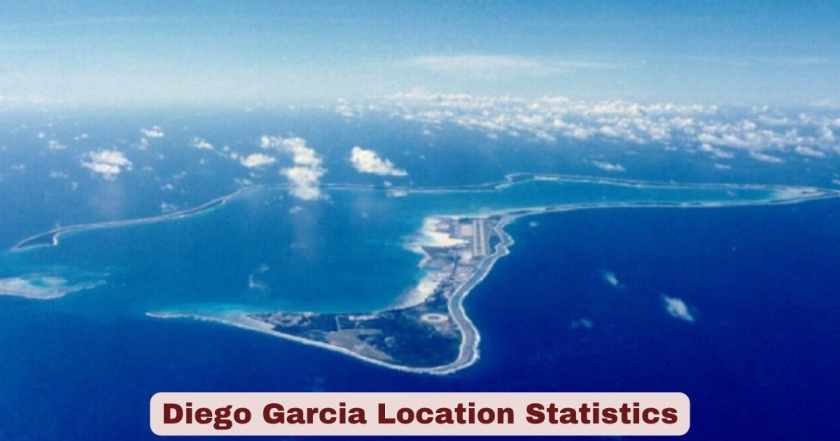
Where is Diego Garcia?
Diego Garcia is the largest island of the Chagos Archipelago — a remote coral atoll sitting almost perfectly at the center of the Indian Ocean, roughly 7 degrees south of the equator at coordinates 7°20’S, 72°25’E — and it is the site of the only permanent U.S. military installation in the Indian Ocean, operated jointly by the United States and the United Kingdom as Naval Support Facility (NSF) Diego Garcia. The island is shaped like a footprint — a long, thin V-shaped cay curling around a central lagoon — and that geographical accident has earned it the nickname “Footprint of Freedom”, a phrase that simultaneously captures its strategic shape and its role in American power projection across three ocean theaters: the Middle East, Africa, and the Indo-Pacific. Covering just 17 square miles (44 square kilometers) of land with a maximum elevation of only 22 feet above sea level, Diego Garcia is by land-mass one of the smallest and flattest pieces of territory the United States military has ever built a major base upon. Yet what it lacks in size it compensates for spectacularly in location: from Diego Garcia, a B-2 Spirit stealth bomber can reach targets across the entire breadth of the Persian Gulf, Arabian Sea, South Asia, and East Africa in a single sortie, and the island’s deep-water port can dock, resupply, and maintain aircraft carriers, submarines, and prepositioned cargo ships simultaneously. No other real estate on earth offers this combination of central Indian Ocean positioning, deep-water harbor, extended runway, and complete political isolation from the surrounding civilian world. Diego Garcia is, as analyst Robert Kaplan described it, the anchor of what he called the “Center Stage for the Twenty-First Century” — and in 2026, that assessment has never seemed more accurate.
The geopolitical story surrounding Diego Garcia in 2026 is as consequential as any in the island’s 55-year military history — and it is unfolding on multiple simultaneous fronts. On the sovereignty front, a landmark treaty signed between the United Kingdom and Mauritius on May 22, 2025 provides for the transfer of sovereignty over the entire Chagos Archipelago (including Diego Garcia) to Mauritius, with the UK retaining a 99-year administrative lease over the base — a deal worth £3.4 billion to Mauritius and representing an annual payment of approximately £101 million per year. That treaty has not yet been ratified by UK Parliament as of March 2026, and President Donald Trump publicly criticized it on January 20, 2026, calling it “an act of GREAT STUPIDITY” on Truth Social before adding on February 18, 2026 that the United States might need to use Diego Garcia against Iran if a nuclear deal could not be reached. On the military operations front, Diego Garcia has been functioning at an extraordinarily high operational tempo: B-2 Spirit stealth bombers were staged there from March 2025 and conducted strikes against Houthi targets in Yemen before the launch of Operation Epic Fury on February 28, 2026, and B-52 Stratofortresses joined the B-2s as the Iran campaign commenced, with CENTCOM commander Admiral Brad Cooper confirming on March 5, 2026 that B-1s, B-52s, and B-2s had collectively hit 200 Iranian targets in the first 72 hours of the operation — many launched from or supported by Diego Garcia. On March 21, 2026, the island is operating at the highest sustained combat-support tempo it has seen since the 2003 invasion of Iraq.
Diego Garcia Key Facts 2026
| Fact Category | Key Fact / Data Point |
|---|---|
| Official Name of Military Base | Naval Support Facility (NSF) Diego Garcia — joint U.S.-UK installation |
| Alternative Names | “Footprint of Freedom”; “Camp Justice”; “The Footprint” |
| Geographic Coordinates | 7°20’S, 72°25’E — 7 degrees south of the equator |
| Ocean / Region | Central Indian Ocean — Chagos Archipelago, British Indian Ocean Territory (BIOT) |
| Island Shape | V-shaped coral atoll — resembles a right human footprint from the air |
| Total Land Area | 17 square miles (44 square km / 6,720 acres) |
| Maximum Elevation | 22 feet (6.7 meters) above sea level |
| Average Elevation | Approximately 4 feet (1.2 meters) above sea level |
| Total Length of Island | Approximately 15 miles (24 km) |
| Maximum Width | Approximately 7 miles (11 km) at widest |
| Chagos Archipelago Total Land Area | 56.1 square km — Diego Garcia represents 57.9% of the total (32.5 sq km) |
| Lagoon | Large central lagoon open at the north end — fully navigable |
| Number of Islands in Chagos Archipelago | More than 60 individual islands across 7 atolls |
| Diego Garcia’s Position in Chagos | Largest and southernmost island of the archipelago |
| Sovereignty Status (March 2026) | British Overseas Territory — governed as British Indian Ocean Territory (BIOT); May 2025 UK-Mauritius sovereignty transfer treaty signed but not yet ratified |
| Treaty Signed | May 22, 2025 — UK-Mauritius Agreement — sovereignty transfers to Mauritius; UK retains 99-year administrative lease on Diego Garcia base |
| UK Payment to Mauritius (Annual) | £101 million per year — part of £3.4 billion total financial arrangement |
| Lease Duration | 99 years minimum (through at least 2124); renewable for additional 40 years (to 2164) |
| Trump Criticism of Treaty | January 20, 2026 — “an act of GREAT STUPIDITY” — Truth Social |
| Trump Warning — Iran Context | February 18, 2026 — Trump stated US “may need Diego Garcia” against Iran if no nuclear deal |
| Current Military Personnel | Approximately 2,500–4,000 military and support personnel — predominantly American |
| Civilian Contractors | Approximately 1,500 civilian contractors based on island |
| British Military on Island | Approximately 50 British military personnel — Royal Naval Party 1002 |
| GPS Ground Control Station | One of only 5 global GPS ground control stations in the world |
Source: Wikipedia Diego Garcia (updated March 21, 2026); Wikipedia Naval Support Facility Diego Garcia (updated March 2026); Britannica Diego Garcia (updated March 3, 2026); archive.eol.ucar.edu Diego Garcia Camp Justice profile; RealClearDefense February 3, 2025
The “Footprint of Freedom” nickname captures Diego Garcia’s strategic identity perfectly — a tiny footprint of land in a vast empty ocean that nonetheless stamps American military power across an enormous geographic radius. The island’s coral atoll formation means it is, geologically speaking, a ring of coral sand barely above the waterline sitting atop an ancient volcanic seamount whose peak is far below the ocean surface. The average 4-foot elevation makes it uniquely vulnerable to sea-level rise in the long run, but it also makes the island’s strategic value all about what has been built on it — not what nature provided. The 6,720 acres of total area have been sculpted over 50 years of U.S. Navy Seabee and contractor engineering into a complete self-contained military installation with an airfield, port, fuel storage, communications arrays, logistics facilities, and support infrastructure that would be remarkable on a mainland base — and is genuinely extraordinary on a coral atoll in the middle of the Indian Ocean that no civilian ship casually visits. The fact that this island is also one of only five global GPS ground control stations — meaning it plays a daily operational role in the navigation of billions of devices worldwide — underscores how deeply woven into the infrastructure of the modern world this otherwise-invisible speck of land actually is.
The £101 million annual payment that the UK will provide to Mauritius under the May 2025 sovereignty treaty — a total package valued at £3.4 billion — is perhaps the most quantified expression of how much Western governments value the Diego Garcia military base in 2026. The treaty grants Mauritius sovereignty over the entire Chagos Archipelago, including Diego Garcia, but guarantees the UK and US 99 years of administrative control over the base itself — with a renewal option extending potentially to 2164. The UK Government’s stated position is that securing this long-term lease is worth the financial cost precisely because no alternative base in the Indian Ocean offers the same combination of location, existing infrastructure, and political reliability. President Trump’s January 2026 public criticism of the deal — and his February 2026 linkage of Diego Garcia to potential Iran strike operations — added an extraordinary layer of public geopolitical drama to what had been a relatively quiet sovereignty negotiation, broadcasting to the entire world that Diego Garcia is not merely strategically important in abstract terms but is an active, operational tool of American military power in the very crisis he was publicly discussing.
Diego Garcia Geographic and Physical Statistics in 2026
| Geographic / Physical Metric | Data / Statistic |
|---|---|
| Distance from Tanzania (East Africa) | 3,535 km (2,197 miles) east |
| Distance from Somalia / Horn of Africa | 2,984 km (1,854 miles) east-southeast |
| Distance from Maldives | 726 km (451 miles) south |
| Distance from Sri Lanka | Approximately 1,796 km (1,116 miles) southwest |
| Distance from southern India coast | Approximately 1,600 km (1,000 miles) south |
| Distance from Strait of Hormuz | Approximately 3,800 km (2,360 miles) east-southeast |
| Distance from Strait of Malacca | Approximately 3,900 km (2,420 miles) west |
| Strike Radius from Diego Garcia | B-52 unrefueled combat radius: ~3,000 nm (5,556 km) — covers Persian Gulf, Arabian Peninsula, East Africa, South Asia |
| Strike Radius with Aerial Refueling | Essentially global reach — covers any target from Africa to the South China Sea |
| Reduction in Strike Flight Time vs. CONUS | Diego Garcia cuts roundtrip bomber flight time from 37 hours (from CONUS) roughly in half vs. missions from US bases |
| Lagoon Dimensions | Approximately 24 km long × 6 km wide — open at north end; deep enough for ships |
| Reef Circumference | Total atoll circumference approximately 64 km |
| Climate | Tropical marine — hot and humid year-round; average temperature ~82°F (28°C); two monsoon seasons |
| Vegetation | Heavily vegetated with coconut palms — remnant of copra plantation era; jungle undergrowth |
| Soil Type | Coral sand and limestone — coralline substrate; no rock foundation |
| Freshwater Source | No natural rivers or lakes — entirely dependent on desalination plants and rainwater collection |
| Annual Rainfall | Approximately 1,000–1,500 mm per year — tropical precipitation |
| Earthquake / Volcanic Risk | Minimal — atoll is geologically stable on coral foundation; no volcanic activity |
| Nearest Major Civilian Port | Colombo, Sri Lanka — approximately 1,796 km distant |
Source: Wikipedia Diego Garcia (updated March 21, 2026); Britannica Diego Garcia (updated March 3, 2026); archive.eol.ucar.edu Diego Garcia Camp Justice profile; GlobalSecurity.org Diego Garcia; Chatham House February 2026; Air & Space Forces Magazine March 9, 2026 (roundtrip flight time comparison)
The distance data is what transforms Diego Garcia from a geographic curiosity into a strategic imperative. The island sits almost exactly equidistant between the Persian Gulf (approximately 3,800 km northwest) and the Strait of Malacca (approximately 3,900 km east) — the two most strategically vital maritime chokepoints in the Indo-Pacific. From this position, it provides unobstructed access to the entire arc of American strategic interest stretching from East Africa through the Arabian Peninsula, South Asia, and toward Southeast Asia — and it does so without depending on the political decisions of any regional government for basing rights, overflight permissions, or port access. The Air & Space Forces Magazine report of March 9, 2026 noted specifically that deploying bombers to Diego Garcia cuts the roundtrip flight time roughly in half compared to missions flown directly from bases in North Dakota, Texas, or South Dakota — and that those CONUS-based missions were taking as long as 37 hours per round trip. For a bomber crew conducting multiple strike sorties against Iranian targets, the difference between a 37-hour mission and an 18-hour mission is the difference between sustainable operational tempo and crew exhaustion — and Diego Garcia’s position in the Indian Ocean is precisely what makes the shorter timeline possible.
The self-sufficiency challenge that Diego Garcia’s remote location creates is solved almost entirely by engineering. The island has no natural rivers, no lakes, and no freshwater springs — every drop of potable water is either distilled from seawater through desalination plants or captured from tropical rainfall. The fuel storage facilities on the island hold enough aviation and marine fuel to sustain extended high-tempo operations without immediate resupply — essential for a base whose nearest major civilian port is nearly 1,800 km away in Sri Lanka. The prepositioned cargo ships (MPS ships) kept at the island’s deep-water port hold additional ammunition, vehicles, spare parts, and supplies sufficient to equip a Marine Expeditionary Brigade for extended combat operations — allowing the U.S. military to generate a heavy combat force in the region without needing to ship everything from the continental United States. These logistics stockpiles are what allowed the U.S. to sustain the 1990–91 Gulf War air campaign from Diego Garcia and to rapidly generate forces for the 2003 Iraq invasion — and they are what supports the current Operation Epic Fury combat operations in 2026.
NSF Diego Garcia Military Infrastructure Statistics in 2026
| Infrastructure Element | Data / Specification |
|---|---|
| Primary Runway | 12,000 feet (3,658 meters) long — 200 feet wide — capable of handling B-2, B-52, B-1B, C-17, and all large military aircraft |
| Secondary Runway | Yes — additional runway capacity on the atoll |
| Runway Designation | Runway 13/31 — primary operational runway |
| Deep-Water Port | Yes — capable of docking aircraft carriers, submarines, destroyers, and MPS cargo ships simultaneously |
| Port Piers / Docks | Multiple piers with modern logistics support systems — rapid resupply capability |
| Fuel Storage Capacity | Extensive aviation and naval fuel storage — exact classified capacity supports sustained high-tempo air operations |
| Aircraft Shelters | Limited hardened shelters — noted as a vulnerability; 4 B-2 Shelter System Extra Large Deployable Aircraft Hangar Systems erected during Afghan operations; debate ongoing about adding more |
| Communications Arrays | Multiple classified systems — includes submarine communications (VLF/ELF); satellite communications; radar |
| GPS Ground Control Station | One of five global GPS Master Control Station network nodes — operated for USG |
| Satellite Intelligence Systems | Space surveillance and satellite tracking systems — part of Space Surveillance Network |
| Prepositioned Maritime Ships (MPS) | Maritime Prepositioned Ships stocked with Marine Expeditionary Brigade equipment — amphibious vehicles, artillery, ammunition, vehicles, 30-day supplies |
| Hospital / Medical | Full medical and surgical facility on island |
| Desalination Plants | Multiple units — sole source of freshwater on island |
| Power Generation | Independent power generation — diesel and jet fuel generators; not connected to any civilian grid |
| Base Construction Period | 1971–1976 — built by U.S. Navy Seabees (NMCB-40 advanced party landed January 23, 1971) |
| Total Base Area | Approximately 6,720 acres — including all runways, port, support facilities, living quarters |
| British Crown Representative | BRITREP — acts as Justice of the Peace and CO of Royal Naval Party 1002 |
| F-15 Deployment (2025) | F-15 fighters deployed to Diego Garcia to provide force protection for B-2 and B-52 bombers — confirmed by Air & Space Forces Magazine, May 2025 |
Source: Wikipedia Naval Support Facility Diego Garcia (updated March 2026); Chatham House February 2026; archive.eol.ucar.edu Diego Garcia Camp Justice; The War Zone May 2025 (B-2 shelters debate); Air & Space Forces Magazine May 18, 2025 (F-15 deployment); GlobalSecurity.org NSF Diego Garcia; Wikipedia Diego Garcia (updated March 21, 2026)
The 12,000-foot primary runway is the single most consequential piece of infrastructure on Diego Garcia — and the attribute that most directly defines its role as a power-projection platform. Most military bases worldwide operate with runways in the 8,000–10,000-foot range, sufficient for fighter aircraft and most transports. The 12,000-foot runway at Diego Garcia is specifically designed to handle the longest and heaviest aircraft in the U.S. Air Force inventory: the B-2 Spirit (which requires significant runway for its delta wing at heavy gross weights), the B-52 Stratofortress (whose water-injected engines demand long takeoff rolls at maximum bomb load), and the B-1B Lancer (which needs extended takeoff roll at heavy weights due to its variable-sweep wing configuration). The fact that all three bomber types were operating from Diego Garcia in support of Operation Epic Fury — as confirmed by CENTCOM commander Admiral Brad Cooper on March 5, 2026 — validates the runway’s operational function precisely as designed. The War Zone’s 2025 analysis of satellite imagery showing six B-2 bombers crowded onto the Diego Garcia airfield on April 2, 2025 highlighted both the island’s operational centrality and its infrastructure constraint: the limited number of hardened aircraft shelters means that bombers parked on the apron are exposed to potential counter-strike, a vulnerability that has driven ongoing debate about whether the U.S. should invest in hardened shelter construction at Diego Garcia.
The prepositioned Maritime Prepositioned Ships (MPS) at Diego Garcia’s deep-water port represent a form of power projection that rarely makes headlines but has been operationally decisive in multiple conflicts. These ships carry the heavy equipment, ammunition, vehicles, and 30-day supplies needed to outfit a Marine Expeditionary Brigade — roughly 15,000 Marines — for combat operations. When a crisis erupts in the region, Marines can fly from the continental United States or nearby bases and marry up with their pre-stored equipment at Diego Garcia’s port in days rather than the weeks it would take to ship everything from California or North Carolina. This concept was proven during Operation Desert Shield in 1990, when three MPS ships at Diego Garcia sortied and delivered a Marine Expeditionary Brigade to Saudi Arabia within days of Iraq’s invasion of Kuwait — allowing a substantial heavy combat force to be in position before any significant sea-lift or air-lift buildup from the continental United States could arrive. In 2026, with the Middle East in active conflict, those prepositioned ships remain one of the most quietly consequential elements of American military readiness in the region.
Diego Garcia Operation Epic Fury Role Statistics in 2026
| Operation / Military Activity | Date | Details |
|---|---|---|
| B-2 Spirit Bombers Arrive at Diego Garcia | March 2025 | Confirmed by Air Force Global Strike Command — first significant B-2 deployment to Diego Garcia since 2020 — initially for Houthi Yemen strikes |
| Six B-2 Bombers at Diego Garcia (Satellite Image) | April 2, 2025 | Planet Labs satellite image confirms 6 B-2 Spirits parked at Diego Garcia airfield |
| B-2s Strike Houthi Targets (Yemen) | March–May 2025 | B-2 Spirits launched from Diego Garcia struck underground Houthi weapons storage sites using GBU-57/B Massive Ordnance Penetrator (MOP) bombs |
| B-52s Join B-2s at Diego Garcia | May 7–8, 2025 | B-52H Stratofortresses arrive — reports indicate 4 B-52Hs plus KC-135 tankers and support assets |
| F-15 Fighters Deployed to Diego Garcia | May 2025 | F-15 fighters deployed for force protection of bomber assets |
| Houthi Ceasefire Shifts Diego Garcia Role | May 6, 2025 | Trump announced halt to Houthi bombing campaign — bomber role shifted toward Iran contingency posture |
| Operation Epic Fury Begins | February 28, 2026 | U.S.-Israeli campaign against Iran launched — Diego Garcia used as forward staging base |
| B-52 Strikes Iranian Missile Sites | March 3, 2026 | CENTCOM reported B-52 strikes on Iranian missile infrastructure and command nodes from Diego Garcia |
| 200 Iranian Targets Hit in First 72 Hours | March 5, 2026 | CENTCOM confirmed B-1, B-52, and B-2 strikes on ~200 targets in first 72 hours |
| KC-135 Tanker Crash in Western Iraq | March 12, 2026 | KC-135 Stratotanker crashed during operation support — confirmed not shot down |
| B-52 Roundtrip Flight Time from Diego Garcia | ~18 hours | Roughly half the duration compared to flights from U.S. mainland bases |
| Trump Warning via Diego Garcia | February 18, 2026 | Statement linked Diego Garcia to potential military action against Iran |
| B-1B Lancer Deployment — Europe (RAF Fairford) | March 2026 | B-1Bs and B-52s positioned in Europe to reduce strike time for Iran operations |
Source: Air & Space Forces Magazine March 27, 2025 (B-2 arrival), May 7–8, 2025 (B-52 arrival), May 18, 2025 (F-15 deployment), March 9, 2026 (Europe bombers); The War Zone May 8, 2025 (satellite imagery, 6 B-2s); Army Recognition March 2026 (B-52 Epic Fury strikes); Chatham House February 2026 (Trump Feb 18 warning); Air & Space Forces Magazine March 9, 2026 (200 targets, bomber roles); Wikipedia Diego Garcia (updated March 21, 2026)
The B-2 Spirit’s deployment to Diego Garcia in March 2025 — and its subsequent employment against Houthi underground targets in Yemen using the GBU-57/B Massive Ordnance Penetrator — established the operational template that has since been applied against Iran during Operation Epic Fury. The B-2 is the only aircraft in the world capable of internally carrying the 30,000-pound GBU-57 MOP, the only conventional bomb designed to penetrate the hardest buried targets. Diego Garcia’s runway is long enough to handle a B-2 at GBU-57 payload gross weights, and the island’s geographic position puts the entire Persian Gulf within unrefueled B-2 range — which is why the U.S. military has consistently returned to Diego Garcia for strategic bombing campaigns against hardened targets in the region. The satellite imagery from Planet Labs on April 2, 2025 — showing six B-2 Spirits parked at Diego Garcia simultaneously — was the most visible public confirmation of the scale of that buildup, and it was almost certainly intentionally visible: the imagery was available to anyone with a commercial satellite account, and the message it sent to Iranian intelligence about American preparedness was a deliberate strategic communication.
The March 2026 confirmation by CENTCOM’s Admiral Brad Cooper that B-1s, B-52s, and B-2s had collectively struck 200 Iranian targets in the first 72 hours of Operation Epic Fury represents the operational payoff of the months of buildup at Diego Garcia and its European counterpart, RAF Fairford. The “200 targets in 72 hours” strike rate requires not just the bombers themselves but a vast supporting architecture: KC-135 Stratotanker refueling tracks keeping bombers airborne, intelligence feeds identifying and targeting Iranian systems in real time, communications links coordinating strike packages across multiple aircraft types from multiple bases, and logistics chains re-arming bombers for subsequent sorties. The KC-135 crash in western Iraq on March 12, 2026 — attributed to a non-combat aircraft incident involving two aircraft, per CENTCOM — was a tragic reminder that sustaining this kind of high-tempo air campaign at strategic distances involves genuine operational risk even before an adversary fires back. Diego Garcia’s position at the center of the Indian Ocean logistics web is what makes this pace of operations physically possible.
Diego Garcia Sovereignty Dispute and Chagossian Displacement Statistics in 2026
| Historical / Political Metric | Data / Statistic |
|---|---|
| Discovery by Europeans | Early 16th century — Portuguese explorers; name from ship captain or navigator |
| Colonial History | French (original); ceded to UK in Treaty of Paris (1814); administered from Mauritius colony |
| UK Purchase from Pre-Independence Mauritius | 1965 — purchased for £3 million; separated from Mauritius as BIOT |
| Chagossian Population Expelled | 1968–1973 — approximately 1,500–2,000 Chagossians (descendants of imported plantation workers) forcibly removed |
| Where Chagossians Were Relocated | Primarily Mauritius, also Seychelles — many eventually migrated to UK |
| Current Chagossian Diaspora Size | Approximately 10,000 people worldwide |
| UK-Based Chagossians | Approximately 3,500 — mainly in Crawley, West Sussex |
| Mauritius-Based Chagossians | Approximately 4,000–5,000 |
| Seychelles-Based Chagossians | Approximately 1,500–2,000 |
| UK-Based Chagossians Holding Mauritian Citizenship | 94% as of April 2025 |
| UN General Assembly Vote (2019) | 116-to-6 resolution condemning UK’s presence — near-unanimous international condemnation |
| ICJ Advisory Opinion (2019) | UK “under an obligation to end its administration as rapidly as possible” |
| Negotiations Count | 13 rounds of talks over more than two years before May 2025 treaty |
| UK-Mauritius Treaty Signed | May 22, 2025 — sovereignty to Mauritius; UK retains 99-year lease on Diego Garcia base |
| Chagossian Resettlement Terms | Permitted on Peros Banhos and Salomon atolls only — Diego Garcia explicitly excluded |
| Chagossian Trust Fund | £40 million — managed by 12-member board with 7 Chagossian representatives (majority control) |
| Criticism of Trust Fund Amount | Critics note £40M represents less than 0.5% of the total £3.4 billion UK-Mauritius financial arrangement |
| UK Parliament Ratification Status (March 2026) | Not yet ratified — requires primary and secondary legislation; UK expected ratification “sometime in 2026” |
| UN Committee Concern | UN Committee on the Elimination of Racial Discrimination expressed “deep concern” at treaty terms |
| China Factor | UK and US opponents of deal argue Mauritius sovereignty could allow Chinese military presence on Chagos Islands outside Diego Garcia |
| Chatham House Assessment | China-on-Chagos risk “overlooks complexity” — Mauritius-India relationship would likely blunt Chinese efforts |
Source: Wikipedia Diego Garcia (updated March 21, 2026); Britannica Diego Garcia (updated March 3, 2026); TheWorldData.com Chagos Islands Statistics (January 22, 2026); House of Commons Library CBP-10273; Chatham House February 2026; Library of Congress In Custodia Legis July 2025; NPR January 2026; Human Rights Watch Chagos reporting 2025
The forced displacement of 1,500–2,000 Chagossians between 1968 and 1973 to make way for the Diego Garcia military base remains one of the most extensively documented and internationally condemned acts of colonial displacement in post-World War II British history. The Chagossians — descendants of African slaves and Indian indentured laborers brought to the islands during the French and British plantation era — had been farming coconuts and fishing in the Chagos Archipelago for generations, developing a distinct Creole culture and identity. When the UK negotiated its 1966 defense arrangement with the United States to build the Diego Garcia base, the decision was made at the highest levels of the British government — documented in Cabinet papers — that the islands needed to be depopulated entirely. The euphemism used in official communications at the time was that the islanders were merely “contract workers” who could be relocated — a legal fiction that British courts have repeatedly rejected in subsequent decades of litigation. The £40 million trust fund allocated in the May 2025 treaty for Chagossian benefit — against a total UK-Mauritius financial package of £3.4 billion — represents less than 0.5% of the deal’s total value, and many Chagossian community representatives have publicly described the amount as inadequate compensation for generations of dispossession.
The UK Parliament’s failure to ratify the May 2025 treaty as of March 2026 reflects the extraordinarily complex political environment the deal navigates. Conservative opposition in Westminster argues that the deal weakens British and American security by transferring sovereignty to a small island nation whose relationship with China could eventually provide Beijing with a strategic foothold near Diego Garcia. The Chatham House analysis published in February 2026 challenged this argument directly, noting that Mauritius’s deep strategic relationship with India would make Chinese base-building on the Chagos Islands politically implausible, and that China has focused its Indian Ocean naval diplomacy on Gwadar (Pakistan), Kyaukphyu (Myanmar), and other locations where U.S. and UK leverage is lower. President Trump’s January 20, 2026 Truth Social post criticizing the deal — comparing the loss of Diego Garcia to the broader theme of territorial assertions including Greenland — added American political pressure to an already stressed ratification timeline. What is certain on March 21, 2026 is that the treaty exists, the base continues to operate under full British and American authority, and the Chagossians remain in diaspora — the most affected parties of this entire geopolitical drama are once again the last to be consulted about its resolution.
Diego Garcia Military Operational History Statistics in 2026
| Operation / Event | Year | Diego Garcia’s Role |
|---|---|---|
| First U.S. Military Construction Begins | January 23, 1971 | 9-man advance party from NMCB-40 landed; 50 Seabees from ACB-2 marked underwater obstacles and cleared beaches; 160 additional Seabees arrived March 20, 1971 |
| Base Construction Complete | 1971–1976 | Full base built by U.S. Navy Seabees — airfield, port, fuel storage, communications, barracks |
| First B-52 Strategic Air Command Deployment | 1987 | SAC began deploying B-52s after airfield construction was complete |
| First Aircraft Carrier to Dock | 1985 | USS Saratoga — first carrier to tie up at newly completed port facilities |
| Operation Desert Shield / Desert Storm | 1990–1991 | MPS ships sortied to Saudi Arabia; B-52G bombers flew 200+ 17-hour bombing missions over 44 days; 800,000 short tons of bombs dropped on Iraqi forces; one B-52 crashed just north of island — 3 of 6 crew lost |
| Operations in Afghanistan | October 7, 2001 onward | B-1, B-2, and B-52 bombers struck Taliban and al-Qaeda targets; critical launchpad while regional countries denied basing rights; 4 B-2 shelter systems erected |
| B-1 Lost at Diego Garcia | December 12, 2001 | B-1 bomber lost to mechanical failure just after takeoff — crew survived, rescued by USS Russell |
| Operation Iraqi Freedom | 2003 | Diego Garcia served as major launchpad for bomber sorties against Iraqi targets |
| Operation Enduring Freedom Continued Use | 2001–2014 | Sustained B-1, B-2, B-52 operations throughout Afghanistan campaign |
| CIA “Black Site” Allegations | 2003–2007 | Questions raised — never officially confirmed or denied — about possible CIA interrogation facility on island |
| First MQ-9 / ISR Expansion | 2010s | ISR drone and surveillance operations expanded at Diego Garcia |
| Houthi Yemen Strikes (B-2 deployed) | March 2025 | B-2 Spirits strike Houthi underground weapons sites using GBU-57/B MOP — launched from Diego Garcia |
| Six B-2s at Diego Garcia (Satellite Confirmed) | April 2, 2025 | Planet Labs imagery confirms 6 B-2 Spirits at airfield — largest B-2 presence there since 2001 |
| B-52 Deployment Joins B-2s | May 2025 | 4+ B-52Hs + KC-135 tankers join B-2s — 10+ bombers total on island |
| Operation Epic Fury (Iran Strikes) | February 28 – ongoing March 2026 | Diego Garcia serves as primary Indian Ocean launchpad for B-52 and B-2 strikes against Iranian ballistic missile infrastructure and command nodes |
Source: Wikipedia Naval Support Facility Diego Garcia (updated March 2026); Wikipedia Diego Garcia (updated March 21, 2026); archive.eol.ucar.edu Diego Garcia history; Chatham House February 2026; The War Zone May 2025; Air & Space Forces Magazine March 2025–March 2026; Army Recognition March 2026; CENTCOM Admiral Cooper statements March 5, 2026
The operational history of Diego Garcia across five decades of U.S. military use is a compressed chronicle of every major American military campaign since the Cold War that required power projection across the Indian Ocean, Middle East, and South Asian regions. The Desert Storm campaign — in which B-52G bombers flew more than 200 separate 17-hour missions from the island over 44 days and dropped 800,000 short tons of bombs — established Diego Garcia as an air power hub with no equivalent anywhere in the region. The tragic loss of B-52 #59-2593 in a crash just north of the island — killing three of its six crew members — and the subsequent loss of a B-1 bomber on takeoff in December 2001 underline that operating heavy strategic bombers at maximum gross weight from an island with limited abort options has always carried inherent risk. Those losses are part of the permanent record of the price the United States has paid to maintain this base as a functioning strategic platform. The September 11 attacks accelerated Diego Garcia’s importance dramatically: when Pakistan, Turkey, Saudi Arabia, and other regional nations initially refused or limited U.S. basing access for the Afghanistan campaign, Diego Garcia’s political isolation from regional governments — the same quality that initially made it seem an obscure choice — became its defining strategic virtue. There was no government to say no, no parliament to debate, no population to protest. The bombers simply flew.
The 2025–2026 operational arc — from the March 2025 B-2 deployment and subsequent Houthi strikes, through the May 2025 consolidation of B-52 and B-2 forces, to the February 28, 2026 launch of Operation Epic Fury and the subsequent 200 Iranian targets struck in 72 hours — represents the most sustained high-tempo use of Diego Garcia as a combat-launch platform since the Afghan campaign of 2001–2002. The base’s limitations have been exposed alongside its capabilities: the crowded airfield conditions visible in satellite imagery, the limited hardened shelters, and the vulnerability of an island barely four feet above sea level to any adversary capable of reaching the Indian Ocean with precision weapons. But those limitations are precisely why the policy debates around the base — the sovereignty treaty, the potential Chinese access concerns, the question of infrastructure investment — have moved from academic exercises to urgent operational planning priorities in 2026. Diego Garcia has always been indispensable. In 2026, with an active air war against Iran launched from its runways, it has never been more immediately, viscerally indispensable than it is today.
Disclaimer: The data research report we present here is based on information found from various sources. We are not liable for any financial loss, errors, or damages of any kind that may result from the use of the information herein. We acknowledge that though we try to report accurately, we cannot verify the absolute facts of everything that has been represented.