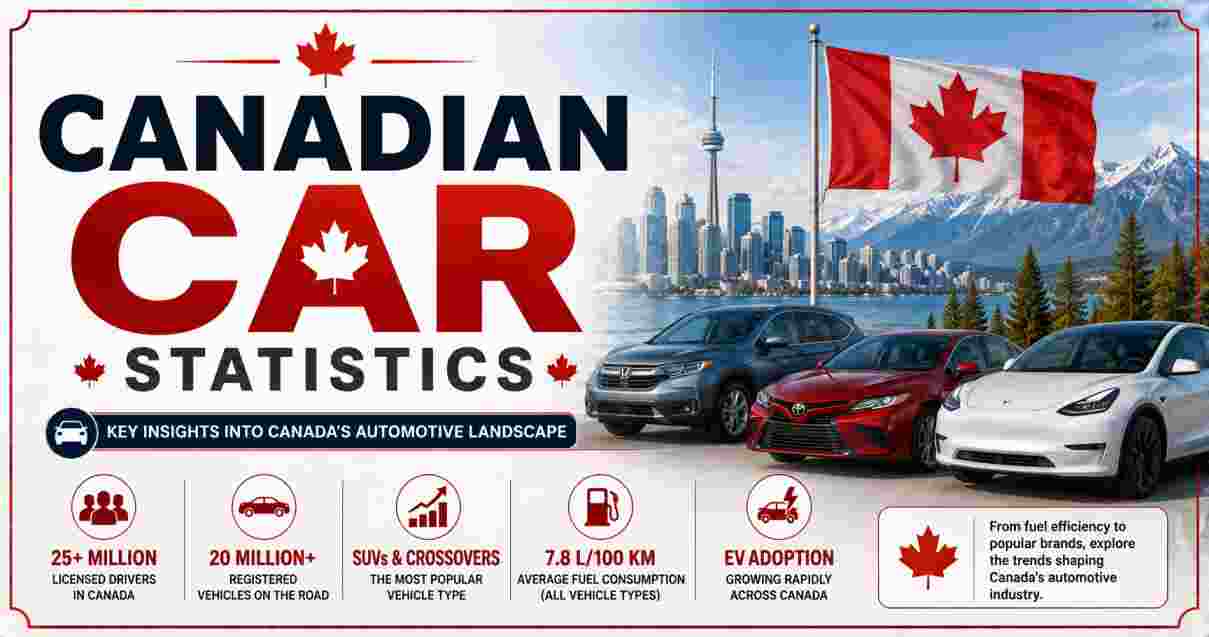
Where does Canada’s car market stand heading into 2026?
Canada’s automotive market enters 2026 in a genuine holding pattern, caught between a modest sales recovery from pandemic-era lows and a fresh wave of trade and policy disruption. After bottoming out at just 1.49 million new light vehicle sales in 2022 — the fewest since 2009 — the market climbed back to 1.72 million in 2023, 1.86 million in 2024, and roughly 1.90 million units in 2025, the strongest year since 2019. Even so, that 2025 total still sits about 7% below the all-time peak of 2.04 million vehicles sold in 2017, meaning “recovery” in the Canadian auto sector has meant steady rebuilding rather than a return to record territory.
Heading further into 2026, that momentum has already started to reverse: first-quarter sales fell 4.4% year-over-year, and mid-year data through June showed new vehicle sales down 1% compared to the same period in 2025. Much of 2025’s strength is now understood to have been “front-loaded” demand, with Canadian consumers pulling purchases forward ahead of anticipated tariff-driven price increases tied to the ongoing U.S.–Canada trade dispute. TD Economics projects a 4.3% decline in full-year 2026 sales, bringing the market down to roughly 1.82 million units, even as the federal government simultaneously pauses its flagship electric vehicle mandate in response to the same trade pressures reshaping the industry.
Interesting Facts About Canadian Car Statistics 2026
| Fact Category | Key Data Point |
|---|---|
| New vehicle sales, 2025 | Approximately 1.90 million units, up about 2% from 2024 |
| New vehicle sales, 2024 | 1,918,861 units, up 9.5% from 2023 |
| Total registered road motor vehicles, 2024 | 26.8 million, up 4.2% from 2023 |
| Best-selling vehicle in Canada, 2025 | Ford F-Series — 16th consecutive year as Canada’s top-selling nameplate |
| Best-selling pickup in Canada, 2025 | Ford F-Series — 60th consecutive year as top pickup |
| Trucks’ share of total 2025 vehicle sales | 88.0% |
| Passenger car sales decline since 2019 | -52.8%, from 496,851 units (2019) to 234,278 units (2025) |
| Households with at least one vehicle | Approximately 84% |
| Average price paid per new vehicle, 2025 | $55,827, up from $43,567 in 2019 |
| Zero-emission vehicle (ZEV) share of new sales, 2024 | 14.6% (up from 11.0% in 2023) |
| Federal 2026 ZEV sales mandate status | Paused by the federal government as of September 2025 |
Source: Statistics Canada, DesRosiers Automotive Consultants, Automotive News Research and Data Center
Taken together, these numbers describe a car market that is large, truck-dominated, and increasingly disrupted by policy and trade uncertainty. The sheer scale of Canada’s vehicle fleet — 26.8 million registered road motor vehicles supporting a population where roughly 84% of households have access to at least one vehicle — confirms that car ownership remains close to a national default rather than an urban luxury. At the same time, the 88.0% truck share of 2025 sales and the collapse of passenger car sales by more than half since 2019 show a market that has fundamentally reshaped itself around SUVs, crossovers, and pickups in barely half a decade.
The Ford F-Series’ run of 60 consecutive years as Canada’s best-selling pickup and 16 consecutive years as the single best-selling vehicle overall is one of the most remarkable brand-loyalty streaks in North American retail of any kind, let alone automobiles. Meanwhile, the federal government’s decision to pause the 2026 zero-emission vehicle mandate — which would have required 20% of new light-duty sales to be zero-emission — reflects how directly U.S. tariff pressure on the Canadian auto sector has begun reshaping domestic climate policy, not just trade flows, heading into the back half of 2026.
Canadian New Vehicle Sales Statistics 2026
Canada — New Light Vehicle Sales by Year (millions)
2017   ████████████████████████████████████████ 2.04 (record)
2022   █████████████████████████████ 1.49 (pandemic low)
2023   ██████████████████████████████████ 1.72
2024   █████████████████████████████████████ 1.86
2025   ██████████████████████████████████████ 1.90
2026*  ████████████████████████████████████ 1.82 (TD Economics forecast)
| Year | New Vehicle Sales | Year-over-Year Change |
|---|---|---|
| 2017 | 2.04 million (record) | +10.3% |
| 2019 | Declined | -3.7% |
| 2022 | 1.49 million (pandemic low) | – |
| 2023 | 1.72 million | +11% |
| 2024 | 1,918,861 (1.92 million) | +9.5% (StatCan) / +8.8% (Focus2move) |
| 2025 | ~1.90 million (1,897,058) | +2% |
| 2026 H1 | 948,977 (Jan–Jun) | -1% vs. H1 2025 |
| 2026 (forecast) | ~1.82 million | -4.3% (TD Economics) |
Source: Statistics Canada; Automotive News Research and Data Center; DesRosiers Automotive Consultants; TD Economics
Canada’s new vehicle sales trajectory over the past decade tells a clear story of boom, bust, and partial recovery: after peaking at an all-time high of 2.04 million units in 2017, the market contracted for several consecutive years, cratered to just 1.49 million during the pandemic-and-supply-chain collapse of 2022, and has since climbed back through 1.72 million (2023), 1.86–1.92 million (2024), and roughly 1.90 million (2025) — a genuine recovery, but one that still falls short of the 2017 peak by about 7%. The first half of 2026 shows that recovery losing steam, with 948,977 vehicles sold from January through June, a 1% decline compared to the same period in 2025.
TD Economics’ full-year forecast of a 4.3% decline to roughly 1.82 million units in 2026 reflects a market absorbing the combined effects of tariff-driven price pressure, softer consumer confidence amid trade uncertainty, and the reversal of 2025’s front-loaded demand as buyers who accelerated purchases ahead of anticipated tariffs are no longer in the market. This pattern mirrors what happened in Canada’s broader goods trade with the United States earlier in 2025, when exports first surged ahead of tariff implementation and then reversed sharply — motor vehicle exports to the U.S. fell almost 25% in a single month during that reversal, illustrating how tightly linked Canada’s domestic vehicle sales and its cross-border trade relationship with the U.S. have become.
Canadian Vehicle Registration Statistics 2026
Canada — Total Road Motor Vehicle Registrations by Year (millions)
2023   ████████████████████████████████████ 25.7
2024   ████████████████████████████████████████ 26.8
| Registration Metric | 2024 Data |
|---|---|
| Total road motor vehicles registered | 26.8 million, up 4.2% from 2023 |
| Light-duty vehicles (LDVs) share of total registrations | 91.6% (24.6 million vehicles) |
| EV share of light-duty vehicle registrations | 5.2%, up from 3.9% in 2023 |
| New motor vehicle registrations, 2024 | 1,852,738, up 8.0% from 2023 |
| Leading province by new registrations, 2024 | Ontario — 699,289 registrations |
| Second-leading province, 2024 | Quebec — 477,761 registrations |
| Third-leading province, 2024 | British Columbia — 219,177 registrations |
| Multipurpose vehicles’ share of new registrations, 2024 | 62.9%, up from 59.7% in 2023 |
Source: Statistics Canada, Table 20-10-0021-01 and Table 23-10-0308-01
Statistics Canada’s official registration data confirms the same truck-and-SUV shift visible in the raw sales figures: light-duty vehicles — a category that includes passenger cars, SUVs, pickups, and vans — accounted for 91.6% of all 26.8 million registered vehicles in 2024, and within that broader LDV category, multipurpose vehicles (SUVs and crossovers) alone made up 62.9% of new registrations, up sharply from 59.7% just a year earlier. The overall 4.2% increase in total registrations partly reflects genuinely stronger new vehicle sales, but Statistics Canada also notes that an automatic registration renewal system introduced in Ontario in July 2024 contributed to the reported growth, a methodological detail worth keeping in mind when comparing year-over-year totals.
The provincial breakdown of new registrations shows Canada’s three largest provinces — Ontario, Quebec, and British Columbia — accounting for the overwhelming majority of national vehicle activity, consistent with their combined share of the national population and economic activity. Notably, EVs made up 5.2% of all light-duty vehicle registrations in 2024, up from 3.9% the year before, a modest but steadily climbing share that provides useful context for understanding why the federal government’s now-paused 20% ZEV sales mandate for 2026 was viewed by many economists as increasingly out of reach on its original timeline.
Popular and Best-Selling Vehicle Models in Canada 2026
| Rank | Model / Manufacturer | 2025 Sales / Notable Data |
|---|---|---|
| 1 | Ford F-Series (F-150 + Super Duty) | 138,470 units — 16th straight year as #1 overall |
| — | General Motors (top manufacturer) | 299,813 units, 15.5% market share (3rd straight year at #1) |
| — | Ford (2nd manufacturer) | 293,897 units (vehicle brand); 294,418 including Lincoln |
| — | Toyota (3rd manufacturer) | 249,445 units — new all-time high |
| 2 | Toyota RAV4 | Best-selling non-pickup vehicle in Canada |
| 9 | Ford Escape | Holds 9th place despite planned discontinuation after 2026 |
| 10 | Subaru Crosstrek | Only subcompact SUV in the top 10 |
Source: Automotive News Data Center; CarGurus.ca; The Car Guide (GuideAutoWeb)
The Ford F-Series’ dominance of the Canadian market is not a recent phenomenon but a multi-generational pattern: with 138,470 units sold in 2025 (a 3.5% increase over 2024), it outsold the combined totals of the closely related Chevrolet Silverado and GMC Sierra nameplates and has now held the title of Canada’s best-selling vehicle, across all categories, for 16 consecutive years. At the manufacturer level, General Motors edged out Ford for the third year running, with 299,813 total units sold and a 15.5% market share, while Toyota’s 249,445 units represented a new all-time company high in Canada, driven substantially by the enduring popularity of the Canadian-built RAV4, which held onto its position as the best-selling non-pickup vehicle in the country despite transitioning to a new generation mid-year.
Beyond the top of the sales chart, several storylines stand out heading into 2026: the Ford Escape continued to hold 9th place nationally even as Ford prepares to discontinue the compact SUV after the 2026 model year in favor of the ruggedized Bronco Sport and upcoming electrified models, while the Subaru Crosstrek rounded out the top 10 as the only subcompact SUV to make the cut — a testament to the vehicle’s standard all-wheel drive and reputation for confident winter driving, a feature that carries particular weight for Canadian buyers navigating snow and ice for a significant portion of the year. For readers comparing these Canadian sales trends against the parallel U.S. market, the Automobile Sales Statistics report breaks down which manufacturers and models are leading south of the border over the same period.
Canadian Vehicle Ownership Statistics 2026
Canada — Vehicle Ownership Snapshot
Households with 1+ vehicle    ███████████████████████ 84%
Average vehicle age (StatCan) ███ 9.66 years (2016 data)
Commuters driving to work     ███████████████████████ 83.9%
| Ownership Metric | Data |
|---|---|
| Households with access to at least one vehicle | Approximately 84% |
| Total registered road motor vehicles, 2022 | 26.3 million |
| Most recent official average vehicle age (Statistics Canada) | 9.66 years (2016 Canadian Vehicle Survey figure) |
| Commercially estimated current average vehicle age | Approximately 10.5 years |
| Canadian commuters traveling by car, truck, or van | 83.9% (about 11 million of 13.1 million commuters) |
| Commuters who drive alone | Nearly 9 in 10 of vehicle commuters |
| Commuters using sustainable transportation (transit/walk/cycle) | 13.9% (7.7% transit, 6.2% walking/cycling) |
Source: Statistics Canada Canadian Vehicle Survey; 2021 Census of Population; Auto Service World industry reporting
Car ownership in Canada remains close to a societal default, with roughly 84% of households reporting access to at least one vehicle and 83.9% of the country’s 13.1 million commuters — about 11 million people — traveling to work by car, truck, or van, according to the 2021 Census of Population. Within that group, nearly 9 in 10 drive alone rather than carpooling, leaving only a modest 13.9% of commuters relying on transit, walking, or cycling as their primary mode. This heavy reliance on personal vehicles is closely tied to Canada’s geography: provinces with vast rural landscapes and limited public transit infrastructure, such as Alberta and Saskatchewan, report some of the highest ownership rates in the country, while dense urban centers like Toronto and Vancouver, where transit is a more viable alternative, see comparatively lower rates.
The question of vehicle age in Canada is more methodologically complicated than it first appears. Statistics Canada’s own Canadian Vehicle Survey last published an official average vehicle age figure of 9.66 years, based on 2016 data, and no more recent StatCan figure has superseded it — meaning any “current” average age cited elsewhere, commonly around 10.5 years, comes from commercial or industry estimates rather than an updated federal source. Industry analysts note that Canada’s climate plays a meaningful role here: road salt and harsh winters accelerate wear on the national vehicle fleet more than in most U.S. states, which — combined with a steady flow of used vehicles being exported south to the U.S., often around six or seven years old — helps explain why Canada’s fleet skews younger on average than comparable U.S. figures, even as both countries’ vehicles have been aging steadily for over a decade. For readers curious how vehicle durability and defect patterns factor into ownership decisions, the Vehicle Recall Statistics in US report tracks how recall volume and manufacturer reliability trends have evolved across the broader North American market in parallel with these ownership figures.
Canadian Electric Vehicle and Zero-Emission Vehicle Statistics 2026
Canada — ZEV Share of New Vehicle Registrations
2022   ████████ 6.7% (approx.)
2023   ███████████ 11.0%
2024   ██████████████ 14.6%
2026*  ██████████ ~14% (forecast, ~270,000 units — mandate target of 20% paused)
| EV / ZEV Metric | Data |
|---|---|
| ZEV share of new registrations, 2024 | 14.6% (270,985 units), up from 11.0% in 2023 |
| ZEV registration growth, 2024 vs. 2023 | +43.6% |
| ZEV registration growth, 2024 vs. 2022 | +119.2% |
| BEV share among all ZEVs, 2024 | 74.6% (PHEVs made up the remaining 25.4%) |
| Leading province for ZEV adoption, 2024 | Quebec — 30.9% of all new registrations in-province |
| Quebec’s share of national ZEV registrations | 54.4% |
| Original 2026 federal ZEV sales mandate target | 20% of new light-duty sales (equivalent to ~380,000 units) |
| Forecast actual 2026 ZEV sales (post-pause) | Approximately 270,000 units — about 14% of projected sales |
| Federal mandate status as of late 2025 / 2026 | Paused for 2026 models; long-term 2035 target (100% ZEV) under review |
Source: Statistics Canada; C.D. Howe Institute; Government of Canada policy announcements (September 2025)
Canada’s zero-emission vehicle adoption has grown rapidly in percentage terms — climbing from 11.0% of new registrations in 2023 to 14.6% in 2024, a 43.6% year-over-year increase in ZEV unit volume — but that pace still fell meaningfully short of the 20% threshold the federal Electric Vehicle Availability Standard had set as a mandatory target for 2026 model-year vehicles. Analysis from the C.D. Howe Institute projected that, absent the mandate, actual 2026 ZEV sales would land around 270,000 units against projected total sales of 1.9 million, roughly 14% — a shortfall of about 110,000 units relative to the original 20% requirement, which the Institute cited as the central reason the government waived the mandate rather than risk penalizing automakers for missing an unreachable target.
Quebec’s outsized role in Canada’s EV transition is one of the clearest provincial stories in this data: the province alone accounted for 54.4% of all new ZEV registrations nationally in 2024, and ZEVs represented 30.9% of all new vehicle registrations within Quebec itself — more than double the 20.9% rate in British Columbia and nearly quadruple Ontario’s 8.1% rate. Prime Minister Mark Carney’s September 2025 decision to pause the federal mandate for one year, alongside Quebec’s own move to partially lift its 2035 gas-vehicle sales ban, reflects a broader recalibration of Canadian EV policy in response to U.S. tariff pressure on the auto sector — though provincial mandates in Quebec and British Columbia technically remain in force even as the federal framework undergoes review, creating a genuinely uneven regulatory patchwork for automakers to navigate through the rest of 2026.
Canadian Vehicle Performance and Manufacturing Statistics 2026
| Performance / Industry Metric | Data |
|---|---|
| Vehicles assembled domestically in Canada annually | Approximately 1.4 million |
| Auto parts suppliers integrated into Canada’s supply chain | Nearly 700 |
| Average dealership revenue per vehicle sold, 2025 | $55,827, up from $43,567 in 2019 |
| New vehicle sales by dollar value, spring 2025 (monthly) | Topped $10.5 billion every month, March–May |
| 2025 total new vehicle sales value change | +10.8% compared to 2023 in dollar terms |
| Ford Q1 2026 recall volume (Canada/North America-wide campaigns) | Among the largest contributors to a 11.6 million-vehicle industry-wide Q1 recall total |
| Canadian motor vehicle exports to U.S., April 2025 (tariff shock month) | Down almost 25% month-over-month |
Source: Statistics Canada; Focus2move; BizzyCar Q1 2026 Recall Report; Automotive News
Beyond the sales and registration figures, Canada’s role as an actual vehicle producer — not just a consumer market — remains substantial: the country assembles roughly 1.4 million vehicles annually, supported by a domestic parts-supply network of nearly 700 companies integrated into global automotive supply chains. That manufacturing base has made Canada acutely sensitive to the same tariff and trade dynamics reshaping sales figures, with motor vehicle exports to the United States falling almost 25% in a single month during the April 2025 tariff shock — a sharp illustration of how quickly production and export volumes can swing when cross-border trade policy shifts.
On the pricing side, the rising average dealership revenue per vehicle — up from $43,567 in 2019 to $55,827 in 2025, a jump of nearly 28% in six years — reflects both genuine vehicle price inflation and the ongoing shift toward higher-priced trucks and SUVs at the expense of cheaper passenger cars. Meanwhile, the reliability and recall side of vehicle “performance” has become an increasingly cross-border story in its own right: with Ford opening 2026 as the industry’s dominant recall contributor within a broader 11.6-million-vehicle first-quarter total, Canadian owners of affected models are subject to the same manufacturer campaigns as their U.S. counterparts, and readers can consult the Consumer Reports Vehicles Statistics in US report for a deeper breakdown of which specific models and manufacturers are driving reliability concerns across the shared North American vehicle market in 2026.
Disclaimer: The data research report we present here is based on information found from various sources. We are not liable for any financial loss, errors, or damages of any kind that may result from the use of the information herein. We acknowledge that though we try to report accurately, we cannot verify the absolute facts of everything that has been represented.