What Is Binge Drinking and Its Link to Liver Disease
Binge drinking is defined by the National Institute on Alcohol Abuse and Alcoholism (NIAAA) as a pattern of alcohol consumption that raises blood alcohol concentration (BAC) to 0.08 grams per deciliter or higher — the legal impairment threshold. For most adults, this corresponds to consuming 5 or more standard drinks for men, or 4 or more standard drinks for women, within approximately two hours. A standard drink in the United States contains 0.6 fluid ounces (14 grams) of pure alcohol — the amount found in a 12-ounce regular beer, a 5-ounce glass of wine, or a 1.5-ounce shot of 80-proof spirits. Binge drinking is the most common and most costly form of excessive alcohol use in the United States, and it has a direct, well-documented, and dose-dependent relationship with one of the most serious and irreversible organ injuries in medicine: alcohol-associated liver disease (ALD). The spectrum of ALD runs from alcoholic fatty liver (steatosis), to alcoholic hepatitis (inflammation), and ultimately to alcoholic cirrhosis — the permanent, largely irreversible end-stage scarring of the liver that is now the leading indication for liver transplantation in the United States. As of April 2026, binge drinking-related liver disease represents one of the most pressing and rapidly worsening public health crises in American medicine.
The scale of this crisis is brought into sharp focus by the latest federal data. According to the 2024 National Survey on Drug Use and Health (NSDUH), administered by SAMHSA, 57.9 million Americans aged 12 and older — 20.1% of that age group — reported binge drinking in the past month. Among adults aged 18 and older, that figure rises to 57.0 million (21.7%). Meanwhile, the liver disease consequences of this drinking are accumulating at an alarming rate: a JAMA Network Open study published June 2025, analyzing 436,814 ALD-related deaths from CDC WONDER data, found that age-adjusted ALD mortality rates doubled from 6.71 to 12.53 deaths per 100,000 between 1999 and 2022, with the steepest acceleration occurring between 2018 and 2022. Of the 96,610 total liver disease deaths among Americans 12 and older in 2023, 44.5% — approximately 43,004 deaths — involved alcohol, according to NIAAA data compiled from the CDC’s Multiple Cause of Death files. The economic toll is equally staggering: annual costs of alcohol-associated liver disease are projected to grow from $31 billion in 2022 to $66 billion by 2040 — a 118% increase — according to research published in the American Journal of Gastroenterology.
Key Interesting Facts About Binge Drinking & Liver Disease in the US 2026
The following verified facts on binge drinking and liver disease in the United States 2026 are drawn exclusively from U.S. government agencies including the CDC, NIAAA/NIH, SAMHSA, and peer-reviewed studies using CDC WONDER and NSDUH federal databases.
| Fact Category | Key Fact |
|---|---|
| Americans binge drinking monthly (2024 NSDUH) | 57.9 million Americans aged 12+ (20.1%) reported binge drinking in the past month — 2024 NSDUH (SAMHSA/NIAAA) |
| Adult binge drinking rate (2024) | 57.0 million adults 18+ (21.7%) binge drink monthly — 24.9% of men and 18.7% of women (2024 NSDUH) |
| Binge drinking is most common form of excessive drinking | Over 90% of U.S. adults who drink excessively report binge drinking (CDC) |
| Alcohol-related liver disease deaths (2023) | Of 96,610 liver disease deaths, 44.5% (43,004) involved alcohol — 27,684 male, 15,319 female (NIAAA, 2023 CDC Multiple Cause of Death data) |
| ALD mortality rate doubled | Age-adjusted ALD mortality rates doubled from 6.71 to 12.53 per 100,000 between 1999 and 2022 (JAMA Network Open, June 2025; CDC WONDER data) |
| Excessive drinking deaths per year | ~178,000 Americans die annually from excessive alcohol use — 488 per day (CDC) |
| Binge drinking drives most excessive alcohol costs | 77% of the economic cost of excessive drinking is attributable to binge drinking (CDC) |
| ALD — leading liver transplant indication | ALD is the #1 indication for liver transplantation in the US — accounting for 41.1% of liver transplant recipients in 2023 (AASLD, UNOS data) |
| Liver cirrhosis death rate — pandemic-era peak | Age-adjusted liver cirrhosis death rate peaked at 15.5 per 100,000 in 2021 — dropped to 14.1 per 100,000 by 2023 (NIAAA Surveillance Report #123, September 2025) |
| Fatty liver in heavy drinkers | ~90% of heavy drinkers develop alcoholic fatty liver (steatosis) — the first stage of ALD (Merck Manual; Cleveland Clinic 2025) |
| Cirrhosis in heavy drinkers | 10–20% of people who drink heavily develop cirrhosis (Merck Manual Consumer Version) |
| ALD projected deaths 2019–2040 | More than 1 million people will die from ALD in the United States between 2019 and 2040 (Gastroenterology & Hepatology, November 2024) |
Source: SAMHSA — 2024 National Survey on Drug Use and Health (NSDUH), Tables 2.28A/2.28B (cited August 12, 2025); NIAAA — Alcohol and the Human Body fact page (2025); CDC — Data on Excessive Alcohol Use (updated February 2025); JAMA Network Open — “Alcohol-Associated Liver Disease Mortality” (June 11, 2025; CDC WONDER 1999–2022 data); NIAAA Surveillance Report #123 — Liver Cirrhosis Mortality in the United States: National, State, and Regional Trends 2000–2023 (September 2025); AASLD/UNOS data via AASLD Liver Fellow Network (2024); American Journal of Gastroenterology — Julien et al. (February 2024; PMC published 2025)
These facts collectively reveal the severity of a public health crisis that has no parallel in its acceleration rate among liver-related conditions in the United States. The doubling of ALD mortality rates between 1999 and 2022 is not a gradual, linear trend — the JAMA Network Open analysis confirmed a dramatic annual percentage change of 8.94% between 2018 and 2022, meaning the situation accelerated dramatically during and after the COVID-19 pandemic, when alcohol consumption among Americans surged. The finding that 77% of the entire economic cost of excessive drinking — estimated at $249 billion in 2010, substantially higher today — is attributable to binge drinking frames this not as a problem of alcohol dependency alone, but as a population-wide behavioral health issue in which episodic high-volume drinking by people who do not consider themselves alcoholics is destroying livers by the tens of thousands annually.
Binge Drinking Prevalence Statistics in the US 2026
The most current and authoritative national binge drinking prevalence data comes from the 2024 National Survey on Drug Use and Health (NSDUH), the federally conducted annual survey administered by SAMHSA’s Center for Behavioral Health Statistics and Quality. The 2024 NSDUH data, cited across NIAAA pages updated in August 2025, represents the most recent available population-level data as of April 2026.
| Prevalence Metric | Data Point | Source / Period |
|---|---|---|
| Total binge drinkers — all ages 12+ (past month) | 57.9 million people (20.1%) | 2024 NSDUH, SAMHSA/NIAAA |
| Male binge drinkers — ages 12+ (past month) | 32.2 million males (22.8%) | 2024 NSDUH, SAMHSA/NIAAA |
| Female binge drinkers — ages 12+ (past month) | 25.7 million females (17.4%) | 2024 NSDUH, SAMHSA/NIAAA |
| Adult binge drinkers — ages 18+ (past month) | 57.0 million adults (21.7%) | 2024 NSDUH, SAMHSA/NIAAA |
| Adult men binge drinking — ages 18+ (past month) | 31.8 million men (24.9%) | 2024 NSDUH, SAMHSA/NIAAA |
| Adult women binge drinking — ages 18+ (past month) | 25.2 million women (18.7%) | 2024 NSDUH, SAMHSA/NIAAA |
| Young adults binge drinking — ages 18–25 (past month) | 9.3 million (26.7%) — including 4.7M males (26.5%) and 4.7M females (26.9%) | 2024 NSDUH, NIAAA |
| College students binge drinking — ages 18–25 (past month) | 2.3 million full-time college students (25.0%) | 2024 NSDUH, NIAAA |
| Youth binge drinking — ages 12–17 (past month) | 900,000 youth (3.5%) — 385,000 boys (2.9%) and 515,000 girls (4.1%) | 2024 NSDUH, NIAAA |
| Underage binge drinking — ages 12–20 (past month) | 2.9 million (7.6%) — 1.4M males (7.1%) and 1.6M females (8.3%) | 2024 NSDUH, NIAAA |
| Proportion of drinkers who binge drink | Nearly 45% of adults who drink at all report binge episodes | South Denver Therapy / NSDUH data |
| Binge drinking adults — median frequency | Adults who binge drink do so a median of about twice per month | CDC Excessive Drinking Data |
Source: NIAAA — “Alcohol Use in the United States: Age Groups and Demographic Characteristics” (citing 2024 NSDUH, Tables 2.28A/2.28B; cited August 12, 2025); NIAAA — “Alcohol and Young Adults Ages 18 to 25” (citing 2024 NSDUH; updated 2025); NIAAA — “Underage Drinking in the United States (Ages 12 to 20)” (citing 2024 NSDUH; updated 2025); CDC — “Data on Excessive Alcohol Use” (updated February 2025)
The 2024 NSDUH binge drinking prevalence data presents a picture of a behavior that is both normalized and widespread across the American adult population. The 57.0 million adults aged 18 and older who report binge drinking monthly represents more than one in five U.S. adults — a figure that has remained stubbornly persistent despite decades of public health messaging. The gender gap — 24.9% of men versus 18.7% of women — while significant, is narrowing over time, consistent with the documented rise in alcohol consumption and ALD mortality among women specifically. Perhaps the most medically concerning data point is the 26.7% binge drinking rate among young adults aged 18–25, the age cohort with the highest prevalence of binge drinking in the entire country. This demographic is engaging in drinking patterns that, if sustained over years or decades, will drive the next wave of ALD diagnoses — and consistent with what liver disease epidemiologists have observed, the typical ALD patient in the United States is presenting in their 40s and 50s, meaning today’s binge-drinking 20-somethings are building the liver disease burden of the 2040s and 2050s.
Binge Drinking & Liver Disease Mortality Statistics in the US 2026
The relationship between binge drinking and liver mortality in the United States is quantified through multiple federally sourced datasets, including the CDC WONDER database, the NIAAA Surveillance Report #123 (September 2025), and the JAMA Network Open study (June 2025) analyzing 436,814 ALD deaths from 1999 to 2022.
| Liver Disease Mortality Metric | Data Point | Source |
|---|---|---|
| ALD-related deaths studied (1999–2022) | 436,814 total ALD-related deaths — 70.7% male (308,923 men) | JAMA Network Open, June 2025 (CDC WONDER data) |
| ALD age-adjusted mortality rate (1999) | 6.71 per 100,000 | JAMA Network Open, June 2025 |
| ALD age-adjusted mortality rate (2022) | 12.53 per 100,000 — nearly doubled from 1999 | JAMA Network Open, June 2025 |
| ALD mortality acceleration (2018–2022) | Annual percentage change of +8.94% — steepest acceleration recorded | JAMA Network Open, June 2025 |
| All liver cirrhosis death rate — peak | 15.5 per 100,000 at COVID-19 pandemic peak (2021) | NIAAA Surveillance Report #123, September 2025 |
| All liver cirrhosis death rate (2023) | 14.1 per 100,000 — decline from pandemic peak | NIAAA Surveillance Report #123, September 2025 |
| Alcohol-involved liver disease deaths (2023) | 43,004 deaths (44.5% of 96,610 total liver disease deaths) | NIAAA / CDC Multiple Cause of Death data, 2023 |
| Male alcohol-related liver deaths (2023) | 27,684 male deaths from alcohol-involved liver disease | NIAAA / CDC, 2023 |
| Female alcohol-related liver deaths (2023) | 15,319 female deaths from alcohol-involved liver disease | NIAAA / CDC, 2023 |
| Total excessive alcohol use deaths (US, annual) | ~178,000 deaths per year (488 per day) from excessive alcohol use | CDC |
| ALD — share of cirrhosis-related deaths | ALD accounts for approximately one-quarter of all cirrhosis-related deaths | JAMA Network Open, June 2025 |
| Projected US ALD deaths (2019–2040) | More than 1 million people projected to die from ALD in the US 2019–2040 | Gastroenterology & Hepatology, November 2024 |
Source: JAMA Network Open — “Alcohol-Associated Liver Disease Mortality” (Pan CW et al., June 11, 2025; doi: 10.1001/jamanetworkopen.2025.14857; CDC WONDER 1999–2022 data); NIAAA Surveillance Report #123 — Liver Cirrhosis Mortality in the United States: National, State, and Regional Trends 2000–2023 (Chen and Alpert, September 2025); NIAAA — Alcohol and the Human Body fact page (2025; citing 2023 CDC Multiple Cause of Death data); CDC — Data on Excessive Alcohol Use (February 2025); Gastroenterology & Hepatology journal (November 2024)
The mortality data for binge drinking and liver disease in America 2026 is among the most alarming in all of chronic disease epidemiology. The doubling of ALD mortality rates between 1999 and 2022 — from 6.71 to 12.53 deaths per 100,000 — documents a trajectory that has been moving in the wrong direction for more than two decades, with the alarming acceleration of +8.94% annually between 2018 and 2022 representing the steepest upswing since the study period began. The COVID-19 pandemic created conditions — social isolation, increased alcohol availability at home, economic stress, reduced access to addiction treatment — that directly worsened an already deteriorating trend. The 43,004 alcohol-involved liver disease deaths in 2023 represent nearly half of all liver disease deaths that year, confirming alcohol as by far the dominant driver of liver mortality in the United States. The projection that more than one million Americans will die from ALD between 2019 and 2040 is not a worst-case scenario — it is the research community’s central estimate based on current drinking trajectories, and it underscores with grim clarity why the connection between binge drinking and liver mortality is one of the most urgent preventable health crises facing the country.
Binge Drinking Liver Disease Demographic & Racial Disparity Statistics in the US 2026
The burden of binge drinking-related liver disease in the United States 2026 is not shared equally across demographic groups. Federal NSDUH data and CDC WONDER analyses reveal stark disparities by sex, age, and racial/ethnic group that carry profound implications for targeted prevention and clinical care.
| Demographic Group | Key Statistic | Source |
|---|---|---|
| Young adults (25–44) — fastest-rising ALD mortality | ALD mortality showed disproportionate increases in young adults aged 25–44 during study period | JAMA Network Open, June 2025 |
| Women — disproportionate ALD mortality increase | Women experienced disproportionately faster ALD mortality increases than men (2018–2022) | JAMA Network Open, June 2025 |
| American Indian/Alaska Native populations | Disproportionately highest ALD mortality increases among all racial/ethnic groups | JAMA Network Open, June 2025 |
| Women’s cirrhosis mortality rate increase (alcohol-related) | Age-adjusted alcohol-related cirrhosis death rate for women rose 83.5% (2000–2019) — vs. 33% for men | NIAAA Surveillance Report #118 |
| White women — cirrhosis death rate increase | Death rates for White women from alcohol-related cirrhosis rose 106% (2000–2019) | NIAAA Surveillance Report #118 |
| Male share of ALD deaths | Men account for 70.7% of ALD deaths (308,923 of 436,814 total 1999–2022) | JAMA Network Open, June 2025 |
| Gen Z (18–25) binge drinking — highest rate | 26.7% of adults aged 18–25 binge drink monthly — the highest of any age group | 2024 NSDUH, NIAAA |
| Females ages 12–20 binge drinking | 1.6 million (8.3%) of females aged 12–20 binge drink — higher rate than males (7.1%) in same age group | 2024 NSDUH, NIAAA |
| Non-Hispanic White binge drinking (adults 18+) | 34.5 million White adults (21.8%) report binge drinking | 2024 NSDUH, NIAAA |
| Black/African American binge drinking (adults 18+) | 7.1 million Black adults (22.3%) report binge drinking | 2024 NSDUH, NIAAA |
| Asian adults — lowest binge drinking rate | 2.0 million Asian adults (11.6%) — the lowest rate among racial groups | 2024 NSDUH, NIAAA |
| ALD estimated prevalence among heavy drinkers | 26.0% among hazardous drinkers and 55.1% among those with diagnosed alcohol use disorder | AASLD Liver Fellow Network (2024) |
Source: JAMA Network Open — “Alcohol-Associated Liver Disease Mortality” (June 2025; CDC WONDER data); NIAAA Surveillance Report #118 (NIAAA/NCHS data); 2024 NSDUH, Tables 2.28A/2.28B via NIAAA (August 2025); NIAAA — Alcohol Use in the United States: Age Groups and Demographic Characteristics; AASLD Liver Fellow Network — ALD transplant and prevalence data (2024)
The demographic data on binge drinking liver disease in America 2026 exposes health disparities that are simultaneously urgent and preventable. The finding that women experienced disproportionately faster ALD mortality increases than men during the 2018–2022 period — continuing a long-term trend documented by the 83.5% rise in women’s alcohol-related cirrhosis death rates between 2000 and 2019 — is rooted in well-understood biology: women develop ALD at lower consumption thresholds, progress faster, and have lower post-abstinence survival than men. The population-level consequence is a rapidly closing gender gap in liver death rates despite women still consuming less alcohol overall. The situation for American Indian and Alaska Native populations, who showed the most disproportionate ALD mortality increases of any racial/ethnic group in the JAMA analysis, represents a compounding crisis of biological risk, socioeconomic disadvantage, and systemic barriers to addiction treatment access. The 26.7% binge drinking rate among young adults aged 18–25 — combined with the clinical reality that ALD typically presents 10–20 years after sustained heavy drinking begins — means that the demographic entering peak binge-drinking behavior today is building the patient population that liver disease clinicians will be treating in full crisis mode by the late 2030s and 2040s.
Binge Drinking Liver Disease Symptoms in the US 2026
Understanding the clinical symptom profile of binge drinking-related liver disease is critical for early detection, as the condition progresses through three distinct stages — each with a different symptom burden and reversibility profile.
| Stage / Symptom | Description & Clinical Notes | Source |
|---|---|---|
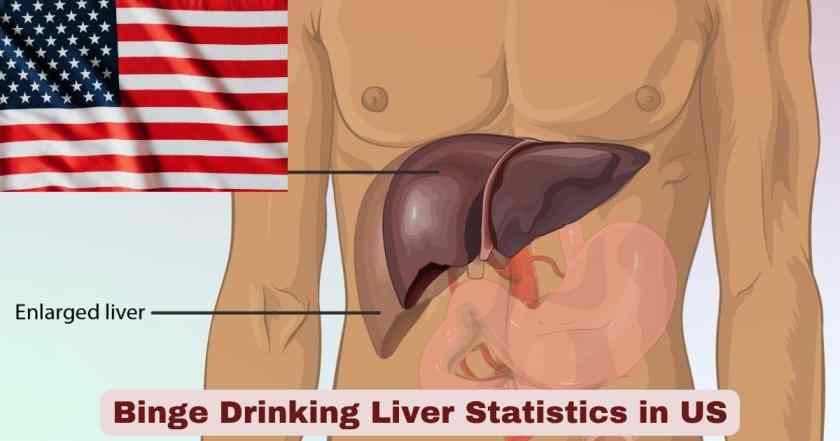
| Alcoholic Fatty Liver (Steatosis) — Stage 1 | Fat accumulates in liver cells; usually no symptoms; liver may enlarge; largely reversible with abstinence | Cleveland Clinic ALD page (2025); Merck Manual |
| Alcoholic Hepatitis — Stage 2 | Liver inflammation from fat build-up; can occur acutely during binge drinking episodes; may heal with abstinence | Cleveland Clinic (2025); Medical News Today (December 2025) |
| Alcoholic Cirrhosis — Stage 3 | Permanent scarring replaces healthy tissue; largely irreversible in advanced stages; liver cannot function normally | Cleveland Clinic (2025); American Liver Foundation (2025) |
| Jaundice | Yellowing of skin and eyes from bilirubin buildup; appears in moderate-to-advanced disease | NIAAA; NIH/StatPearls |
| Ascites | Fluid accumulation in the abdomen; indicates decompensated cirrhosis; occurs in 10–35% of ALD patients reaching hepatitis stage | Merck Manual; American Liver Foundation (2025) |
| Hepatic encephalopathy | Brain dysfunction due to toxin accumulation; confusion, drowsiness, coma in severe cases | NIH/StatPearls (updated 2025) |
| Portal hypertension and varices | Increased blood pressure in the portal vein; risk of esophageal variceal bleeding, one of the most dangerous complications | Merck Manual; American Liver Foundation (2025) |
| Right upper abdominal pain / tenderness | Dull ache or tenderness below the right ribcage as the liver swells | Cleveland Clinic (2025) |
| Fatigue and malaise | Often the earliest and most non-specific symptom; frequently dismissed | Cleveland Clinic (2025); NIH/StatPearls |
| Nausea and loss of appetite | Impaired liver metabolism affects digestion; common in active ALD | NIH/StatPearls; American Liver Foundation |
| Bleeding and bruising easily | Reduced liver production of clotting factors in advancing cirrhosis | American Liver Foundation (2025) |
| 90% of heavy drinkers develop Stage 1 | 90% of people who drink heavily develop fatty liver — even after as little as two weeks of heavy drinking | Yale Medicine ALD page; Cleveland Clinic (2025) |
Source: Cleveland Clinic — “Alcohol-Associated Liver Disease: Symptoms & Stages” (updated August 28, 2025); American Liver Foundation — “Alcohol-Associated Liver Disease: Causes & Symptoms” (updated 2025); Merck Manual Consumer Version — Alcohol-Related Liver Disease (updated May 2025); NIH/NCBI StatPearls — “Alcohol-Associated Liver Disease” (2025 edition); Medical News Today — “Alcohol-related liver disease: Stages, symptoms, and treatment” (updated December 2025)
The symptom profile of binge drinking-related liver disease in America 2026 is defined by a dangerous medical paradox: the stage at which the damage is still largely reversible — alcoholic fatty liver, which affects 90% of heavy drinkers — produces almost no symptoms at all. This means that the enormous majority of the tens of millions of Americans whose livers are already being damaged by binge drinking are receiving no internal warning signal telling them to stop. By the time symptoms like jaundice, ascites, abdominal pain, or hepatic encephalopathy appear, the liver has typically already progressed to hepatitis or cirrhosis — stages where the damage is either partially or entirely permanent. Acute binge drinking is a clinically recognized trigger for alcoholic hepatitis — meaning that a severe, sudden episode of binge drinking in a person with underlying fatty liver disease can precipitate a rapid-onset hepatic inflammatory crisis that is potentially fatal. The distinction between cirrhosis and earlier ALD stages is crucial from a treatment perspective: fatty liver and early hepatitis can often reverse completely with total abstinence, while cirrhosis cannot be reversed — management at that stage focuses on preventing complications, managing ascites and encephalopathy, and, in severe cases, evaluating for liver transplantation.
Binge Drinking Liver Disease Treatment Statistics in the US 2026
The treatment landscape for binge drinking-related liver disease in the United States 2026 centers on alcohol cessation as the single most effective intervention, supported by emerging pharmacological options for alcohol use disorder and a liver transplant system that has been increasingly reshaped by ALD’s dominance.
| Treatment Metric | Data Point / Description | Source |
|---|---|---|
| Most effective treatment — total abstinence | Alcohol abstinence is the most effective treatment to reverse liver damage at all stages | American Liver Foundation (2025); NIDDK/NIH |
| FDA-approved medications for alcohol use disorder (AUD) | 3 FDA-approved medications: disulfiram, acamprosate, naltrexone — associated with reduced binge drinking and ALD hospitalizations | Annals of Hepatology (2024); NIAAA |
| MAUDs improve survival in severe ALD | Use of medications for AUD for ≥3 months associated with 6.6% higher 1-year survival and 18.5% higher 3-year survival in severe ALD patients | JAMA Network Open, February 2026 (UCLA/MGH study) |
| MAUDs use remains very low | Use of medications for alcohol use disorder among severe ALD patients referred for liver transplant remains very low | JAMA Network Open, February 2026 |
| Corticosteroids — alcoholic hepatitis | Prednisolone/corticosteroids used to reduce inflammation in severe acute alcoholic hepatitis; require careful clinical evaluation | NIH/StatPearls; Merck Manual Professional (2025) |
| Liver transplantation — ALD as #1 indication | ALD accounted for 41.1% of all liver transplant recipients in 2023 — #1 indication | AASLD/UNOS data (2024); JAMA Network Open (2025) |
| Liver transplant for ALD — proportion growth | Proportion of liver transplants for ALD rose from 24.2% in 2002 to 36.7% in 2016 — nearly doubled | PubMed / UNOS data (Lee et al., 2019; cited 2024) |
| 5-year post-transplant survival — ALD | 79% cumulative 5-year survival for ALD liver transplant recipients | Lee et al. JAMA Internal Medicine 2019 / PubMed |
| Liver transplant cost | Liver transplant for advanced ALD/MASLD can cost over $500,000 per procedure | American Journal of Gastroenterology / PMC (2025) |
| Alcohol relapse post-transplant | Alcohol relapse occurs at rate of 4.7% per year for any alcohol use after liver transplant | AASLD Liver Fellow Network (2024) |
| Nutritional therapy | Nutritional support and adequate protein intake are essential components of ALD treatment at all stages | American Liver Foundation (2025); NIH |
| Fatty liver reversal | Alcoholic fatty liver usually reverses within 4 weeks of abstinence | PMC — Epidemiology of Alcohol-Associated Liver Disease; NIH |
Source: JAMA Network Open — “Medications for Alcohol Use Disorder Among Patients With Severe Alcohol-Related Liver Disease” (Sundaresh et al., February 2, 2026; doi: 10.1001/jamanetworkopen.2025.59016); American Liver Foundation — ALD Treatment and Causes page (updated 2025); AASLD Liver Fellow Network — ALD Transplant overview (2024); Lee BP et al. JAMA Internal Medicine (2019; widely cited through 2024); NIH/NCBI StatPearls — ALD (2025); Annals of Hepatology (2024); PMC — Epidemiology of Alcohol-Associated Liver Disease
The treatment data for binge drinking liver disease in America 2026 reveals both an evolving clinical toolbox and a serious gap between what is available and what is being used. The most important single finding in recent treatment research is the JAMA Network Open study published in February 2026, which found that medications for alcohol use disorder (MAUDs) given for at least three months were associated with 6.6% higher one-year survival and 18.5% higher three-year survival among patients with severe ALD referred for liver transplant — yet the same study confirmed that MAUDs use in this population remains very low. This gap between evidence and practice is one of the most actionable problems in ALD care right now, and closing it represents a concrete opportunity to save lives that are currently being lost because a proven, FDA-approved pharmacological treatment is being systematically underutilized. The position of ALD as the #1 indication for liver transplantation — accounting for 41.1% of all recipients in 2023 — and the documented $500,000+ cost per liver transplant frames this as both a clinical tragedy and a financial one: many of these transplants are in patients who might never have reached that endpoint if effective alcohol use disorder treatment had been initiated earlier, when the liver disease was still in a reversible stage.
Binge Drinking Liver Disease Prevention Statistics in the US 2026
Preventing binge drinking-related liver disease in the United States 2026 requires addressing both individual consumption behavior and population-level risk factors, supported by evidence-based strategies endorsed by the CDC, NIAAA, and clinical liver disease organizations.
| Prevention Strategy | Evidence / Impact Data | Source |
|---|---|---|
| Complete alcohol abstinence | Most effective single intervention — reverses fatty liver, halts hepatitis progression; essential at all ALD stages | American Liver Foundation (2025); NIDDK/NIH |
| Stay within low-risk drinking limits (NIAAA) | Men: no more than 4 drinks/day or 14/week; Women: no more than 3 drinks/day or 7/week | NIAAA — Drinking Levels Defined |
| Binge drinking defined threshold to avoid | Men: 5+ drinks in ~2 hours; Women: 4+ drinks in ~2 hours (raises BAC to ≥0.08 g/dL) | NIAAA binge drinking definition |
| Alcohol use disorder screening at every clinical encounter | AASLD and ACG recommend AUD screening at every medical encounter in primary care, gastroenterology, and emergency settings | ACG Clinical Guideline: ALD (Jophlin et al., 2024) |
| Validated screening tools | AUDIT (Alcohol Use Disorders Identification Test) and CAGE questionnaire recommended for early detection | Merck Manual Professional (2025); ACG 2024 guideline |
| Alcohol policy measures | Alcohol pricing policies, taxation, and reduced availability are effective at reducing high-risk drinking at population level | Lancet Public Health; NIAAA |
| Healthy body weight | Obesity significantly increases ALD risk; weight management reduces liver disease susceptibility | NCBI StatPearls ALD; Nursing Center guideline (June 2025) |
| Avoid concurrent hepatitis C infection risks | 16–24% of heavy drinkers have hepatitis C — combination of alcohol + HCV greatly accelerates cirrhosis | Merck Manual Consumer Version (May 2025) |
| Hepatitis B vaccination | Prevents HBV infection; reduces risk of accelerated liver damage in drinkers | CDC immunization guidance |
| Avoid other hepatotoxic substances | Certain medications, supplements, and illicit drugs compound alcohol liver damage | American Liver Foundation (2025); NIDDK |
| Early FIB-4 / FibroScan screening in at-risk drinkers | Non-invasive fibrosis screening recommended for individuals with heavy drinking + metabolic risk factors | EASL-EASD-EASO MASLD Guidelines 2024; hepatology guidance |
| Behavioral/addiction treatment programs | CBT, motivational enhancement therapy, 12-step programs, and pharmacotherapy reduce relapse and ALD hospitalizations | Annals of Hepatology (2024); NIAAA |
Source: American Liver Foundation — ALD Treatment and Causes page (2025); NIAAA — Drinking Levels Defined; NIAAA — Understanding Binge Drinking fact sheet (2025); ACG Clinical Guideline on Alcohol-Associated Liver Disease (Jophlin et al., 2024, American Journal of Gastroenterology); Merck Manual Consumer Version — Alcohol-Related Liver Disease (May 2025); CDC — Data on Excessive Alcohol Use; NCBI/Nursing Center — Alcohol-Associated Liver Disease clinical summary (June 2025)
The prevention evidence for binge drinking and liver disease in the United States 2026 sends a clear and actionable message at every level of intervention — individual, clinical, and societal. At the individual level, the clinical definition is precise: for women, any drinking session involving 4 or more drinks in two hours constitutes binge drinking and begins to generate the hepatic stress that, when repeated over months or years, initiates the fatty liver → hepatitis → cirrhosis cascade. This threshold is meaningfully lower than what many Americans consider a “heavy” night of drinking, which is part of why so many people are damaging their livers without recognizing the risk they’re taking. At the clinical level, the 2024 ACG Clinical Guideline on Alcohol-Associated Liver Disease calls explicitly for AUD screening at every medical encounter across all clinical settings — not just addiction medicine or hepatology — because primary care and emergency medicine are often the first points of contact for patients whose ALD is still in an early, reversible stage. The population-level evidence that alcohol pricing policies and reduced availability lower high-risk drinking provides policymakers with validated tools to reduce the binge drinking rates that are driving this liver disease epidemic, tools that are increasingly supported by the fiscal argument that preventing ALD is dramatically less expensive than treating it: annual ALD costs are projected to double from $31 billion to $66 billion by 2040, and the cumulative tab through 2040 is projected at $880 billion.
Disclaimer: The data research report we present here is based on information found from various sources. We are not liable for any financial loss, errors, or damages of any kind that may result from the use of the information herein. We acknowledge that though we try to report accurately, we cannot verify the absolute facts of everything that has been represented.