
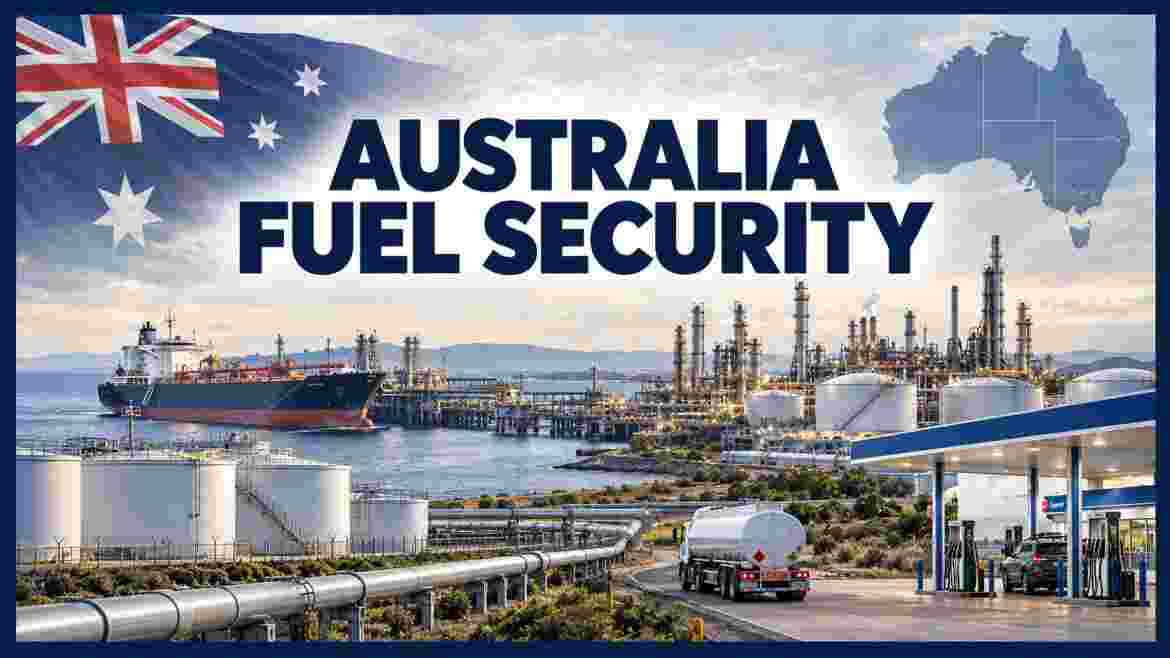
Australia entered 2026 with roughly 30 days of onshore fuel cover, far below the International Energy Agency’s 90-day benchmark, and the gap turned into a live crisis when the Strait of Hormuz closed in late February. In response, Canberra announced a $14.8 billion Australian Fuel Security and Resilience Package in May, targeting 50 days of diesel and jet fuel cover.
Australia Fuel Security 2026 – Introduction
Australia fuel security 2026 stopped being an abstract policy debate and became a live national emergency within the first ten weeks of the year. Australia imports almost all of its liquid fuels, operates only two domestic oil refineries where it once ran eight, and entered 2026 holding roughly 30 days of onshore cover against the International Energy Agency’s 90-day member benchmark. When the United States and Israel launched strikes on Iran on 28 February 2026, triggering a near-total closure of the Strait of Hormuz, that thin buffer was tested almost immediately.
What followed was a cascade: panic buying, a refinery fire, emergency stockpile releases, and ultimately a $14.8 billion federal package designed to rebuild Australia’s fuel resilience from the ground up. This report walks through Australia’s fuel reserves, import dependency, refining capacity and the policy response that followed the 2026 crisis, using government and industry data confirmed through October 2026.
Interesting Facts About Australia Fuel Security 2026
AUSTRALIA'S FUEL RESERVE COVER, 2026 (days of supply)
Petrol        | █████ 36-39
Jet fuel      | ███ 29-31
Diesel        | ████ 32-33
IEA benchmark | ██████████████████████ 90
| Fact | Confirmed 2026 Data |
|---|---|
| Petrol reserves (days of cover) | 36–39 days |
| Diesel reserves (days of cover) | 32–33 days |
| Jet fuel reserves (days of cover) | 29–31 days |
| IEA member benchmark | 90 days |
| Domestic refineries remaining | 2 (down from 8 in 2005) |
| Share of national fuel demand met by domestic refining | Less than 20% |
| Fuel Security and Resilience Package (May 2026) | $14.8 billion |
Source: Department of Climate Change, Energy, the Environment and Water (DCCEEW); Macquarie University Lighthouse; Discovery Alert, 2026.
The chart shows how thin Australia’s buffer really was heading into 2026: petrol cover sat around 36 to 39 days, diesel around 32 to 33 days, and jet fuel the lowest of all at 29 to 31 days — all far short of the IEA’s 90-day benchmark for member countries. The table fills in why that gap exists structurally: Australia now runs just two domestic refineries, down from eight two decades ago, and those two plants together meet less than 20% of national fuel consumption.
The headline policy response, a $14.8 billion package announced in May 2026, is the direct consequence of that exposure being tested in real time. It represents the most significant restructuring of Australian fuel security policy in decades, built specifically around closing the gap between the country’s historic 30-day private-sector buffer and a new 50-day target for diesel and jet fuel.
The 2026 Fuel Crisis: Timeline of Australia’s Strait of Hormuz Shock
| Date | Event |
|---|---|
| 28 February 2026 | US-Israeli strikes on Iran begin; Strait of Hormuz shipping disrupted |
| 13 March 2026 | Government activates Fuel Security (Temporary Reduction) Instrument |
| 16–25 March 2026 | Panic buying, regional shortages reported, sulphur standards eased |
| 15–16 April 2026 | Fire at Viva Energy’s Geelong refinery, ~150 million litres of diesel lost |
| 6 May 2026 | $14.8 billion Australian Fuel Security and Resilience Package announced |
Source: Wikipedia, 2026 Strait of Hormuz crisis; SBS News; ABC News; Discovery Alert, 2026.
The crisis began with a geopolitical shock entirely outside Australia’s control. Iran’s near-total blockade of the Strait of Hormuz, through which roughly 20% of the world’s oil trade passes, followed the 28 February 2026 US-Israeli air campaign. Australia does not import crude directly from the Persian Gulf in large volumes, but the Asian refineries supplying most of its fuel — in South Korea, Singapore and Malaysia — are critically dependent on that exact feedstock, meaning the disruption reached Australian bowsers indirectly but forcefully.
The government’s first response came fast: on 13 March, it activated the Fuel Security (Temporary Reduction) Instrument, cutting the Minimum Stockholding Obligation by up to 20% and releasing roughly 762 million litres from companies’ own domestic holdings to ease the immediate squeeze. That relief measure has since been extended twice, most recently through 30 September 2026. Then, on 15–16 April, a fire tore through Viva Energy’s Geelong refinery — one of only two plants left in the country — destroying an estimated 150 million litres of diesel and knocking out a facility that supplies more than half of Victoria’s fuel, compounding a crisis that was already straining supply chains nationally.
Australia’s Refining Capacity 2026: Down to Two Plants
| Refinery | Operator | Location | Status in 2026 |
|---|---|---|---|
| Lytton | Ampol | Brisbane, Queensland | Operating; does not rely on Persian Gulf crude |
| Geelong (Corio) | Viva Energy | Geelong, Victoria | Damaged by April 2026 fire; supplies ~50% of Victoria’s fuel |
| Six closed refineries since 2003 | Various | Multiple states | Permanently closed |
Source: ABC News; Wikipedia, Lytton Oil Refinery and Geelong Oil Refinery entries, 2026.
Australia’s refining base has collapsed from eight plants in 2005 to just two today, and both remaining facilities are now treated as matters of national strategic concern rather than ordinary commercial infrastructure. Ampol CEO Matthew Halliday said directly that the 2026 Iran war “proves why Australia’s last two refineries still matter,” noting that six refineries have closed since 2013 alone, leaving the country with essentially no surge capacity to offset an import disruption of any size.
The two plants also carry different risk profiles. Lytton, in Brisbane, does not depend on Persian Gulf crude and continued largely uninterrupted through the crisis, while Geelong’s April fire removed a facility supplying over half of Victoria’s fuel at the worst possible moment. Together, even operating at full capacity, Australia’s domestic refineries meet less than 20% of national consumption, meaning the country’s fuel security fundamentally rests on continuous imports rather than any realistic path back to self-sufficiency. The same chokepoint dynamics that triggered this crisis are explored further in this breakdown of Kharg Island statistics, which covers the Iranian export terminal at the center of the broader Strait of Hormuz disruption.
Australia’s Fuel Imports 2026: Where the Fuel Actually Comes From
| Metric | 2026 Figure |
|---|---|
| Share of refined fuel imports from South Korea, Singapore, Malaysia | 65% |
| Share of Australia’s maritime fuel imports transiting Indonesian straits | 83% |
| Singapore’s share of crude sourced from the Persian Gulf region | ~66% |
| Australia’s daily oil consumption | ~1.15 million barrels |
Source: Morningstar Australia; A Refined View from Down Under (nthorderalpha); SBS News, 2026.
Even though Australia’s two refineries process relatively little Gulf-origin crude directly, the country’s dependence on the Strait of Hormuz is real and runs through its suppliers. Three countries — South Korea, Singapore and Malaysia — together supply 65% of Australia’s refined fuel imports, and Singapore alone sources roughly 66% of its crude from the Persian Gulf region, which usually transits the same strait Iran blockaded. That indirect exposure is precisely why a conflict thousands of kilometres from Australian shores could still trigger domestic shortages within weeks.
A second chokepoint compounds the risk. Even when refined product does reach Australia, 83% of the country’s maritime fuel imports must transit the Indonesian straits, meaning Australia’s fuel security depends on at least two separate maritime bottlenecks functioning normally, neither of which Australia controls. During the crisis, Malaysia warned it would prioritize domestic fuel needs over export partners including Australia, while China suspended fuel exports entirely through the end of March, illustrating how quickly diplomatic goodwill can evaporate when exporting nations face their own shortages. The broader economic fallout from this exposure is tracked in this look at Australia’s GDP statistics, where rising fuel prices and Middle East-linked supply concerns were explicitly flagged by the Bureau of Statistics as a drag on growth.
The $14.8 Billion Fuel Security Package 2026: What’s Actually in It
AUSTRALIAN FUEL SECURITY AND RESILIENCE PACKAGE, MAY 2026 (billions AUD)
Fuel and Fertiliser Security Facility     | ███████████████ 7.5
Australian Fuel Security Reserve (AFSR)   | ███████ 3.2
Refining feasibility studies              | ▌ 0.01
Fuel security management (5-year)         | ▌ 0.0547
| Component | Funding | Purpose |
|---|---|---|
| Fuel and Fertiliser Security Facility | $7.5 billion | Securing more fuel internationally; loans, insurance, equity support |
| Australian Fuel Security Reserve (AFSR) | $3.2 billion | Government-owned reserve holding ~1 billion litres of diesel and jet fuel |
| Refining capability feasibility studies | $10 million | Co-funded with states/territories to study expanded refining |
| Fuel security management funding | $54.7 million (5 years) | Ongoing administration of the Fuel Security Framework |
Source: Department of Climate Change, Energy, the Environment and Water; Trade Minister Don Farrell media release, May 2026.
The $14.8 billion headline figure breaks down into several distinct instruments rather than a single fund. The largest single piece, the $7.5 billion Fuel and Fertiliser Security Facility, is designed to help fuel companies secure financing, insurance and equity to purchase and store more stock internationally — addressing the private sector’s historic reluctance to hold fuel reserves beyond the bare legal minimum. The $3.2 billion Australian Fuel Security Reserve is the more structurally significant piece: it establishes, for the first time, a government-owned strategic reserve of roughly one billion litres of diesel and jet fuel, something Australia has never had before.
Smaller allocations target the refining question directly. $10 million will fund feasibility studies into new or expanded domestic refining capability, co-funded with state and territory governments, while $54.7 million over five years funds the ongoing administration of Australia’s Fuel Security Framework. Combined with a roughly 10-day increase to the Minimum Stockholding Obligation across all fuel types, the package’s stated goal is to lift diesel and jet fuel cover to 50 days — still below the IEA’s 90-day benchmark, but a substantial improvement on the roughly 30-day baseline Australia operated under for years.
Australia vs. the World: How Exposed Is the Fuel Supply, Really?
DAYS OF FUEL COVER: AUSTRALIA VS NEW ZEALAND (May 2026)
Australia — gasoline   | ████████████████████████████████████ 39
New Zealand — gasoline | ███████████████████████████████████ 35.1
Australia — jet fuel   | ███████████████████████████████ 31
New Zealand — jet fuel | ████████████████████████████████ 32.4
Australia — diesel     | █████████████████████████████████ 33
New Zealand — gasoil   | █████████████████████████ 25.1
| Fuel Type | Australia (late May 2026) | New Zealand (24 May 2026) |
|---|---|---|
| Gasoline/Petrol | 39 days | 35.1 days |
| Jet fuel | 31 days | 32.4 days |
| Diesel/Gasoil | 33 days | 25.1 days |
Source: Discovery Alert, “Australia’s Fuel Stockpile Relief Extended to September 2026.”
Despite the crisis headlines, Australia’s position compares reasonably well against its closest regional peer. As of late May 2026, Australia held more days of cover than New Zealand across gasoline and diesel, with jet fuel roughly comparable between the two. That comparison matters for context: Australia’s fuel security problem is not uniquely severe among comparable import-dependent nations, but it is still a long way from the IEA’s 90-day standard that most member countries with domestic reserves meet comfortably.
The deeper issue analysts keep returning to is not the exact day-count at any given moment, but the structural fragility underneath it — a “just-in-time” import model with minimal surge capacity, reliant on continuous tanker deliveries through two separate maritime chokepoints, with domestic refining reduced to a level that provides only a partial buffer rather than genuine backup capacity. That exposure also fed directly into Australia’s broader 2026 inflation story, with fuel costs flowing through to transport, food and manufacturing prices in a pattern consistent with the wider trend covered in these global CPI statistics, where the OECD specifically revised its inflation forecasts upward citing Strait of Hormuz-linked energy price shocks.
Frequently Asked Questions About Australia Fuel Security 2026
How many days of fuel does Australia currently hold?
As of mid-2026, Australia held roughly 36 to 39 days of petrol, 32 to 33 days of diesel, and 29 to 31 days of jet fuel — all below the International Energy Agency’s 90-day benchmark for member countries.
Why did Australia have a fuel crisis in 2026?
The US-Israeli military campaign against Iran, launched on 28 February 2026, triggered a near-total closure of the Strait of Hormuz, disrupting the Asian refineries that supply most of Australia’s imported fuel.
How many oil refineries does Australia have left?
Two: Ampol’s Lytton refinery in Brisbane and Viva Energy’s Geelong refinery in Victoria. Australia operated eight refineries as recently as 2005.
What was the $14.8 billion fuel security package?
Announced on 6 May 2026, it includes a $7.5 billion Fuel and Fertiliser Security Facility, a $3.2 billion government-owned Australian Fuel Security Reserve holding about one billion litres, and smaller funding for refining feasibility studies and program administration.
What happened at the Geelong refinery in 2026?
A major fire broke out at Viva Energy’s Geelong (Corio) refinery on the night of 15–16 April 2026, destroying an estimated 150 million litres of diesel and disrupting a facility that supplies more than half of Victoria’s fuel.
Does Australia meet the IEA’s 90-day fuel reserve requirement?
No. Australia has never met the International Energy Agency’s 90-day benchmark and remained well below it throughout 2026, even after emergency measures and the new fuel security package.
Where does Australia’s fuel actually come from?
Primarily imported refined product, with South Korea, Singapore and Malaysia together supplying about 65% of imports. About 83% of Australia’s maritime fuel imports transit the Indonesian straits.
What is the Australian Fuel Security Reserve (AFSR)?
A new government-owned strategic fuel reserve, funded with $3.2 billion, designed to hold approximately one billion litres of diesel and aviation fuel — the first reserve of its kind Australia has operated.
How does Australia’s fuel security compare to New Zealand’s?
As of late May 2026, Australia held more days of cover than New Zealand for gasoline and diesel, with jet fuel levels roughly comparable between the two countries.
Is the Minimum Stockholding Obligation relief still in effect?
Yes. The temporary 20% reduction to the Minimum Stockholding Obligation, first activated in March 2026, has been extended through 30 September 2026 as of the most recent government announcement.
Could Australia become fuel self-sufficient again?
Unlikely in the near term. Even with both remaining refineries operating at capacity, domestic refining meets less than 20% of national fuel demand, and rebuilding meaningful refining capacity would require years of investment well beyond the feasibility studies currently funded.
Disclaimer: The data research report we present here is based on information found from various sources. We are not liable for any financial loss, errors, or damages of any kind that may result from the use of the information herein. We acknowledge that though we try to report accurately, we cannot verify the absolute facts of everything that has been represented.