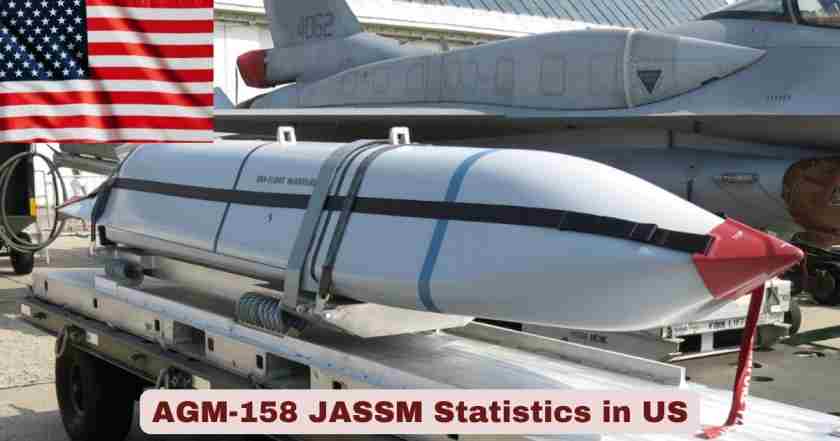
What is AGM-158 JASSM?
The AGM-158 Joint Air-to-Surface Standoff Missile — universally abbreviated as JASSM and colloquially pronounced “jazz-em” — is the United States military’s premier long-range, low-observable, precision-guided standoff cruise missile, and in 2026 it is one of the most operationally active and strategically consequential weapons in the American arsenal. Developed by Lockheed Martin under a contract awarded in April 1998 following the cancellation of the excessively expensive AGM-137 TSSAM program, the JASSM was designed to solve a specific and urgent tactical problem: how to destroy heavily defended, high-value targets — command bunkers, air defense installations, hardened weapon storage sites, airfields, strategic infrastructure — without sending the launching aircraft anywhere near the enemy’s surface-to-air missile systems. The answer is a missile with a low-observable (stealthy) airframe, a 1,000-pound class armor-piercing penetrator warhead, GPS/INS mid-course guidance with an imaging infrared (IIR) terminal seeker for autonomous target recognition, and enough range to allow the launch aircraft to remain far outside the threat envelope before releasing the weapon and departing. The baseline AGM-158A entered operational service in September 2003 with an initial range exceeding 200 miles (370 km), and the AGM-158B JASSM-ER (Extended Range) — which entered service in December 2014 with a new Williams F107-WR-105 turbofan engine and larger fuel tank — more than doubled that range to over 500 miles (925 km), establishing JASSM-ER as the Air Force’s primary weapon for use in high-end threat scenarios where air superiority has not yet been established. As of March 2026, Lockheed Martin is producing approximately 720–1,100 JASSMs per year at facilities in Troy, Alabama and Orlando, Florida, the Air Force has placed the missile in multiple active combat theaters simultaneously, and the program has approved procurement objectives ranging up to 13,061 missiles total in its most recent Selected Acquisition Report baseline.
The JASSM’s operational record in 2026 is written across some of the most consequential strike missions the United States has executed in the 21st century, and its active employment during the current Operation Epic Fury campaign against Iran — which began February 28, 2026 — represents the most intense sustained employment of the weapon since the program reached full operational maturity. The missile’s combat debut came on April 14, 2018, when 19 AGM-158A missiles were launched against Syria’s Barzah Research Center during Operation Retaliation, completely destroying the facility in a single strike. JASSM missiles were subsequently used to level the Barisha compound following the October 2019 raid that killed Abu Bakr al-Baghdadi, and at least 20 AGM-158 missiles were used during the March–May 2025 U.S. attacks on Houthi targets in Yemen. CENTCOM confirmed on March 5, 2026 that B-1B, B-52, and B-2 bombers struck 200 Iranian targets in the first 72 hours of Operation Epic Fury — the JASSM and JASSM-ER are the primary standoff precision weapons carried by all three of those platforms, and the missile’s design was specifically optimized for exactly the mission being executed today: attacking heavily defended targets from outside the envelope of Iran’s advanced S-300 and Bavar-373 surface-to-air missile batteries, allowing B-52 crews to release weapons at ranges where Iranian air defenses cannot reach them. The AGM-158 JASSM is not a future capability. It is a present combat reality, in active operational use, today.
AGM-158 JASSM Key Facts in the US 2026
| Fact Category | Key Fact / Data Point |
|---|---|
| Full Name | AGM-158 Joint Air-to-Surface Standoff Missile (JASSM) |
| Pronunciation | “Jazz-em” — colloquial throughout USAF and defense community |
| Primary Developer / Manufacturer | Lockheed Martin Missiles and Fire Control, Orlando, Florida / Troy, Alabama |
| Program Origin | Initiated 1995 following cancellation of AGM-137 TSSAM (Tri-Service Standoff Attack Missile) |
| Development Contract Awarded | April 1998 — Lockheed Martin won competitive EMD contract over McDonnell Douglas |
| First Powered Test Flight | November 1999 |
| First Flight (Program) | April 8, 1999 |
| Initial Operational Capability (IOC) | September 2003 (AGM-158A baseline); December 2014 (AGM-158B JASSM-ER) |
| Active Variants in Service (2026) | AGM-158A (legacy), AGM-158B JASSM-ER (primary), AGM-158B-2 (current production), AGM-158C LRASM (anti-ship) |
| Variants in Development (2026) | AGM-158B-3 (M-Code GPS, projected 2026 production), AGM-158D / JASSM-XR (extreme range, delivery from 2027) |
| Total Deliveries as of March 2024 | 4,119 missiles delivered (18 lots) — per DoD MSAR December 2023 |
| Total JASSM-ER Procurement Objective | 11,027–13,061 missiles — per DoD SAR FY2023 |
| Total Program Quantity (All Variants) | 10,000–13,061 JASSM total (all variants) |
| First Combat Use | April 14, 2018 — Syria (Barzah Research Center) — 19 AGM-158A missiles |
| Second Combat Use | October 2019 — Barisha raid / Abu Bakr al-Baghdadi compound leveling |
| Third Combat Use | March–May 2025 — Yemen (Houthi targets) — at least 20 AGM-158 missiles |
| Current Combat Use (2026) | Active in Operation Epic Fury — Iran campaign — B-1B, B-52, B-2 all carry JASSM/JASSM-ER |
| Unit Cost — AGM-158A | Approximately $421,000–$500,000 per missile (baseline, production-representative) |
| Unit Cost — AGM-158B JASSM-ER | Approximately $1.3–1.6 million per missile (B-2 variant higher due to integration) |
| Unit Cost — AGM-158B-2 | $1.6 million per missile — per Wikipedia / DoD data |
| FY2025 Annual Production Rate | Approximately 550–720 AGM-158B JASSM-ER per year at current rate |
| Target Production Rate (By 2027) | ~1,100 missiles per year — Lockheed Martin scaling to meet demand |
| Lot 22 Contract (2024) | $3.23 billion firm-fixed-price — approximately 2,000 missiles — completion July 2032 |
Source: Wikipedia AGM-158 JASSM (updated March 2026, 2 weeks ago); Air & Space Forces Magazine AGM-158 JASSM fact sheet (October 8, 2025, airandspaceforces.com); DoD Modernized Selected Acquisition Report (MSAR) JASSM December 2023 (esd.whs.mil); DoD SAR JASSM-ER December 2022 (esd.whs.mil); Air & Space Forces Magazine “Lockheed Gets $3.5B for Missiles” (September 30, 2024); Army Recognition AGM-158 JASSM profile; deagel.com AGM-158 JASSM database (September 2025); designation-systems.net AGM-158 technical reference
The program origin story of the JASSM — born from the wreckage of a cancelled program rather than a clean-sheet design competition — is actually one of the most important contextual facts about what the missile became. The AGM-137 TSSAM was cancelled in 1994 after costs escalated beyond any reasonable procurement scenario, leaving the Air Force and Navy with a recognized need for a low-observable standoff missile and no fielded system to fill it. The JASSM program was specifically constrained by a “should cost” ceiling that required Lockheed Martin to build the capability for dramatically less than the TSSAM had attempted, which drove the design toward the simplest possible architecture that could still achieve the core requirements: stealth shaping for radar reduction, GPS/INS guidance supplemented by the IIR seeker, a standard 1,000-pound class warhead, and a fold-out wing design that reduces the missile’s profile in the weapon bay to a manageable footprint. The result — entering service in 2003 at approximately $421,000 per missile — delivered roughly 90% of the TSSAM’s intended capability at approximately 30% of its cost, a weapons acquisition outcome so rare that the program is frequently cited in defense acquisition studies as one of the more successful examples of cost-constrained requirements management in the post-Cold War era.
The total procurement trajectory — from an original program quantity that has been repeatedly revised upward, through the DoD SAR FY2023’s baseline of 13,061 missiles (all variants) — reflects a consistent pattern of the Air Force increasing its JASSM stockpile objectives as the program demonstrates operational maturity and as the strategic environment has demanded more standoff precision strike capacity. The Air & Space Forces Magazine documented that the Air Force increased its JASSM stockpile objective by 47 percent in connection with the FY2025 budget, driven explicitly by threats in Europe and the Pacific requiring deeper stockpiles of standoff precision weapons. The opening of a second Lockheed Martin production facility in Troy, Alabama — specifically built to double JASSM/LRASM production capacity — is the industrial expression of that strategic judgment: the Air Force is planning for a world in which it may need to fire hundreds of JASSMs in a sustained campaign and cannot afford to exhaust its inventory in the first days of a conflict.
AGM-158 JASSM Technical Specifications Statistics in the US 2026
| Technical Parameter | Specification / Data |
|---|---|
| Length | 14 feet (4.27 m) — same for AGM-158A and AGM-158B (identical external airframe) |
| Body Diameter | Approximately 1.9–2 feet (~0.57 m) |
| Wingspan (Deployed) | 7.8 feet (2.38 m) — fold-out wings deploy automatically at launch |
| Launch Weight — AGM-158A | Approximately 2,250 lb (1,021 kg) |
| Launch Weight — AGM-158B JASSM-ER | Approximately 2,250 lb (1,021 kg) — same airframe; weight difference minimal |
| Propulsion — AGM-158A (Baseline) | Teledyne Technologies J402 turbojet — same engine used in Harpoon missile |
| Propulsion — AGM-158B JASSM-ER | Williams International F107-WR-105 turbofan — higher fuel efficiency; enables extended range |
| Speed | Subsonic — approximately Mach 0.7–0.8 (450–550 mph) cruise speed |
| Range — AGM-158A (Baseline) | 200+ miles (370+ km / 230+ nautical miles) |
| Range — AGM-158B JASSM-ER | 500+ miles (925 km / 575+ nautical miles) |
| Range — AGM-158D (Extreme Range, projected) | ~1,000 miles (1,600 km) — currently in development |
| Warhead — AGM-158A | WDU-42/B — 1,000-pound class armor-piercing penetrator — penetrates before detonating inside structure |
| Warhead — AGM-158B JASSM-ER | Same 1,000-lb class penetrator warhead |
| Warhead — AGM-158C LRASM | WDU-44 1,000-lb blast fragmentation warhead — optimized for surface ships |
| Guidance — Mid-Course | GPS / Inertial Navigation System (INS) — jam-resistant GPS in B-2 and B-3 variants |
| Guidance — Terminal | AIM/AAQ-33 Imaging Infrared (IIR) Seeker — autonomous target recognition; attacks specific aim points |
| Stealth Characteristics | Low-observable (LO) airframe — faceted surfaces, radar-absorbing coatings, no external protrusions |
| Flight Profile | High-altitude cruise (unlike terrain-following cruise missiles) — range-efficient; stealth design avoids need for terrain masking |
| Fuze — AGM-158B-2 Enhancement | Electronic Safe and Arm Fuze (ESAF) — replaces earlier mechanical fuze; improved safety and target effectiveness |
| GPS Receiver — B-2 Variant | JASSM Anti-Jam GPS Receiver (JAGR-S) — anti-jam GPS for contested environments |
| GPS Receiver — B-3 Variant | JAGR-M M-Code GPS — military-grade encrypted GPS impervious to common jamming |
| Post-Launch Retargeting — AGM-158D | Line-of-Sight and Beyond Line-of-Sight Weapon Data Link (WDL) — in-flight target updates |
| Material Availability Rate (2022) | 97.4% (AGM-158A); 86.7% (AGM-158B) — per DoD SAR |
Source: Wikipedia AGM-158 JASSM (updated March 2026); Air & Space Forces Magazine AGM-158 JASSM fact sheet (October 2025); DoD MSAR JASSM December 2023; designation-systems.net AGM-158 technical reference; Army Recognition AGM-158 JASSM specifications; deagel.com AGM-158 database (September 2025)
The identical external airframe shared by the AGM-158A and AGM-158B is one of the most operationally significant design decisions in the program, and one that is routinely exploited as a tactical advantage. Because the baseline JASSM and the JASSM-ER look identical from the outside — same length, same wingspan, same general radar cross-section profile — an adversary’s air defense network cannot determine from sensor returns alone which variant it is tracking or whether it is dealing with a missile that will fly 200 miles or one that will fly 500 miles. This uncertainty complicates air defense planning in fundamental ways: a defense system that intercepts JASSM based on projected impact time or intercept geometry cannot know with confidence whether the geometry is that of a shorter-range missile or a much more capable one. The Air & Space Forces Magazine fact sheet explicitly noted that the baseline and ER variants are “indistinguishable by appearance alone”, and while this was written as a description of identification challenge for allied maintenance crews, the same ambiguity applies to adversary sensor operators. The design decision to prioritize cost by keeping the same airframe — rather than building a visibly larger ER missile — inadvertently produced a tactical deception advantage as a byproduct.
The AGM-158D’s Weapon Data Link (WDL) capability — adding both line-of-sight and beyond-line-of-sight in-flight targeting update capability — addresses the single most operationally limiting feature of the current JASSM and JASSM-ER: once launched, they fly their pre-programmed route to a pre-programmed target and cannot be redirected. Against fixed, pre-surveyed targets — hardened bunkers at known GPS coordinates, permanent air defense installations, airfield runways — this is not a limitation. Against road-mobile targets — ballistic missile launchers, mobile command vehicles, ships at sea — a missile that cannot adjust its aim point after launch has limited utility. The AGM-158D’s WDL changes this equation, allowing a controlling aircraft or ground station to update the missile’s terminal aim point during flight based on real-time target movement data. This is the capability that makes the D-variant relevant against Iran’s mobile Shahab-3 and Emad ballistic missile launchers — which can relocate between the time a launch decision is made and the time a non-retargetable missile arrives — and against IRGC naval vessels attempting to evade by maneuvering after a JASSM launch is detected.
AGM-158 JASSM Variants and Development Statistics in the US 2026
| Variant | Designation | Status (March 2026) | Key Upgrade / Difference | Unit Cost |
|---|---|---|---|---|
| JASSM Baseline | AGM-158A | Legacy — production completed 2021 (Lot 16) | Original JASSM; J402 turbojet; 200+ mile range | ~$421,000–$500,000 |
| JASSM-ER | AGM-158B | In service; primary variant; Lots 17–18 completed | Williams F107-WR-105 turbofan; 500+ mile range | ~$1.3–1.5 million |
| JASSM-ER Upgraded | AGM-158B-2 | LRIP Lot 19 awarded 2021; deliveries began 2024; current production | Wing restructure; new MCU; ESAF fuze; JAGR-S anti-jam GPS; C++ software rewrite; new coating | $1.6 million |
| JASSM-ER M-Code | AGM-158B-3 | In development; production projected 2026 | M-Code encrypted GPS (jam-resistant); builds on B-2 hardware | ~$1.6+ million |
| LRASM (Anti-Ship) | AGM-158C | In service — IOC December 2018 on B-1B | Anti-ship seeker; WDU-44 blast fragmentation warhead; maritime targeting | ~$3+ million |
| JASSM Extreme Range | AGM-158D (JASSM-XR) | In development — $240M contract June 2023; additional $208M March 2025 | WDL for retargeting; LOS + BLOS data link; ~1,000-mile range; new wing/chine design | TBD |
| JASSM-XR (Separate Concept) | Lockheed “XR” concept | Self-funded by Lockheed Martin; test flight possible 2026 | Extended fuselage (additional fuel volume); ~1,600 km range possible; B-21 and F-35 capable | TBD |
| JASSM on F-35 | All F-35 variants | Flight testing ongoing — JASSM/LRASM externally on F-35B/C began 2024 | Block 4 upgrade enables external carriage; JASSM-ER integration on F-35A planned | N/A (integration program) |
Source: Wikipedia AGM-158 JASSM (updated March 2026); Air & Space Forces Magazine JASSM fact sheet (October 8, 2025); Air & Space Forces Magazine “Lockheed Gets $3.5B for Missiles, Eyes ‘Extreme Range’ JASSM” (September 30, 2024); DoD MSAR JASSM December 2023; deagel.com AGM-158 database (September 2025)
The AGM-158B-2’s production — with lots 19 and 20 on contract to deliver 925 AGM-158B and AGM-158B-2 missiles combined, Lot 19 delivering 82 missiles as of the March 2024 MSAR data — represents the transition point between the B-1 production standard and the current upgraded production standard that will define the JASSM stockpile going forward. The B-2 variant’s significance extends beyond its anti-jam GPS and electronic fuze: the software rewrite from Ada to C++ modernizes the missile’s programmability, making future capability updates cheaper and faster to develop and field. The coating changes improve stealth performance — an important enhancement as adversary radar systems have continued to mature — and the wing restructure in the B-2 improves flight stability at the extreme end of the missile’s range, where small aerodynamic imperfections have a larger effect on accuracy. By the time Lots 22–26 of the Multi-Year Procurement (MYP) contract are fully executed — completing in July 2032 with a minimum buy of 550 missiles per lot — the JASSM-ER B-2 and B-3 will constitute the overwhelming majority of the Air Force’s operational JASSM stockpile.
The self-funded Lockheed Martin JASSM-XR concept — unveiled at the AFA Air, Space and Cyber Conference in September 2024 — represents an unusual instance of a contractor investing its own research and development funds to develop a variant it anticipates the Air Force will eventually want, rather than waiting for a formal government requirement. Lockheed’s VP of Strike Missile Systems John Rothstein told Air & Space Forces Magazine that the XR “lays the groundwork for a more modular design” and that the company was “positioning” itself for a longer-range requirement, noting that the Air Force is not interested in “incremental improvements but step changes” in capability. The additional range of the XR — achieved by extending the missile body by several feet to accommodate more fuel — would allow launch aircraft to release weapons even further from defended airspace, or alternatively to return to a tanker and reload more quickly after launching at longer standoff distances, increasing sortie generation rates in a sustained campaign. Whether Lockheed’s private investment in the XR translates into a government contract depends on the Air Force’s formal requirements process — but the company’s willingness to invest before that requirement is formally stated is itself a signal of confidence in the market.
AGM-158 JASSM Aircraft Compatibility and Carrier Statistics in the US 2026
| Aircraft / Platform | JASSM Status | Carry Quantity | Notes |
|---|---|---|---|
| B-52H Stratofortress | Fully certified — JASSM-ER primary carrier | Up to 20 internally on rotary launchers + external | Primary long-range JASSM-ER launch platform; currently deploying from Diego Garcia in Operation Epic Fury |
| B-1B Lancer | JASSM-ER cleared for combat 2015; widely used | Up to 24 internally | Most JASSM-ER sorties in active service; very high weapons capacity; cleared for combat Yemen 2025, Iran 2026 |
| B-2A Spirit | JASSM-ER first integration test 2022; in service | 16 internally on rotary launchers | First B-2A JASSM-ER integration test flight 2022; B-2 currently deploying JASSM/GBU-57 from Diego Garcia |
| F-15E Strike Eagle | JASSM-ER Full Operational Capability 2018 | 2 per aircraft (limited by pylon) | First JASSM-ER combat-ready fighter; F-15EX first shot August 2023 in integrated testing |
| F-16 (Block 40–52) | Certified for AGM-158A | 2 per aircraft | Cleared for baseline JASSM; not compatible with JASSM-XR due to weight |
| F/A-18 Super Hornet | Cleared; used internationally (Australia) | 2 per aircraft | Navy platforms cleared; LRASM primary Navy anti-ship variant |
| F-35A | JASSM integration planned — in development | 2 internally (projected) | JASSM test assets purchased 2023; flight testing began 2025 |
| F-35B / F-35C | External carriage flight testing began 2024 | External — Block 4 upgrade | F-35B and C began JASSM/LRASM external carriage flight tests 2024 as part of Block 4 |
| B-21 Raider | Planned — designed for JASSM/LRASM/AGM-158D | Internal — large weapon bay | B-21 designed from outset to carry full JASSM family including AGM-158D |
| C-17 Globemaster III (Palletized) | Proof of concept 2020 — not operational | Multiple (palletized) | Proof of concept deploying JASSM from C-17 ramp September 2020 — massed standoff attack concept |
| MC-130 (Palletized) | Proof of concept 2020 — not operational | Multiple (palletized) | Same 2020 palletized JASSM test from MC-130 — special operations context |
Source: Air & Space Forces Magazine AGM-158 JASSM fact sheet (October 8, 2025); Wikipedia AGM-158 JASSM (updated March 2026); DoD MSAR JASSM December 2023; designation-systems.net AGM-158; Air & Space Forces Magazine “Lockheed Gets $3.5B” (September 30, 2024)
The B-52H’s role as the primary long-range JASSM-ER launch platform in Operation Epic Fury — flying from Diego Garcia in the central Indian Ocean to targets in Iran — is the precise application that the JASSM program was designed for: a non-stealthy aircraft that cannot penetrate modern integrated air defense systems nevertheless delivering precision strikes deep inside contested airspace because the missile, not the aircraft, does the penetrating. The B-52 releases its JASSM-ER missiles at ranges of hundreds of miles from the defended territory, turns around, and flies back to Diego Garcia — never approaching the S-300 or Bavar-373 battery coverage zones that would threaten an aircraft at normal engagement ranges. The missile’s stealth design then allows it to approach the target without triggering the radar returns that would invite engagement. CENTCOM confirmed this operational architecture explicitly: B-1B, B-52, and B-2 bombers were all used in the first 72 hours of Epic Fury strikes on 200 Iranian targets — three different bomber platforms, all capable of carrying JASSM-ER, all deployed simultaneously to maximize strike capacity and complicate Iranian air defense resource allocation.
The F-35 integration story is the next chapter in JASSM’s operational expansion. The Air & Space Forces Magazine confirmed that JASSM test assets were purchased in 2023 for flight testing starting in 2025, and the DoD MSAR documented that F-35/JASSM integration resumed planning in August 2021 after a period of hiatus. The F-35’s internal weapons bays — which can carry JASSM internally, maintaining the aircraft’s stealth profile — combined with the jet’s AN/APG-81 AESA radar, AN/DAS-2 Distributed Aperture System, and sensor fusion capability would create a weapons system far more capable than either platform alone: a stealthy aircraft carrying a stealthy missile, with the aircraft’s onboard sensors continuously updating the missile’s targeting before launch in a way that a B-52 executing a pre-planned strike package cannot do. The F-35’s integration with JASSM is, operationally, the most important near-term development in the missile’s carrier aircraft profile — because unlike the bomber platforms (which are relatively few in number), there are hundreds of F-35s in service and on order, and each one with internal JASSM capability multiplies the Air Force’s standoff strike mass dramatically.
AGM-158 JASSM Procurement and Combat Statistics in the US 2026
| Procurement / Combat Metric | Data / Detail |
|---|---|
| Total Delivered as of March 2024 | 4,119 missiles — 18 production lots — per DoD MSAR December 2023 |
| Lots 17–18 (AGM-158B) Completed | 750 missiles delivered — completed November 2023 |
| Lots 19–20 (AGM-158B and B-2) | 925 missiles on contract; Lot 19 had delivered 82 as of March 2024 |
| FY2025 Annual Procurement | 550 JASSM-ER per year (maximum rate) — FY25 funds continue max-rate procurement |
| Current Annual Production Rate | ~720 JASSMs/year — en route to 1,100/year per Lockheed Martin |
| Target Production Rate (2027) | ~1,100 JASSMs/year — new Troy facility + Orlando scaling |
| USAF Plans to Buy Per Year | 810 missiles/year — USAF plan due to European + Pacific threats |
| Lot 22 Multi-Year Procurement | $3.23 billion — 2,000 missiles (est.) — complete July 2032 — Lots 22–26 (5 lots) |
| Lot 22 Air Force Portion | $1.5 billion — plus $2.1M O&M |
| Lot 22 FMS (International) | $752 million — allied purchases included |
| Total Lot 22 Contract Package | $3.56 billion (combined with associated LRASM contract) |
| AGM-158D Development Contract 1 | $240 million — awarded June 1, 2023 |
| AGM-158D Development Contract 2 | $208 million additional — awarded March 2025 |
| Foreign Military Sales — Italy | December 2025 — State Dept approved possible FMS to Italy |
| Foreign Military Sales — Japan | January 2025 — State Dept approved possible FMS to Japan |
| Foreign Military Sales — Netherlands | Netherlands signed Letter of Offer for undisclosed quantity of AGM-158B |
| Countries with JASSM In Service | United States, Australia, Finland, Poland |
| JASSM Stockpile Objective Increase | +47% — Air Force increased stockpile objective connected to FY2025 budget |
| First Combat Use | April 14, 2018 — Syria (19 missiles — Barzah center completely destroyed) |
| Yemen 2025 Use | At least 20 missiles — March–May 2025 attacks on Houthi targets |
| Operation Epic Fury Use (2026) | Active — B-1B, B-52, B-2 all using JASSM/JASSM-ER — 200 Iranian targets hit in 72 hours |
Source: DoD Modernized Selected Acquisition Report (MSAR) JASSM December 2023 (esd.whs.mil); Air & Space Forces Magazine JASSM fact sheet (October 8, 2025); Air & Space Forces Magazine “Lockheed Gets $3.5B” (September 30, 2024); Wikipedia AGM-158 JASSM (updated March 2026); CENTCOM statements March 5, 2026 (Operation Epic Fury); Defense Security Cooperation Agency FMS announcements January 2025 (Japan) and December 2025 (Italy)
The 47% increase in JASSM stockpile objectives connected to the FY2025 budget — documented by Air & Space Forces Magazine — is the clearest quantitative signal of where the Air Force sees the strategic risk environment evolving. A 47% upward revision in how many JASSMs the United States needs is not a marginal adjustment of planning parameters. It is an institutional statement that the Air Force believes it will need to fire substantially more standoff precision weapons in future conflicts than its prior planning assumptions allowed, driven explicitly by “threats in Europe and the Pacific” — meaning Russia’s demonstrated willingness to use military force against NATO-adjacent territory, and China’s increasingly assertive posture in the Western Pacific, particularly with respect to Taiwan. The operational lesson drawn from Ukraine — where Russia expended cruise missile inventories at rates that surprised Western planners and consistently ran short of precision weapons — is that modern high-intensity conflict consumes guided munitions at rates that peacetime procurement programs were not built to sustain. The 47% stockpile increase, the 810-missiles-per-year procurement target, the $3.23 billion Lot 22 contract, and the second Troy production facility are all expressions of the same strategic conclusion: the United States needs substantially more JASSMs than it had planned to buy, and it needs them faster than the existing production line could deliver.
The Foreign Military Sales expansion in 2025 — with Japan approved in January 2025 and Italy approved in December 2025, joining the existing JASSM operators of Australia, Finland, and Poland — reflects a parallel strategic decision by the United States to extend the missile’s deterrent value through allied integration. A Japan that can hold Chinese naval and military installations at risk from its F-35 fleet using JASSM-ER at 500+ mile range is a strategically more capable Japan than one limited to shorter-range weapons operating within Chinese air defense coverage. A Poland with JASSM-ER on its F-16s can threaten Russian military infrastructure in Kaliningrad from positions inside Polish territory — a deterrence geometry that changes Russian operational planning significantly. The JASSM’s export expansion is not merely a commercial success story for Lockheed Martin. It is the distributed deployment of a standoff capability that multiplies American alliance deterrence value in exactly the two theaters — Europe and the Indo-Pacific — that the USAF identified as driving the 47% stockpile objective increase. The missile’s allies are part of its strategic function.
Disclaimer: The data research report we present here is based on information found from various sources. We are not liable for any financial loss, errors, or damages of any kind that may result from the use of the information herein. We acknowledge that though we try to report accurately, we cannot verify the absolute facts of everything that has been represented.